中文简体



Previous Post
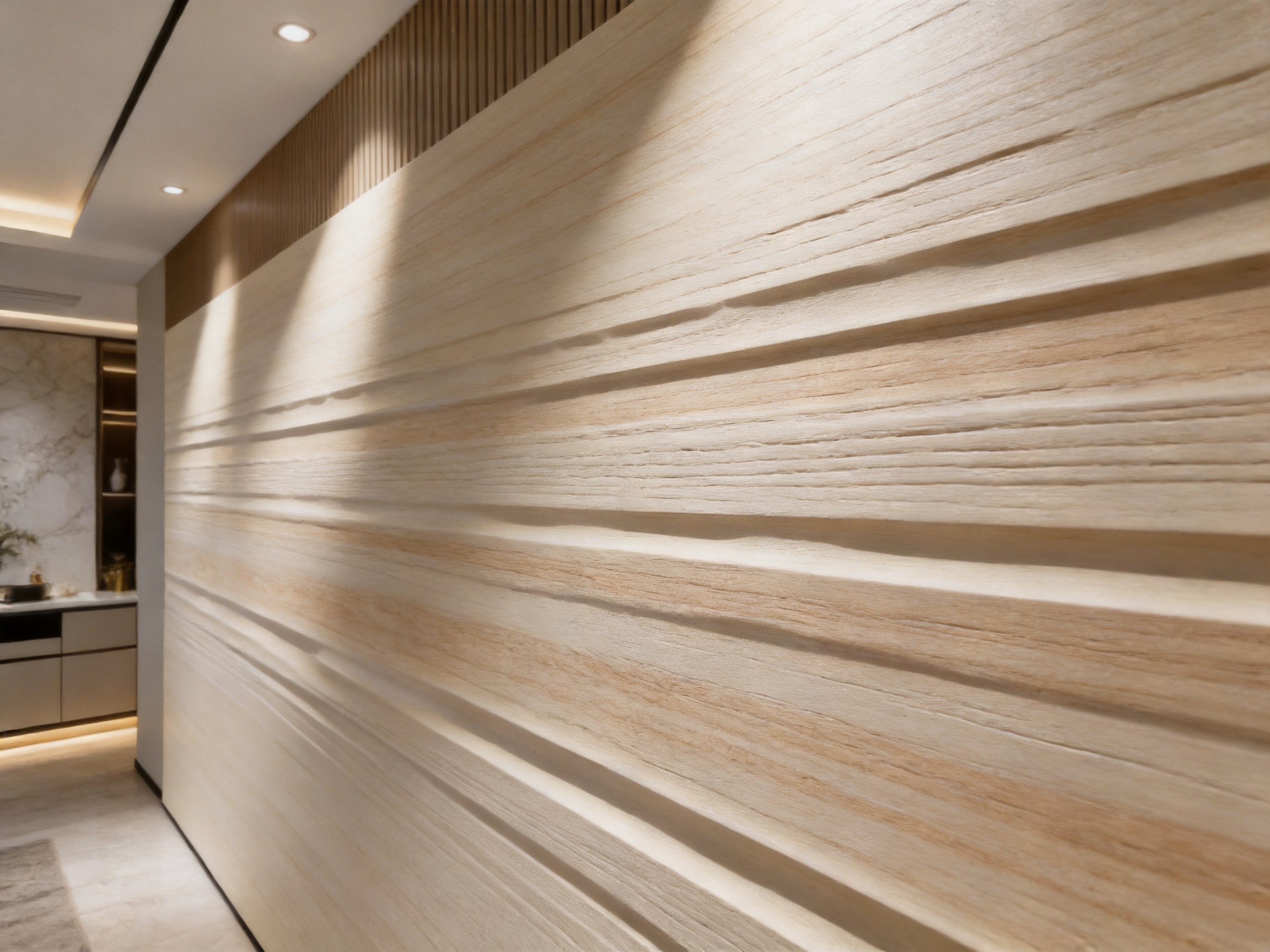
Interior design is moving toward surfaces that do more than imitate natural materials. Designers, architects, furniture manufacturers, and property developers increasingly seek decorative panels that combine authentic appearance, convincing tactile depth, stable performance, responsible material selection, and efficient fabrication. The TS01 Synchronized Oak with Cutting Texture in Natural responds to this demand by combining synchronized woodgrain embossing with a distinctive cut-texture design.
This product is designed to recreate the visual character and tactile irregularity of cut oak while retaining the practical advantages of a manufactured melamine panel. Its surface is intended to deliver a coordinated relationship between what the eye sees and what the hand feels. Instead of a flat printed wood image placed over a generic texture, the grain pattern and embossed structure are developed to work together, creating a more realistic three-dimensional wood experience.
The result is a decorative surface with a warm natural character, a clear linear direction, and a modern sense of structure. It can be used for custom furniture, cabinetry, wall systems, wainscoting, retail interiors, hotels, clubs, offices, showrooms, and other residential or commercial applications where visual quality and long-term usability are important.
Behind the product is YAKCO New Materials (Jiangsu) Co., Ltd., a Chinese manufacturer focused on high-end decorative panels, wall panels, three-dimensional surface technology, and advanced pressing processes. Established in 2007, the company operates a modern production facility covering approximately 50 acres, including more than 30,000 square meters of standard factory buildings. Its manufacturing capabilities, material development experience, and focus on environmentally conscious production support the development of decorative panels for demanding interior environments.
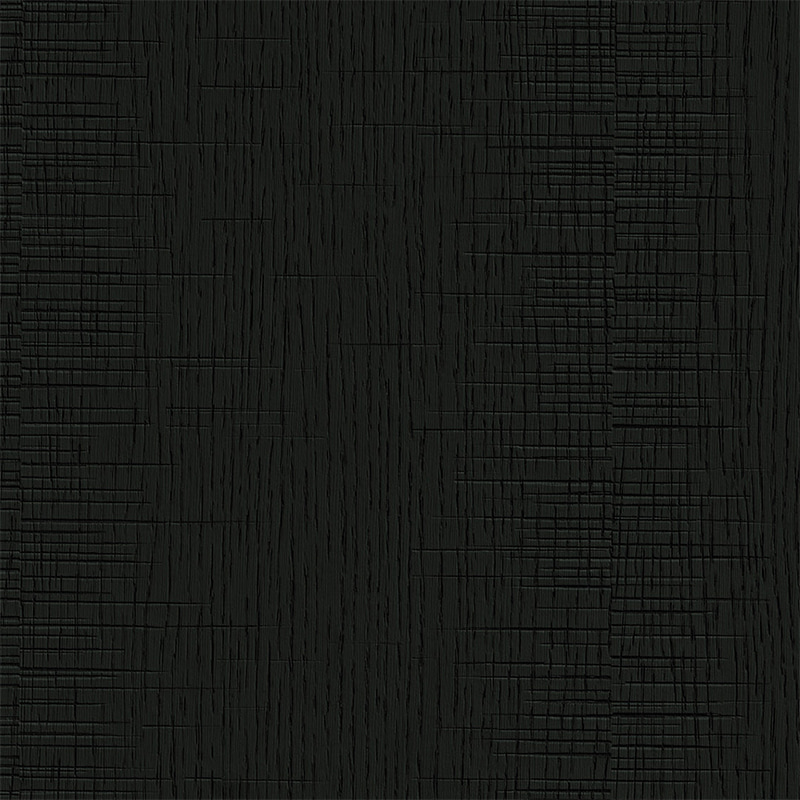
TS01 Synchronized Oak with cutting texture - Natural
What Is Synchronized Oak with Cutting Texture?
Synchronized Oak with Cutting Texture is a melamine-faced decorative panel that combines a printed oak appearance with an embossed surface aligned to the visual grain. The term “synchronized” refers to the coordination between the decorative image and the physical texture. Where the printed grain appears to rise, split, deepen, or change direction, the embossed surface is designed to reinforce that visual impression.
This alignment creates a more convincing wood effect than a conventional smooth melamine surface. On a standard printed panel, the visual grain may suggest one structure while the touch reveals another. The discrepancy can make the material feel artificial, especially when viewed closely or used on large furniture surfaces. Synchronized embossing reduces this visual and tactile contradiction by making the printed design and surface relief work as a unified composition.
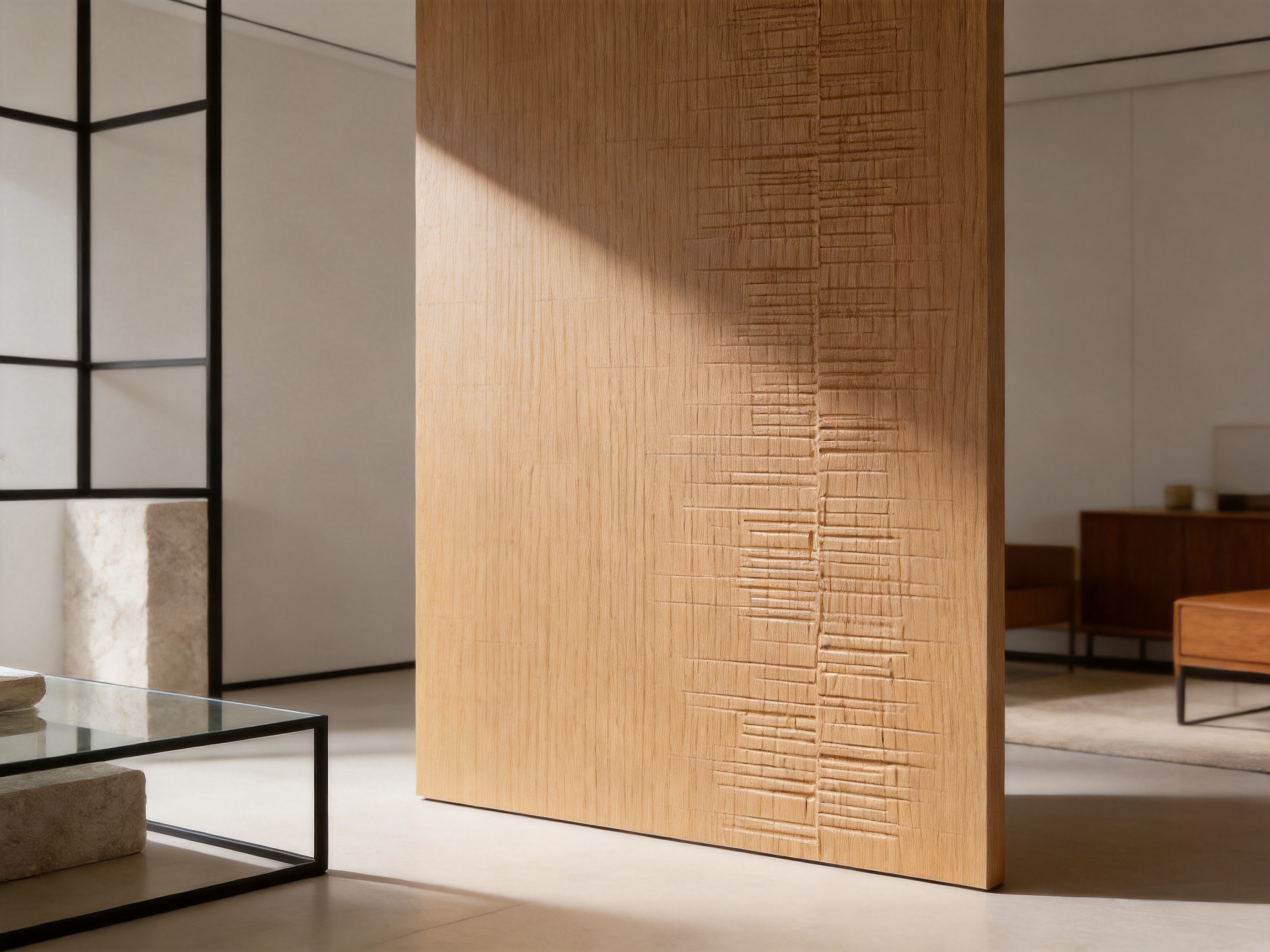
The cutting texture adds another layer of character. Rather than representing only the flowing grain of a traditional oak board, it suggests the linear marks, cross-sectional layers, and directional structures associated with cutting and processing timber. This gives the design a more architectural and contemporary appearance. It can resemble the visual language of a carefully cut oak surface while maintaining the consistency and repeatability expected from an engineered decorative panel.
The Natural colorway emphasizes the warm, organic side of the design. Its appearance can support calm interiors, minimalist furniture, hospitality spaces, and commercial environments that require a material with a natural foundation and a refined modern finish.
The Design Concept: Natural Warmth with Modern Precision
Wood remains one of the most influential materials in interior architecture because it can provide warmth, familiarity, and visual comfort. However, natural solid wood and traditional veneer can present challenges related to consistency, availability, processing, maintenance, and cost. A high-quality melamine wood panel offers an alternative by combining a carefully developed wood appearance with a stable engineered substrate.
TS01 is positioned between two design goals. The first is a return to nature, expressed through oak-inspired color, grain, and tactile variation. The second is modern craftsmanship, expressed through directional cut marks, controlled embossing, and a repeatable industrial manufacturing process.
This combination allows the panel to avoid two common extremes. It does not need to appear overly rustic or irregular, and it does not need to look flat, artificial, or purely decorative. Instead, it provides a balanced surface that can be used in contemporary spaces where natural references are wanted but a precise, coordinated design language is also required.
The linear cut texture is particularly useful in interiors that depend on visual direction. Applied vertically, it can support a sense of height in wardrobes, wall panels, and feature columns. Applied horizontally, it can emphasize the length of cabinetry, reception counters, or wall systems. When used across multiple panels, the grain direction can contribute to a unified visual rhythm.
Because the texture is controlled during production, designers can achieve a stronger level of consistency than may be possible when selecting individual pieces of natural timber. This is especially valuable in large projects where numerous panels must share a similar appearance across different rooms, floors, or buildings.
Core Surface Technology
Synchronized Grain Matching
The defining technical feature is the synchronization between the melamine-impregnated decorative paper and the embossed texture. This process requires accurate coordination between the printed pattern, pressing plate or embossing structure, and panel production parameters.
When these elements are properly aligned, the surface produces a stronger illusion of real wood. Grain lines are not simply visible; they have a corresponding physical presence. Changes in the grain direction can be felt, while recessed and raised areas help create natural-looking light and shadow.
This approach offers a clear advantage over basic flat melamine finishes. Flat finishes can provide attractive images, but their lack of tactile depth may become apparent on cabinet doors, tabletops, wall panels, or other surfaces that are viewed and touched at close range. Synchronized embossing gives the design greater material credibility.
Cutting Texture
The cutting texture is developed to suggest the linear structure produced when oak is cut and processed. It introduces visual direction and a more pronounced relationship between the surface and surrounding architectural elements.
Compared with conventional straight grain or mountain-style grain, the cutting texture can feel more engineered and graphic. It is suitable for modern minimalism, industrial interiors, light luxury schemes, and contemporary natural designs. Its linear character also allows it to coordinate effectively with metal, stone, glass, concrete-look finishes, and solid-color panels.
The texture can create a more substantial appearance without relying on excessive decorative irregularity. This makes it appropriate for projects that require a premium surface but still prefer clean lines and controlled composition.
Three-Dimensional Light and Shadow
Surface depth influences how a panel changes throughout the day. Under direct light, raised areas catch illumination while recessed areas create shadow. Under diffuse light, the surface may appear softer and more uniform. These changes contribute to the sense that the panel is a material rather than a printed image.
The cross-sectional effect suggested by the cutting texture can add layering to cabinet fronts, wall cladding, furniture side panels, and other vertical or horizontal applications. This additional depth can help designers create feature surfaces without using complex construction methods or multiple layers of solid wood.
Product Specifications
| Specification | Product Information |
|---|---|
| Product | TS01 Synchronized Oak with Cutting Texture – Natural |
| Category | Wood Design Melamine Board |
| Surface finish | Synchronized texture |
| Facing material | Melamine-impregnated paper |
| Available thicknesses | 1.5 mm, 9 mm, 12 mm, 18 mm, 22 mm, and 25 mm |
| Standard dimension | 1220 × 2745 mm |
| Additional dimensions | 1220 × 2800 mm, 1220 × 3050 mm, and 1220 × 3300 mm |
| Available substrates | LSB, SOSB, MDF, HMR MDF, fireproof MDF, particleboard, fireproof board, veneer, and plywood |
| Matched edge banding | 1 × 26 mm and 1 × 56 mm |
| Environmental rating options | E0, E1, and P2, subject to the selected substrate and applicable documentation |
| Primary color | Natural oak-inspired tone |
| Recommended use | Furniture, cabinetry, wall systems, wainscoting, retail, hospitality, offices, and residential interiors |
The range of thicknesses allows the product to be adapted to different manufacturing and construction requirements. Thin material can be considered for suitable facing or design applications, while thicker boards can be used for furniture components, shelving, cabinet parts, wall systems, and other structural or semi-structural elements according to the selected substrate and project specifications.
The panel dimensions are suitable for large-format applications. Longer lengths can help reduce the number of visible joints in tall cabinets, wall cladding, wardrobe fronts, and feature installations. Using larger sheets may also improve visual continuity when the design requires a strong vertical or horizontal grain direction.
Since substrate options influence weight, machining, moisture performance, fire performance, and structural behavior, the correct board should be selected according to the application. Project teams should confirm the requested substrate, thickness, environmental rating, edge treatment, and installation conditions before ordering.
Advantages Over Conventional Decorative Panels
More Convincing Than Flat Printed Melamine
The most immediate advantage is the relationship between visual grain and tactile texture. A conventional flat decorative panel can reproduce the color and pattern of oak, but it cannot provide the same level of physical correspondence. Synchronized embossing improves close-range realism and gives users a stronger sense of material authenticity.
This is particularly important for premium furniture. Wardrobe doors, kitchen cabinets, reception desks, and wall panels are often viewed from a short distance and touched frequently. A surface that responds to touch in a way that agrees with its visual appearance can improve the perceived quality of the entire installation.
More Consistent Than Uncontrolled Natural Timber
Natural oak is valued for its individuality, but natural variation can make it difficult to achieve a consistent appearance across a large project. Differences in tone, grain direction, knots, moisture content, and board availability may require careful sorting and additional preparation.
A manufactured synchronized melamine panel provides controlled repetition and more predictable supply. This does not eliminate the visual appeal of wood; instead, it translates selected wood characteristics into a consistent production format. Designers can use the same surface across multiple furniture units or rooms while maintaining a unified design identity.
More Practical Than Many Traditional Veneer Solutions
Traditional veneer can provide a genuine wood surface, but it may require additional finishing, careful handling, and maintenance. Its appearance can also vary from sheet to sheet. A melamine-faced panel is produced as a ready decorative surface, which can simplify fabrication and reduce the need for separate coating operations in many projects.
The melamine surface is designed to provide resistance to everyday wear, scratches, and stains. These characteristics are valuable in kitchens, offices, hospitality facilities, retail environments, and family homes where surfaces experience repeated use.
Stronger Design Direction Than Generic Oak Patterns
Many wood-look panels offer a general oak impression but lack a distinctive design concept. The cutting texture gives TS01 a recognizable identity. Its directional lines and cross-sectional references can help a project look more intentional and curated.
This is a practical advantage for furniture brands, interior contractors, and developers who want to differentiate a project without using unusual or difficult-to-source materials. The panel can serve as a signature surface within a broader material palette.
Suitable for Large-Scale Coordination
Available large dimensions, multiple thicknesses, several substrate choices, and matched edge banding support coordinated project delivery. Designers can specify the same decorative concept for cabinet doors, side panels, shelves, wall panels, and built-in storage, while selecting different cores or thicknesses where necessary.
The availability of matched edge banding is particularly useful. Exposed panel edges can interrupt the appearance of a wood design if they are finished with an unrelated color or texture. Coordinated edge treatment helps maintain a more complete and professional visual result.
Performance Characteristics
Wear Resistance
Interior surfaces are exposed to repeated contact, movement of objects, cleaning, and general daily use. The melamine surface is designed to resist normal wear, helping preserve the appearance of furniture and wall applications over time.
Wear performance depends on the selected substrate, manufacturing quality, edge treatment, installation, and usage conditions. The product should be specified according to the relevant technical requirements for the intended environment. In high-traffic or specialized applications, project teams should request appropriate test information before final approval.
Scratch and Stain Resistance
Kitchen fronts, office storage, reception counters, and retail fixtures can encounter contact with packaging, tools, food, liquids, and cleaning agents. The melamine surface provides a practical barrier against many ordinary stains and minor surface scratches encountered in interior use.
Even a durable decorative panel should be maintained correctly. Abrasive pads, highly aggressive chemicals, prolonged standing water, and excessive heat may damage the surface or edge areas. Routine cleaning with suitable non-abrasive products helps protect the finish.
Dimensional Stability
The panel is available with engineered cores such as MDF, HMR MDF, particleboard, LSB, SOSB, plywood, and other specified substrates. These materials are manufactured to provide predictable dimensions and fabrication behavior compared with many unprocessed natural materials.
Dimensional stability is affected by humidity, temperature, storage, panel balance, edge sealing, and installation. Boards should be stored flat, protected from direct moisture, and acclimatized according to project conditions before machining or installation.
Fabrication Convenience
The product is intended to be compatible with common panel processing methods, including cutting, drilling, routing, edge treatment, and furniture assembly, subject to the properties of the selected substrate. This makes it suitable for cabinet manufacturers, joinery workshops, furniture factories, and interior contractors familiar with engineered wood panels.
Proper tooling and machining settings are important for maintaining clean edges and minimizing chipping. Cutting direction, saw quality, feed speed, support, and edge-banding procedures should be adjusted to the selected board construction and thickness.
Environmental and Material Considerations
Environmental performance is increasingly important in residential and commercial construction. The product specifications include E0, E1, and P2 environmental rating options, depending on the selected substrate and applicable product documentation. These classifications should be confirmed with the manufacturer for each order because the final performance depends on the core material, adhesive system, production batch, and relevant testing standard.
YAKCO describes its production approach as using environmentally conscious adhesives and processes, including a stated zero-formaldehyde-emission adhesive approach for applicable products. The company also identifies product development aligned with the international ENF formaldehyde standard. Buyers should request current technical documents, test reports, and compliance information for the specific product and substrate required for a project.
Environmental performance should be considered as part of a broader material assessment. Responsible specification includes selecting the correct substrate, reducing unnecessary waste during cutting, planning panel layouts efficiently, protecting boards during transport and storage, and following proper end-of-life or recycling procedures where available.
For residential interiors, schools, offices, healthcare-related spaces, and hospitality projects, designers should verify the environmental requirements of the building and the applicable local regulations. A product with a suitable formaldehyde classification can help support healthier indoor environments, but installation, ventilation, surrounding materials, and total interior specification also influence indoor air quality.
Advanced Manufacturing Strengths
Long-Term Manufacturing Experience
YAKCO New Materials (Jiangsu) Co., Ltd. was established in 2007 and has developed its business around decorative panels and wall panel solutions. This operating history provides experience in material selection, decorative surface development, pressing, panel conversion, quality control, and project-oriented supply.
The company’s stated focus is on high-end decorative panels for residential and commercial spaces. This focus is relevant to the development of products such as TS01 because premium decorative surfaces require more than a printed image. They demand coordination among design, texture, substrate, production parameters, finishing, packaging, and application support.
Modern Factory Infrastructure
The company operates across approximately 50 acres and has more than 30,000 square meters of modern standard factory buildings. A substantial production facility can support organized workflow, equipment integration, raw-material management, quality inspection, sample development, and larger project orders.
Factory scale alone does not guarantee product quality, but it provides the physical foundation for systematic production. When combined with experienced technical personnel, controlled processes, and documented inspection procedures, it can help improve consistency from batch to batch.
Three-Dimensional Decorative Panel Technology
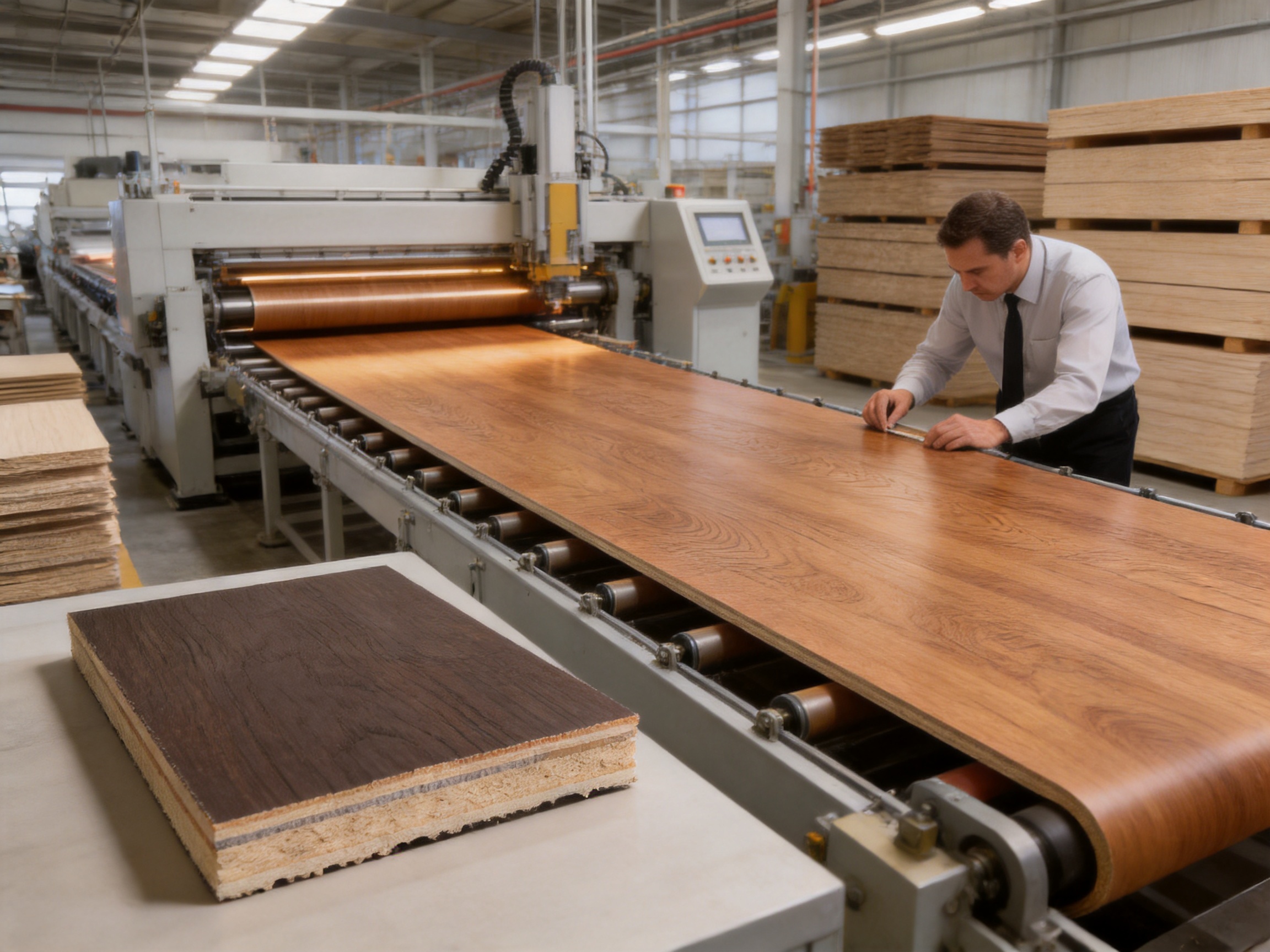
The company focuses on three-dimensional decorative panel technology and has developed deep-pressing processes intended to increase surface depth and texture definition. This expertise is directly relevant to synchronized woodgrain products, where the quality of the embossing affects both visual realism and tactile performance.
Deep pressing must be controlled carefully. Excessive or uneven pressure can influence the decorative layer, board flatness, edge quality, or surface uniformity. Controlled pressing parameters help create repeatable relief while protecting the integrity of the finished panel.
Six Core Production Processes
YAKCO identifies six core production processes as part of its manufacturing capability. While specific process details may vary by product and order, an integrated production system can include decorative paper preparation, substrate preparation, lamination, synchronized embossing or deep pressing, trimming and calibration, and final inspection or packaging.
For a product such as TS01, process integration is especially important. The visual design must remain aligned with the physical texture, the decorative layer must bond reliably to the substrate, and the finished sheet must be suitable for further fabrication. Each stage contributes to the final appearance and usability.
MDI Medical Adhesive Bonding
The company also highlights MDI medical adhesive bonding technology. MDI-based adhesive systems can be associated with strong bonding and lower-emission development goals when formulated and used appropriately. The specific performance of an adhesive system depends on its formulation, application quantity, curing conditions, substrate, and testing results.
In decorative panels, reliable bonding is essential. The adhesive interface must support the decorative layer during pressing, handling, cutting, and long-term interior use. Strong and stable bonding helps reduce the risk of delamination, bubbling, or surface failure when the product is manufactured and installed correctly.
Focus on Depth, Layering, and Stability
The company’s product development emphasizes enhanced depth, layering, texture, stability, easy cutting, deformation resistance, and environmental performance. These objectives correspond closely with the needs of modern interior projects.
Depth and layering improve appearance. Stability supports fabrication and installation. Easy cutting increases workshop efficiency. Deformation resistance helps protect the appearance of large panels. Environmental performance supports responsible specification. Together, these characteristics make the product more than a decorative image applied to a board; they form part of a complete panel solution.
Application in High-End Custom Furniture
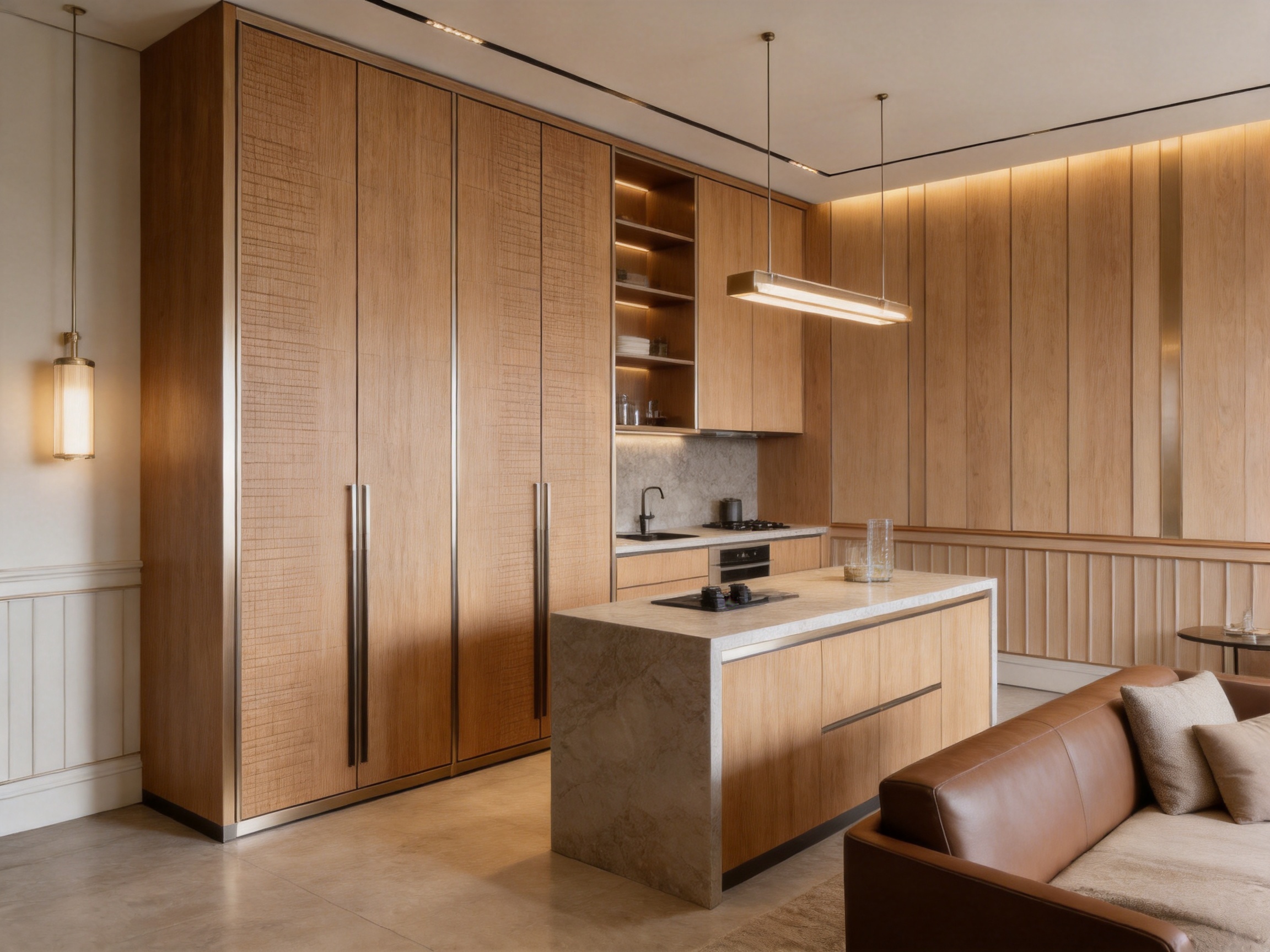
Custom furniture is one of the most suitable applications for Synchronized Oak with Cutting Texture. Wardrobes, kitchen cabinets, bookshelves, sideboards, television units, and storage systems can use the panel to create a consistent wood-inspired appearance across multiple components.
On wardrobe doors, the vertical grain direction can make a room feel taller and more organized. On kitchen cabinetry, the warm oak tone can soften the visual presence of appliances, stone countertops, and metal hardware. On bookshelves and storage walls, the cut texture can provide a strong background for books, artwork, and decorative objects.
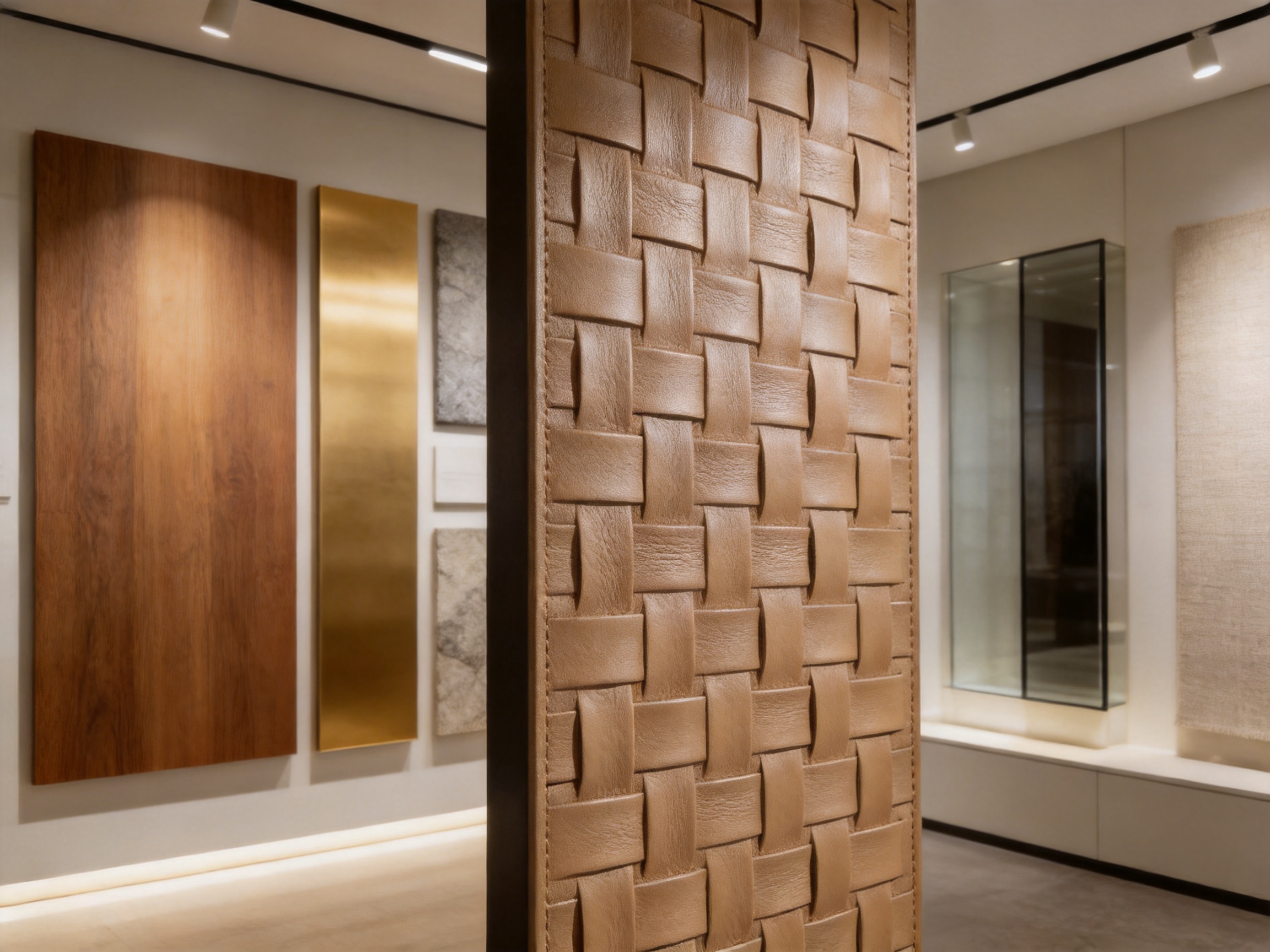
The panel can also be combined with solid-color fronts, dark metals, glass doors, stone-effect surfaces, or warm lighting. These combinations allow furniture designers to control contrast. For example, a natural oak-inspired panel may be paired with matte black hardware for an industrial effect or with brushed brass for a light luxury appearance.
Application in Commercial Interiors
Commercial spaces depend on materials that communicate brand identity while tolerating frequent use. Retail stores, showrooms, offices, reception areas, restaurants, and display environments can use TS01 for wall features, product display structures, counters, storage, and visual zoning.
In a retail setting, the directional texture can guide movement and create a clear background for merchandise. In an office, it can provide warmth in meeting rooms, reception areas, executive offices, and collaborative spaces. In a showroom, the panel can demonstrate how a natural material concept may be translated into furniture and wall systems.
Because the design is contemporary rather than strongly rustic, it can support a wide range of brand identities. It may be appropriate for furniture, lifestyle, hospitality, property, technology, or professional-service environments that want a refined natural reference.
Application in Hotels and Clubs
Hospitality interiors require materials that contribute to atmosphere and remain practical under repeated use. The Natural oak-inspired appearance can support a calm and comfortable mood in guest rooms, corridors, lounges, reception areas, restaurants, and private clubs.
The cut texture adds visual interest without requiring complicated ornamental patterns. It can be used behind reception desks, on feature walls, across cabinet fronts, or within room divider systems. When combined with warm lighting, stone, textiles, leather, and metal, it can contribute to a layered and premium interior language.
Hotels and clubs often require design consistency across multiple areas. The panel format and available sizes can help project teams coordinate furniture and architectural surfaces. Before specification, the project should confirm cleaning requirements, fire regulations, moisture exposure, impact expectations, and any hospitality-specific performance standards.
Application in Wall and Wainscoting Systems
Wall and wainscoting systems can benefit from the continuous visual effect of a synchronized wood texture. Panels can be arranged to create a full-height feature wall, a partial-height wainscot, a headboard background, or a transition between different zones.
A continuous wood effect can make a room feel more cohesive. The cutting texture provides a directional rhythm that can be used to frame doors, emphasize architectural niches, or define a circulation path. Designers can also combine the panel with acoustic elements, lighting channels, shelves, or concealed doors.
Installation details are important. Joints, corners, expansion allowances, edge treatments, and subframe systems should be planned before fabrication. Matched edge banding or carefully designed junctions can help preserve the premium appearance.
Compatible Design Styles
Modern Minimalism
Modern minimalist interiors benefit from surfaces that are visually rich but not excessively decorative. The linear cutting texture provides enough detail to prevent a space from appearing empty while maintaining a controlled, uncluttered appearance.
Industrial Style
In industrial interiors, the oak-inspired surface can soften concrete, steel, black metal, and exposed construction details. Its cut texture supports the material honesty associated with industrial design while introducing warmth and comfort.
Light Luxury
Light luxury interiors often depend on restrained contrast, high-quality surfaces, and carefully selected details. TS01 can be combined with brushed metal, stone, glass, leather, and soft textiles to create a premium atmosphere without excessive ornamentation.
Contemporary Natural
The product is particularly compatible with contemporary natural interiors that use wood, plants, neutral colors, natural stone, woven fabrics, and daylight. Its synchronized surface reinforces the connection to natural materials while retaining the precision of manufactured design.
Specification Guidance for Designers and Buyers
Before placing an order, buyers should define the application, preferred substrate, thickness, dimensions, environmental requirements, edge treatment, and expected quantity. A sample should be reviewed under the actual lighting conditions where possible because texture and color can appear different under daylight, warm artificial lighting, and cool commercial lighting.
Designers should also confirm grain direction. If multiple panels will be installed side by side, the project should determine whether the grain should run continuously, alternate, or follow a specific modular pattern. Clear cutting plans can reduce waste and improve visual consistency.
Substrate selection should be based on function. MDF may be suitable for many furniture and interior applications. HMR MDF can be considered where improved moisture resistance is desired, subject to project requirements. Fireproof MDF or fireproof board may be selected for applications requiring specific fire performance. Plywood, veneer, LSB, SOSB, particleboard, and other listed substrates provide additional options for different fabrication and construction needs.
Environmental ratings should be confirmed for the exact finished configuration. A decorative paper, adhesive system, and substrate work together to determine the final panel characteristics. Requesting product data sheets, test reports, and quality documentation can help ensure that the selected panel meets the project specification.
For large or technically demanding projects, buyers should discuss sample approval, batch control, packaging, delivery schedules, machining requirements, and replacement procedures with the manufacturer or authorized supplier. These steps reduce the risk of inconsistencies during installation.
Maintenance and Installation Considerations
Finished panels should be transported and stored in a dry, clean, and well-ventilated environment. They should be protected from direct rain, standing water, excessive humidity, and prolonged exposure to sunlight before installation. Storing boards flat with adequate support can help reduce the risk of bending or damage.
During installation, the selected substrate and panel thickness should be considered when choosing fasteners, adhesives, subframes, hinges, and edge treatments. The panel should not be forced into an opening that is too small, and appropriate allowances should be provided where environmental movement may occur.
Cleaning should normally be carried out with a soft cloth and a mild, non-abrasive cleaning solution. Spills should be removed within a reasonable time, especially around joints and exposed edges. Strong solvents, abrasive powders, steel wool, and aggressive scraping tools should be avoided unless specifically approved for the surface.
Edge protection is especially important in kitchens, bathrooms, utility areas, and commercial environments. The main decorative surface may resist ordinary moisture exposure, but unprotected edges and joints can be more vulnerable to water penetration. Correct edge banding, sealing, and installation detailing help preserve service life.
Why This Product Is a Competitive Choice
The competitive value of TS01 comes from the combination of design realism, tactile depth, practical performance, substrate flexibility, and manufacturing capability. Many products may provide one or two of these qualities, but a successful premium panel must integrate them into a usable specification.
Its synchronized texture gives it a stronger tactile identity than flat printed boards. Its cutting texture provides a more distinctive appearance than generic wood patterns. Its available dimensions and thicknesses support furniture and architectural applications. Its matched edge banding helps achieve a more complete installation. Its choice of substrates allows project teams to balance cost, weight, machining, moisture behavior, fire performance, and structural needs.
The company’s advanced production focus further supports the product’s positioning. Deep pressing, three-dimensional surface development, MDI adhesive bonding, integrated production processes, and a modern factory environment are relevant strengths for customers seeking consistent decorative panels rather than small-scale or purely image-based products.
For designers, this means greater freedom to create interiors that are natural without being ordinary. For furniture manufacturers, it means a surface with a clear design identity and practical processing potential. For contractors and developers, it means a coordinated panel solution that can be applied across multiple spaces and components.
Quality and Project Value
Quality should be evaluated at several levels. The first is appearance: color, grain clarity, synchronization, embossing definition, and batch consistency. The second is physical performance: bonding, surface durability, dimensional stability, machinability, and edge behavior. The third is documentation: substrate information, environmental rating, test results, and application guidance.
A premium decorative panel creates value when it supports the whole project rather than only looking attractive in a sample. It should help designers achieve the intended visual effect, help manufacturers complete fabrication efficiently, help installers produce clean details, and help end users maintain the surface over time.
TS01 is designed around this broader concept of value. Its natural oak character contributes to atmosphere, while its engineered construction contributes to repeatability and practical use. The surface can improve perceived quality without requiring the cost, variability, or maintenance considerations associated with some solid wood and veneer solutions.
Q&A
What does “synchronized oak” mean?
It means that the printed oak grain and the embossed surface texture are aligned. The visual grain corresponds more closely with the physical relief, creating a surface that looks and feels more like real wood.
What is the purpose of the cutting texture?
The cutting texture simulates the linear grain and layered appearance associated with cutting and processing oak. It gives the panel a stronger directional character and a more contemporary, structured appearance.
Is this product real solid oak?
No. TS01 is a melamine-faced decorative panel designed to reproduce selected visual and tactile characteristics of oak. It provides an engineered alternative to solid timber and traditional veneer for many interior applications.
Where can the panel be used?
It can be used for wardrobes, kitchen cabinets, bookshelves, storage systems, wall panels, wainscoting, retail fixtures, showrooms, offices, hotels, clubs, reception areas, and other residential or commercial interiors.
What substrates are available?
Listed substrate options include LSB, SOSB, MDF, HMR MDF, fireproof MDF, particleboard, fireproof board, veneer, and plywood. The appropriate substrate depends on the intended use and required performance.
What sizes and thicknesses are available?
Available thicknesses include 1.5 mm, 9 mm, 12 mm, 18 mm, 22 mm, and 25 mm. The standard size is 1220 × 2745 mm, with additional sizes of 1220 × 2800 mm, 1220 × 3050 mm, and 1220 × 3300 mm.
Does the product include matching edge banding?
Matched edge banding is listed in 1 × 26 mm and 1 × 56 mm formats. Buyers should confirm the required edge-banding specification, availability, and color matching for the project order.
Is the surface resistant to scratches and stains?
The melamine surface is designed to provide wear resistance, scratch resistance, and stain resistance for normal interior use. Actual performance depends on the selected configuration, installation, maintenance, and usage conditions.
How should the environmental rating be understood?
The listed options include E0, E1, and P2. The applicable rating depends on the selected substrate and product configuration. Buyers should request current technical documents and test reports for the exact panel being specified.
Can the panel be cut and machined like other furniture boards?
It is intended for common panel-processing operations such as cutting, drilling, routing, and edge treatment, subject to the selected substrate and thickness. Proper tools, support, feed settings, and machining procedures should be used to achieve clean results.
Which interior styles suit the product?
The product is particularly suitable for modern minimalist, industrial, light luxury, and contemporary natural interiors. It also works well with metal, stone, glass, concrete-look materials, leather, textiles, and solid-color surfaces.
What makes it different from a standard oak-look melamine board?
Its main distinction is the synchronized relationship between visual grain and physical embossing, combined with a cutting-texture design. This gives the panel greater tactile realism, stronger directional character, and more pronounced three-dimensional light and shadow.
Who manufactures the product?
The product is manufactured by YAKCO New Materials (Jiangsu) Co., Ltd., a Chinese company focused on high-end decorative panels, wall panels, three-dimensional decorative technology, deep pressing, and engineered surface solutions.
What information should be confirmed before ordering?
Buyers should confirm the substrate, thickness, sheet dimensions, environmental rating, edge-banding requirements, color and texture sample, quantity, packaging, delivery schedule, machining requirements, and project-specific compliance documentation.
Conclusion
TS01 Synchronized Oak with Cutting Texture – Natural is a premium melamine panel developed for interiors that require both authentic wood character and engineered practicality. Its synchronized embossing aligns visual grain with tactile relief, while its cutting texture creates a distinctive linear structure inspired by processed oak.
The product offers a practical alternative to flat printed boards, uncontrolled natural timber, and some traditional veneer applications. It provides a consistent appearance, a broad choice of substrates and dimensions, matched edge-banding options, and surface characteristics suited to furniture and architectural interiors.
Its value is strengthened by the manufacturing capabilities of YAKCO New Materials (Jiangsu) Co., Ltd. The company’s experience since 2007, modern factory infrastructure, focus on three-dimensional decorative panel technology, deep-pressing processes, integrated production capabilities, and MDI adhesive bonding support the development of stable, visually refined panel products.
For projects seeking a material that feels natural but looks carefully designed, Synchronized Oak with Cutting Texture offers a compelling solution. It brings together the warmth of oak, the precision of synchronized manufacturing, and the performance expectations of modern decorative panels.
References
1. Product specification information for TS01 Synchronized Oak with Cutting Texture – Natural, including surface finish, dimensions, substrates, thicknesses, edge banding, and environmental rating options.
2. Manufacturer-provided product description concerning synchronized grain matching, cutting texture, three-dimensional visual effects, durability, and application scenarios.
3. Manufacturer information regarding YAKCO New Materials (Jiangsu) Co., Ltd., its establishment, production facilities, decorative panel focus, and three-dimensional surface technology.
4. Manufacturer information concerning deep-pressing processes, MDI adhesive bonding, environmental performance objectives, and ENF-oriented product development.
5. General technical principles for melamine-faced engineered wood panels, decorative surface maintenance, panel storage, machining, edge treatment, and interior installation practice.