中文简体



Previous Post
Modern interior projects require materials that combine visual richness, structural reliability, manufacturing consistency, and environmental responsibility. Designers and manufacturers are increasingly looking for decorative panels that can reproduce the character of natural wood while offering better dimensional stability, easier processing, and more dependable quality control. A 3D deep-embossed melamine wood panel addresses these needs by combining a durable decorative surface with an engineered wood substrate and a carefully controlled embossing process.
The LSB Panel is a melamine board substrate developed for residential, commercial, furniture, wall panel, and interior decoration applications. It is designed to provide a balanced combination of appearance, texture, strength, workability, and stability. Its deep-embossed wood effect gives surfaces a stronger three-dimensional character than conventional flat decorative boards, while the engineered substrate supports efficient cutting, installation, and long-term use.
Manufactured by YAKCO New Materials (Jiangsu) Co., Ltd., the panel reflects the company’s focus on high-end decorative panels and wall panels. Since its establishment in 2007, the company has developed manufacturing capabilities for decorative building materials and expanded its expertise in three-dimensional surface technology. Its production strategy combines modern factory infrastructure, multiple core processing stages, MDI adhesive bonding, and formaldehyde-conscious material selection.
For buyers, architects, furniture producers, contractors, and distributors, the value of this product lies not only in its wood-inspired appearance. It also lies in the relationship between the decorative layer, embossing technology, substrate performance, and quality assurance. When these elements are engineered together, a panel can deliver a more convincing surface, more predictable fabrication, and a lower risk of common problems such as warping, delamination, uneven texture, and inconsistent color.

LSB Panel - Yakco/Lekco
Understanding the LSB Melamine Panel
LSB refers to a type of engineered wood panel substrate commonly associated with structural oriented strand board technology. In a decorative application, the substrate provides the core strength and dimensional support, while a melamine decorative surface creates the visible finish. This structure makes the product suitable for projects in which both appearance and practical performance matter.
The LSB Panel is categorized as a melamine board substrate. It can be used as a finished decorative board or as a component in a broader interior system. Depending on the design specification, the panel may be applied to furniture elements, cabinetry, wall surfaces, partitions, display areas, doors, counters, and other architectural or decorative structures.
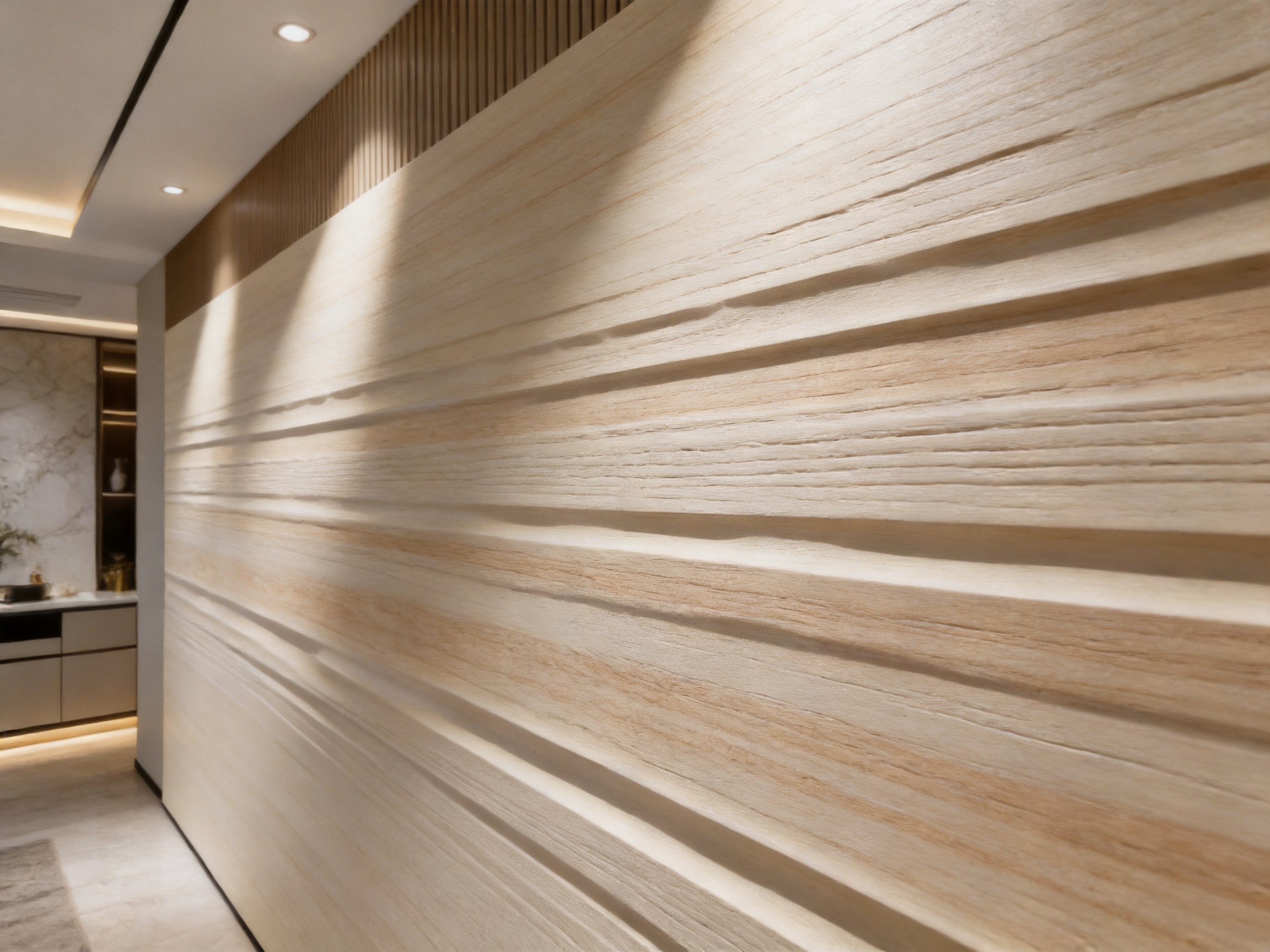
Unlike a simple printed board, a deep-embossed melamine panel uses surface relief to add tactile definition. The grain pattern is not perceived only through color or printed lines. Light and shadow interact with the raised and recessed areas, creating a more natural visual depth. This effect can make a wood-inspired finish appear more substantial and premium, especially on large wall areas or prominent furniture surfaces.
The engineered format also makes the panel more suitable for standardized production. Natural solid wood varies from piece to piece and may require careful grading, conditioning, and finishing. A decorative engineered panel can provide a more uniform design language across multiple batches while reducing some of the variability associated with natural timber. This is particularly useful for hospitality, retail, office, and residential developments that require repeated finishes throughout a project.
Why Deep Embossing Matters in Decorative Design
Surface texture has become an important part of contemporary interior design. Flat printed boards can reproduce color and grain patterns, but they may not always provide enough visual depth for premium applications. Deep embossing improves the sensory quality of the material by adding a tangible grain structure that can be seen and felt.
The interaction between the decorative pattern and the embossed relief is central to the product’s appearance. When the printed design follows the relief accurately, the grain can look more authentic and integrated. The surface does not appear to be a graphic image placed on top of a board; instead, it presents itself as a coordinated material surface with visual and tactile continuity.
Deep embossing can also improve the way a panel responds to different lighting conditions. Under direct light, raised grain areas may create highlights, while recessed areas form shadows. Under softer ambient lighting, the texture can provide subtle variation without overwhelming the room. This flexibility helps designers create walls, furniture fronts, ceilings, and partitions with more character.
Texture is also useful for establishing visual hierarchy. A strongly embossed panel can become a feature wall or a focal furniture surface. A more restrained texture can be used across larger areas to add warmth without making the space visually busy. Because the panel is available within a controlled decorative manufacturing system, designers can coordinate multiple applications using related surface patterns and colors.
Compared with ordinary flat melamine boards, a 3D deep-embossed panel offers several potential advantages:
It creates a stronger natural-wood impression through coordinated visual and tactile grain.
It gives large surfaces greater depth and reduces the monotonous appearance that may occur with completely flat finishes.
It supports premium interior concepts without requiring the cost and maintenance associated with selected solid timber or natural veneer.
It allows manufacturers to develop decorative products that are easier to standardize across a project.
It provides designers with another method for combining texture, color, lighting, and material contrast.
Core Product Advantages
Three-Dimensional Decorative Effect
The most visible advantage of the LSB Panel is its three-dimensional surface treatment. The deep-embossed wood effect creates a more convincing interpretation of timber grain than a two-dimensional printed finish alone. The resulting surface can support both close-range tactile experiences and long-range visual impact.
This characteristic is especially valuable in hospitality interiors, retail displays, reception areas, restaurants, offices, and residential feature walls. In these environments, materials are often evaluated not only by their technical specifications but also by how they contribute to the identity and atmosphere of the space.
Balanced Appearance and Practicality
Natural wood remains attractive because of its warmth, variation, and tactile quality. However, natural materials can require extensive maintenance, careful finishing, and detailed installation. A melamine panel offers a more controlled alternative. It can reproduce wood-related visual qualities while providing a manufactured surface intended for repeatable use.
The balance between visual expression and practical handling is one of the panel’s main strengths. It can be incorporated into a commercial design language without requiring every component to be produced from solid wood. This may help project teams achieve a coordinated appearance while managing cost, processing time, and material consistency.
Improved Surface Depth and Layering
Deep pressing adds layered relief to the panel surface. This layering can make decorative applications appear more refined and architecturally integrated. Rather than relying only on color contrast, the designer can use physical surface variation to create a richer composition.
In contemporary interiors, layered textures are often used to soften large planes and provide a sense of craftsmanship. A textured wood panel can be paired with stone-inspired surfaces, metal, glass, fabric, or painted finishes. The contrast between smooth and textured materials can strengthen the visual structure of a room.
Dimensional Stability and Deformation Resistance
Engineered wood panels are selected in many projects because they offer more predictable performance than irregular natural timber. The LSB Panel is designed with attention to stability and deformation resistance. Its substrate, adhesive bonding, and production controls work together to support a more consistent panel structure.
Dimensional stability is important during storage, transportation, fabrication, and installation. A panel that remains more stable is easier to cut, edge, align, and install. It can also reduce the likelihood of visible gaps, uneven joints, or surface irregularities caused by movement.
Actual performance will depend on the installation environment, moisture exposure, edge treatment, support structure, and compliance with project requirements. Nevertheless, the product’s engineered construction is intended to provide a dependable foundation for interior applications where consistency is essential.
Easy Cutting and Fabrication
Decorative panels must do more than look attractive after installation. They must also be practical for manufacturers and installers. The LSB Panel is developed to support easy cutting and efficient processing. This can be valuable for furniture factories, cabinet workshops, interior contractors, and custom fabricators that need to produce multiple components from standard board formats.
Efficient cutting can improve production planning by reducing unnecessary handling and helping operators achieve repeatable dimensions. It can also make the panel more adaptable to project-specific details such as service openings, corner conditions, shelves, doors, wall niches, and integrated storage.
As with any engineered board, the correct cutting tools, blade selection, feed speed, support method, and dust extraction system should be determined according to the equipment and the panel specification. Proper fabrication practices help protect the decorative surface and preserve edge quality.
Environmental and Formaldehyde-Conscious Performance
Material safety and indoor air quality are increasingly important in residential and commercial construction. The company states that its products are designed to meet the international ENF formaldehyde standard. This focus reflects the growing demand for low-emission interior materials, particularly in bedrooms, offices, schools, hospitality areas, and other occupied spaces.
Formaldehyde performance is influenced by the raw materials, adhesive system, pressing conditions, storage, and testing methods. The use of MDI medical adhesive bonding is an important part of the manufacturer’s stated technical approach. MDI, or methylene diphenyl diisocyanate, is used in engineered wood production to create strong bonding performance while supporting a low-emission product strategy when properly formulated and controlled.
Project buyers should always confirm the current technical documentation, test reports, product certificates, and applicable regional requirements before specifying the panel. Even so, a manufacturing system designed around low-emission objectives provides a strong foundation for environmentally responsible product development.
Advanced Manufacturing Process
The performance of a decorative panel is the result of several connected production stages rather than one isolated operation. Surface design, substrate preparation, adhesive application, pressing, embossing, cooling, trimming, inspection, and packaging must all work together. If one stage is poorly controlled, the finished product may show problems such as weak bonding, uneven texture, color inconsistency, edge damage, or dimensional variation.
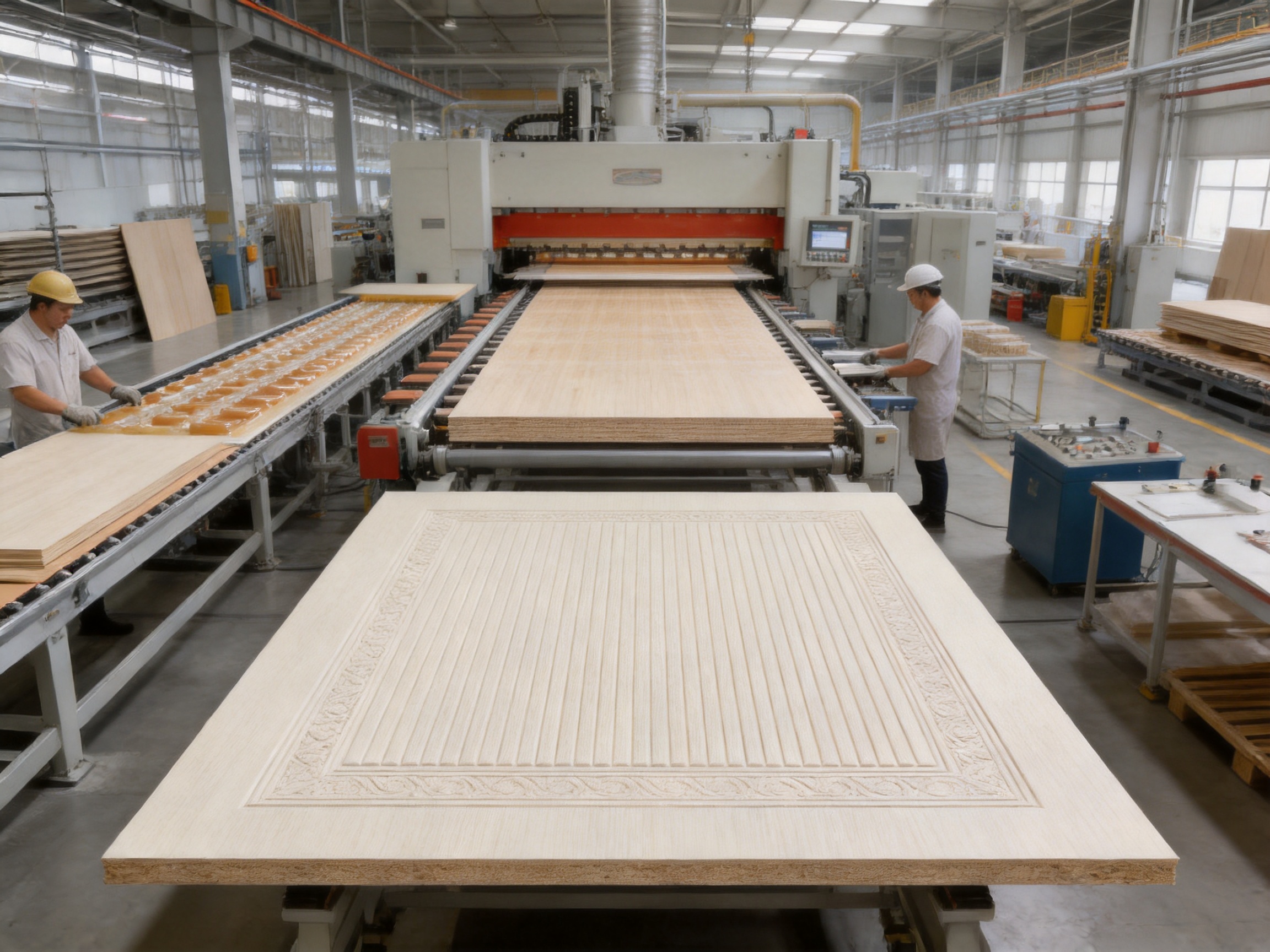
YAKCO New Materials has developed six core production processes for its decorative panel manufacturing. These processes are supported by a modern standard factory building covering more than 30,000 square meters and a company site of approximately 50 acres. The production environment provides the space needed for equipment arrangement, raw material handling, panel processing, quality inspection, storage, and dispatch.
Substrate Preparation
The first stage is the preparation of the engineered wood substrate. The substrate must meet requirements for thickness, flatness, density distribution, surface condition, and internal bonding. A carefully prepared substrate supports the later decorative stages and helps maintain consistent panel performance.
Substrate preparation can include conditioning, surface cleaning, grading, sanding, and dimensional inspection. The purpose is to create a stable and suitable base for the decorative layer. Any irregularities at this stage may be transferred to the final surface, so material handling and preparation are important parts of the quality system.
Decorative Layer Coordination
The wood design is selected and coordinated with the embossing structure. This alignment is important because the printed visual grain and the physical surface relief should work together. If the design and texture are not properly synchronized, the result may look artificial or visually disconnected.
Color control is also essential. Decorative panels may need to be used across multiple rooms or production batches, so the manufacturer must manage color consistency and pattern repeat. A controlled production environment helps reduce avoidable variation and gives buyers a more predictable decorative result.
Adhesive Application
The bonding system connects the decorative layer and the substrate. Adhesive application must be controlled for coverage, quantity, viscosity, and uniformity. Too little adhesive may weaken the bond, while excessive or uneven application can affect surface flatness and pressing behavior.
The use of MDI medical adhesive bonding is one of the technical features associated with the company’s manufacturing approach. The adhesive system is intended to support strong bonding, stability, and a low-emission product profile. The suitability of any adhesive system depends on precise formulation, equipment calibration, curing conditions, and process control.
Deep Pressing and Embossing
Deep pressing is the stage that gives the product its three-dimensional character. Pressure, temperature, press time, mold design, and material alignment must be carefully coordinated. The goal is to create an even and repeatable relief pattern without damaging the decorative surface or compromising the bond between layers.
A controlled pressing process helps ensure that the embossed depth remains consistent across the board. Consistency is particularly important when several panels are installed next to one another. Differences in relief depth can become visible under directional lighting, so uniform pressing is a key quality consideration.
The embossing structure can be designed to support different decorative effects, from relatively subtle grain to stronger three-dimensional wood relief. Product selection should therefore be based on the intended visual distance, lighting environment, application area, and desired level of tactile definition.
Cooling and Stabilization
After pressing, the panel may require controlled cooling and stabilization. This stage allows the materials to settle before trimming, inspection, and packaging. Cooling conditions can influence flatness, internal stress, and the final stability of the decorative surface.
Proper stabilization is particularly important for panels that will be cut into smaller components. A stable panel is easier to process and less likely to change shape during subsequent manufacturing operations. This supports improved efficiency for furniture producers and interior contractors.
Trimming and Inspection
Panel edges are trimmed and checked for dimensional accuracy, surface quality, embossing uniformity, and bonding integrity. Inspection may include visual assessment, measurement, surface checking, and review of production records. A reliable inspection process helps identify defects before products are packed and shipped.
Quality inspection is not only a final activity. Strong manufacturing systems use controls throughout production. Raw materials, process parameters, pressing conditions, and finished panel characteristics should be monitored so that problems can be corrected at their source.
Packaging and Storage
Decorative boards must be protected during storage and transportation. Packaging should reduce the risk of impact, abrasion, moisture exposure, and edge damage. Panels should be stored on suitable supports in a clean, dry, and stable environment.
Correct handling is essential because even a well-manufactured panel can be damaged by poor storage. Buyers and distributors should follow the manufacturer’s recommendations for stacking, lifting, temperature, humidity, and acclimatization before installation.
Manufacturing Strengths of the Supplier
YAKCO New Materials was established in 2007, giving the company substantial experience in the decorative panel sector. Its manufacturing focus is centered on high-end decorative panels and wall panels for residential and commercial spaces. This specialization allows the company to concentrate resources on surface design, panel engineering, production process development, and application-oriented product improvement.
The company’s approximately 50-acre site and more than 30,000-square-meter modern standard factory building provide a substantial operating base. A facility of this scale can support integrated production planning, organized material movement, dedicated processing areas, quality control, packaging, and inventory management.
The company’s brand was established in 2016, representing a further stage in its market development. Since then, its stated focus has remained the delivery of building materials that combine decorative value and functional performance. Its product strategy emphasizes enhanced depth, layering, texture, stability, easy cutting, deformation resistance, and environmental performance.
Another strength is the company’s focus on technology rather than only on surface appearance. A decorative board supplier must understand how visual design interacts with substrate engineering, adhesives, pressing, storage, and installation. By developing multiple core production processes and emphasizing deep-pressing technology, the company positions the LSB Panel as a coordinated material system rather than a simple decorative sheet.
The company also serves both residential and commercial design requirements. This broad application focus can be beneficial to buyers who need similar materials for different project types. Residential projects may prioritize comfort, appearance, and indoor air quality, while commercial projects may place greater emphasis on repeatability, lead times, fabrication efficiency, and large-area consistency. A product designed with both markets in mind can offer useful flexibility.
Advantages Compared with Conventional Decorative Panels
Compared with a basic flat melamine board, the LSB Panel offers a stronger tactile and visual effect through deep embossing. This can improve the perceived quality of a feature wall, cabinet door, reception desk, or display installation. The surface has more ability to interact with lighting and create visual depth.
Compared with some natural veneer applications, a melamine panel can offer greater consistency in pattern and color across multiple units. Natural veneer may require matching, grading, splicing, and additional protective finishing. A manufactured decorative surface can simplify coordination and reduce variation between components.
Compared with solid timber, an engineered decorative panel may provide more predictable dimensions and more efficient material use for large-scale interior production. It can also reduce the need for certain finishing operations, depending on the application and project specification.
Compared with low-quality printed boards, a well-engineered deep-embossed panel can provide stronger relief, better surface integration, and more stable overall performance. The difference is especially noticeable when the panel is viewed closely or illuminated from the side.
Compared with decorative products that use less controlled bonding systems, the stated use of MDI adhesive bonding provides a distinct technical point for evaluation. Strong bonding and low-emission objectives can be important advantages for buyers who are selecting materials for occupied spaces.
| Evaluation Area | LSB Deep-Embossed Melamine Panel | Conventional Flat Melamine Board | Natural Solid Wood or Veneer |
|---|---|---|---|
| Surface appearance | Wood-inspired design with coordinated three-dimensional relief | Primarily flat printed or decorative surface | Natural grain and variation |
| Design consistency | High repeatability for coordinated project applications | Generally consistent, depending on production quality | Natural variation may make matching more difficult |
| Tactile quality | Enhanced by deep embossing and layered texture | Usually limited to the smooth or lightly textured surface | Naturally tactile, depending on species and finish |
| Processing suitability | Designed for cutting and engineered panel fabrication | Generally easy to process | May require more specialized preparation and finishing |
| Dimensional predictability | Engineered for stability and deformation resistance | Depends on substrate construction and quality | Can be influenced by moisture, grain direction, and natural movement |
| Maintenance requirements | Suitable for practical interior maintenance when correctly specified | Suitable for practical interior maintenance when correctly specified | May require periodic refinishing or additional care |
| Environmental focus | Designed around ENF formaldehyde performance and MDI bonding objectives | Varies by substrate and adhesive system | Depends on source, adhesive use, coatings, and finishing system |
Applications in Residential Interiors
In residential interiors, the panel can be used for feature walls, wardrobes, bedroom furniture, living room cabinetry, entrance units, study areas, kitchen elements, and decorative partitions. Its wood-inspired appearance can introduce warmth and material depth without requiring every surface to use natural timber.
Feature walls are one of the most suitable applications for deep-embossed panels. A textured wall can create a strong focal point behind a sofa, bed, television, dining area, or entrance console. The designer can use lighting to emphasize the relief, producing shadows that change subtly throughout the day.
For wardrobes and storage systems, the panel provides an opportunity to coordinate large doors and side panels with surrounding wall surfaces. Its engineered format can support repeated component sizes, while the decorative finish creates a more integrated appearance than unrelated flat surfaces.
Home offices and study areas can also benefit from the balance of warmth and structure offered by a wood-effect panel. A textured background may make a workspace feel more comfortable and visually refined. Because the panel is intended for efficient cutting, it can be incorporated into shelving, desk surrounds, cabinets, and acoustic or visual zoning features, subject to the project’s technical requirements.
In kitchens and utility areas, specification should consider heat, moisture, cleaning products, edge sealing, and proximity to water. The panel may be appropriate for selected cabinet and decorative applications when used within the limits of its technical documentation. It should not be assumed to be suitable for every wet or high-heat condition without confirmation.
Applications in Commercial and Public Spaces
Commercial environments often demand materials that can establish a strong design identity while remaining efficient to fabricate and install. The LSB Panel can support this requirement in offices, hotels, restaurants, retail stores, showrooms, clinics, reception areas, and mixed-use developments.
In offices, deep-embossed wood panels can be used at reception desks, meeting room walls, executive offices, collaborative zones, and storage systems. The texture can help create a more welcoming environment and provide contrast against glass, metal, painted surfaces, and acoustic products.
Hotels and hospitality venues frequently use decorative materials to communicate comfort and quality. The panel can be applied to headboard walls, corridor features, reception backgrounds, restaurant partitions, lounge areas, and selected furniture components. A coordinated decorative surface can help carry a consistent visual theme throughout different spaces.
Retail interiors benefit from materials that support brand-neutral or brand-specific design concepts. Wood-inspired relief can make display walls, shelving surrounds, checkout counters, and product platforms appear more substantial. The panel’s repeatability is useful when the same concept must be implemented across multiple stores or departments.
Restaurants and cafés can use textured panels to create visual warmth and separation between zones. However, material selection should consider cleaning requirements, food-service regulations, fire performance, moisture, and local building codes. The LSB Panel should be specified according to verified technical data rather than appearance alone.
In educational, healthcare, and public environments, indoor air quality and durability are especially important. The manufacturer’s stated focus on ENF formaldehyde performance may be relevant to such projects, but project teams should verify current certifications and performance reports before approval.
Design Flexibility and Material Coordination
A major benefit of a wood-inspired decorative panel is its ability to work with many different design languages. It can support minimalist interiors when used in a restrained color and pattern. It can also contribute to more expressive concepts when combined with strong lighting, contrasting colors, or other tactile materials.
The panel can be coordinated with smooth melamine boards, fabric or textile designs, leather-effect surfaces, stone-effect panels, painted metal, glass, and natural materials. The contrast between a three-dimensional wood texture and a smooth surface can make both materials more noticeable.
For large interiors, designers can use texture to control scale. A pronounced grain can define a feature zone, while a more subtle pattern can cover broader areas. Repeating the same panel on furniture and walls can create continuity. Alternatively, using the panel only on selected elements can produce visual emphasis.
Lighting should be considered early in the design process. Side lighting, wall washing, and adjustable spotlights can emphasize embossed surfaces. Direct frontal lighting may produce a flatter effect, while angled lighting can increase the perception of relief. Sample boards should be evaluated under the actual or simulated lighting conditions planned for the project.
Color selection also affects the perceived depth. Darker tones may create stronger shadow contrast, while lighter tones can produce a softer and more spacious appearance. Warm wood tones may support hospitality and residential settings, whereas neutral or cool tones can complement contemporary office and retail environments.
Installation and Handling Considerations
Successful installation begins before the panels arrive on site. The substrate, wall structure, fixing method, panel orientation, joint layout, edge conditions, and service openings should be reviewed during the design stage. Early coordination can reduce waste and prevent conflicts with electrical, mechanical, and architectural elements.
Panels should be transported and stored in a way that protects the decorative surface and edges. They should remain supported on a flat and stable base, away from direct moisture and severe temperature changes. Stacking methods should prevent bending or point loading.
Before fabrication or installation, panels may need to acclimatize to the interior environment. The correct acclimatization period depends on the product specification, local climate, storage conditions, and installation method. Following the manufacturer’s handling recommendations is important for preserving dimensional stability.
Cut edges may require sealing, edging, or another protective treatment depending on the application. Edge treatment can improve appearance and help protect the substrate from environmental exposure. Fasteners, adhesives, mechanical clips, and support systems should be selected according to the panel thickness, weight, wall condition, and project requirements.
Clean tools and suitable protective materials should be used to avoid scratches and contamination. During installation, the embossed surface should not be dragged across rough floors or unprotected supports. Finished areas should be protected from construction dust, impact, paint, and moisture until the project is complete.
Quality Control and Product Selection
Buyers should evaluate more than the sample appearance when selecting a decorative panel. A professional product assessment may include substrate quality, surface uniformity, embossing depth, color consistency, bonding integrity, flatness, cutting behavior, edge quality, emission performance, and packaging protection.
Large projects should request samples from the intended production batch when possible. This helps the design and procurement teams confirm that the selected color, texture, and relief are suitable for the final application. Full-size samples are often more informative than small pieces because they reveal pattern repeat, lighting response, and visual scale.
Technical documentation should identify the panel construction, available thicknesses and dimensions, surface finish, substrate type, recommended applications, storage conditions, machining guidance, cleaning recommendations, and relevant test results. If the panel will be used in a regulated building environment, fire, moisture, acoustic, structural, and emission requirements should be reviewed separately.
Quality control should also consider batch management. Panels used in the same visible area should ideally be coordinated from compatible production batches. Installation teams should inspect materials before cutting and report any issue promptly. Once panels have been cut or installed, it may be more difficult to determine whether a problem originated in manufacturing, handling, storage, or installation.
Environmental Responsibility and Indoor Air Quality
Environmental performance in interior materials includes more than one factor. Buyers may consider formaldehyde emissions, adhesive chemistry, resource efficiency, product service life, maintenance requirements, packaging, and potential reuse or disposal. A durable product that remains attractive for many years may reduce the need for frequent replacement.
The LSB Panel is developed with attention to low-emission performance and is stated to meet the international ENF formaldehyde standard. This is relevant because indoor materials can influence air quality, particularly in enclosed rooms with limited ventilation. Product-specific test results should be requested for the intended market and application.
The use of engineered wood can also support efficient material utilization by creating a stable panel from processed wood resources. However, responsible sourcing and manufacturing practices remain important. Buyers may wish to review available information concerning raw material management, production waste, energy use, packaging, and compliance with regional environmental regulations.
Environmental performance should be considered alongside service life. A panel that maintains its appearance, remains dimensionally stable, and requires limited refinishing may offer practical sustainability benefits over the life of an interior. Correct specification and installation are essential to achieving this benefit.
Why Choose a Specialized Decorative Panel Manufacturer?
Specialization matters because decorative panel production requires coordination between material science, surface design, equipment, and application knowledge. A supplier that focuses on decorative wall and furniture panels is more likely to understand the requirements of designers, fabricators, contractors, and project owners.
YAKCO New Materials combines experience since 2007 with a production base dedicated to high-end decorative panels and wall panels. Its development of three-dimensional decorative technology reflects an effort to address the limitations of flat surfaces. The company’s six core production processes indicate a structured approach to manufacturing rather than reliance on a single finishing operation.
The company’s focus on deep pressing, surface layering, texture, stability, cutting performance, deformation resistance, and environmental standards directly corresponds to the practical concerns of professional buyers. These characteristics can help reduce the gap between design intent and installed performance.
For distributors, the product may provide an opportunity to offer a differentiated alternative to standard flat decorative boards. For furniture manufacturers, it may support the development of premium textured collections. For architects and interior designers, it may provide a material with both visual expression and efficient production potential.
Frequently Asked Questions
What is an LSB Panel?
An LSB Panel is an engineered wood substrate with a melamine decorative surface. The product described here includes a three-dimensional deep-embossed wood effect intended for interior decoration, furniture, wall panels, and related applications.
What makes the panel different from a flat melamine board?
The main difference is the deep-embossed surface relief. Instead of relying only on a printed wood image, the panel combines visual grain with physical texture. This creates stronger tactile quality, greater interaction with lighting, and a more layered decorative appearance.
Can the panel replace natural wood?
It can serve as an engineered alternative for many decorative applications, but it is not identical to solid timber or natural veneer. The panel offers more controlled appearance and manufactured consistency, while natural wood provides unique grain variation and species-specific characteristics. The correct choice depends on the design, performance, budget, and environmental requirements of the project.
Is the product suitable for furniture manufacturing?
The panel is designed to support cutting and engineered fabrication, making it suitable for selected furniture and cabinetry applications. Fabricators should confirm panel thickness, machining guidance, edge treatment, load requirements, and the intended service environment before production.
Can it be used for wall decoration?
Yes. Wall panels and decorative wall applications are among the product’s intended uses. The support structure, fixing system, joint design, fire requirements, moisture conditions, and installation method should be evaluated for each project.
What adhesive technology is used?
The manufacturer states that it uses MDI medical adhesive bonding. This adhesive approach is part of the company’s effort to provide strong bonding and support a low-emission product strategy. Buyers should request current technical documentation for specific product models and markets.
Does the panel meet formaldehyde requirements?
The manufacturer states that its products are designed to meet the international ENF formaldehyde standard. Because requirements vary by country and application, buyers should verify current test reports, certificates, and compliance documentation before specification.
Is deep embossing consistent across the entire panel?
The production process is designed to provide consistent relief through controlled pressing and inspection. As with all decorative products, buyers should inspect samples and confirm acceptable tolerances with the manufacturer, especially for large projects installed under strong directional lighting.
How should the panels be stored?
Panels should generally be stored flat, fully supported, dry, clean, and protected from direct moisture, impact, and excessive temperature changes. The manufacturer’s storage and acclimatization instructions should be followed for the specific product.
Can the product be customized?
Customization possibilities depend on the available decorative designs, embossing structures, dimensions, thicknesses, minimum order quantities, and production schedule. Buyers should discuss custom color, pattern, texture, and size requirements directly with the supplier.
Where is the manufacturer located?
YAKCO New Materials (Jiangsu) Co., Ltd. is located at No. 17, Furong Road, Baimao, Guli Town, Changshu City, Jiangsu, China. The company can be contacted by telephone at +86-13358024856 or by email at yakco@jsix.com.
Who is the product best suited for?
The product is suited to architects, interior designers, furniture manufacturers, cabinet producers, contractors, developers, building-material distributors, and project owners seeking textured wood-effect panels with engineered stability and controlled decorative quality.
Conclusion
The LSB Panel represents a modern approach to decorative wood-effect surfaces. Its combination of an engineered substrate, melamine finish, and deep three-dimensional embossing provides a useful balance between visual character and manufacturing practicality. The product can deliver stronger texture and material depth than conventional flat boards while offering a more standardized alternative to some natural wood applications.
Its value is supported by the manufacturer’s broader production capabilities. YAKCO New Materials has operated since 2007, maintains a substantial manufacturing facility, and focuses on high-end decorative panels and wall panels. Its six core production processes, deep-pressing technology, MDI adhesive bonding, and stated ENF formaldehyde performance demonstrate an integrated effort to address appearance, stability, fabrication, and indoor environmental considerations.
For residential and commercial interiors, the panel can be used to create feature walls, furniture fronts, cabinetry, partitions, reception areas, hotel interiors, retail displays, offices, and other decorative installations. Its success in each application will depend on correct specification, storage, fabrication, installation, and maintenance.
As design trends continue to move toward tactile, layered, and material-rich interiors, deep-embossed melamine panels provide an effective way to introduce wood character without depending entirely on solid timber or natural veneer. With the right technical verification and project planning, the LSB Panel can help manufacturers and designers achieve attractive, repeatable, and performance-conscious interior solutions.
References
YAKCO New Materials (Jiangsu) Co., Ltd. Product and company information supplied for the LSB Panel.
YAKCO New Materials (Jiangsu) Co., Ltd. Manufacturing information concerning deep pressing, six core production processes, MDI adhesive bonding, and decorative panel technology.
Company information concerning the establishment of YAKCO New Materials in 2007, its factory area, product focus, and brand development.
General technical principles for melamine-faced engineered wood panels and decorative interior board applications.
General material guidance concerning engineered wood substrates, surface embossing, panel fabrication, storage, installation, and indoor air-quality considerations.