中文简体



Previous Post
Interior materials are increasingly expected to do more than cover a wall, cabinet, or partition. Designers and manufacturers now look for surfaces that provide visual character, tactile quality, dimensional stability, environmental performance, and practical installation benefits within one coordinated product. The PS01 Woven Leather Texture Panel-Natural responds to this demand by combining the visual language of woven leather with the manufacturing efficiency of a melamine-faced decorative panel.
Inspired by woven leather used in luxury accessories, handcrafted furniture, and premium vehicle interiors, PS01 reproduces the orderly rhythm of interlaced strips in a single panel surface. Its design combines the warmth of leather with the breathable, crafted impression of textile or natural weaving. Instead of presenting a flat printed image, the panel uses a pronounced embossed structure to create real variations in height, edge shadow, and tactile depth.
This approach gives architects, interior designers, furniture manufacturers, and building-material distributors an alternative to ordinary smooth melamine boards and conventional leather-grain panels. PS01 is suitable for cabinet doors, feature walls, partitions, screens, commercial interiors, hospitality projects, and other applications that benefit from a refined yet tactile finish.
The product is manufactured by YAKCO New Materials (Jiangsu) Co., Ltd., a Chinese decorative-panel producer established in 2007. The company focuses on high-end decorative panels, wall panels, three-dimensional surface technology, deep pressing, substrate engineering, and environmentally oriented production. Through its manufacturing capabilities, PS01 is designed to provide not only an attractive appearance but also a reliable foundation for large-scale interior applications.
What Is the PS01 Woven Leather Texture Panel?
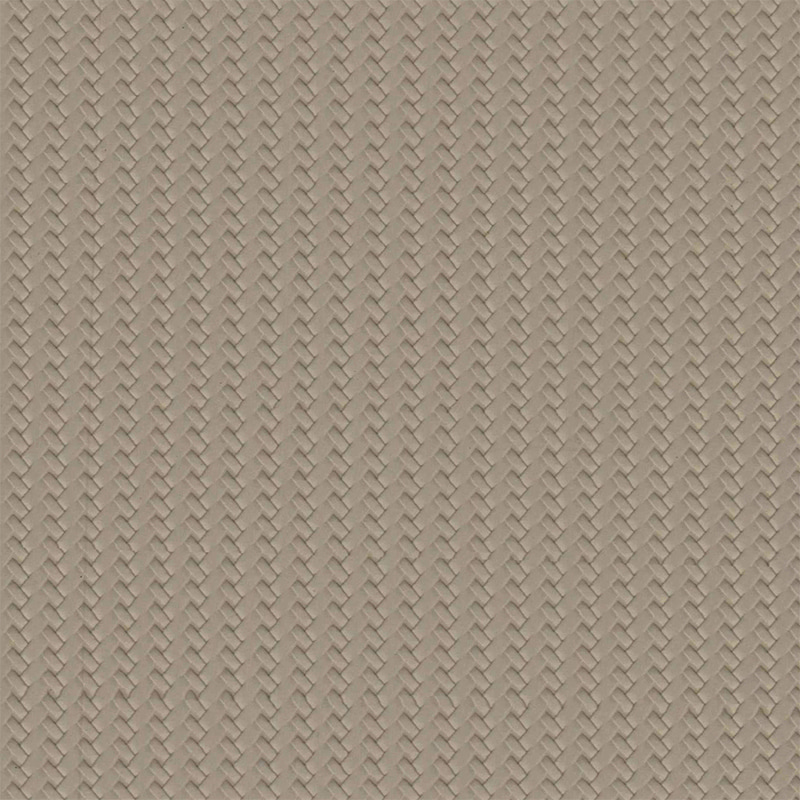
PS01 is a melamine-faced decorative panel featuring a woven leather texture in a natural color. The surface is formed by a pattern that resembles narrow leather strips crossing one another in a regular grid or herringbone arrangement. The repeated geometry creates a consistent visual rhythm, while the surface relief makes the pattern perceptible to the hand.
Traditional woven leather is created by cutting leather into strips and arranging those strips in an interlaced structure. The resulting material is associated with luxury handbags, furniture details, automotive interiors, and other products where craftsmanship and material richness are important. PS01 translates that design language into a panel format that can be manufactured, cut, installed, and specified for broader architectural applications.
The panel does not rely solely on a printed representation of woven leather. Its deep-embossed treatment creates physical differences between the raised and recessed parts of the pattern. These differences produce soft shadows around the overlapping strips and make the surface more expressive as lighting changes across it.
The material sensation sits between leather and fabric. It has the visual warmth of leather but avoids the closed, heavy impression that can sometimes be associated with solid leather surfaces. At the same time, the repeated weave suggests the lightness and breathability of textile construction. This combination gives PS01 a distinctive position among decorative boards.
PS01 is available with several base-material options, including LSB, SOSB, MDF, HMR MDF, particleboard, fire-resistant board, wood veneer, and plywood. The appropriate substrate can be selected according to the intended use, structural requirements, machining method, and project specification.
Design Concept: Combining Leather Luxury with Woven Craft
The design philosophy behind PS01 is based on the interpretation of premium materials rather than the simple imitation of one material. Leather and weaving each carry a strong cultural and design identity. Leather represents durability, refinement, and luxury, while weaving represents human craft, rhythm, flexibility, and material warmth.
Woven structures have appeared in many civilizations through bamboo, rattan, straw, reeds, textiles, and other natural fibers. These materials have been used in furniture, baskets, screens, architecture, and household objects. Their repeated construction creates both utility and visual order. When this principle is combined with the refined surface quality associated with leather, the result is a pattern capable of conveying warmth without looking rustic or informal.
Luxury fashion and furniture have long used woven leather details to create a sense of craftsmanship. The interlaced strips provide more visual complexity than a plain leather surface while remaining orderly and controlled. PS01 extends this aesthetic from smaller handmade products to larger surfaces such as cabinetry, doors, walls, and commercial interiors.
The central design question is whether leather texture must remain flat. PS01 answers this question through deep embossing. Rather than showing leather grain as a printed or lightly pressed image, the product gives the weave a stronger physical presence. The raised and recessed areas can be seen from a distance and felt at close range.
This makes the material particularly suitable for spaces where touch and movement are part of the user experience. A visitor approaching a feature wall, a customer opening a cabinet, or a person passing beside a partition may notice the surface through changing light, shadow, and tactile variation.
Distinctive Surface Characteristics
Deep Three-Dimensional Relief
The most important characteristic of PS01 is its deep-embossed woven structure. The surface contains visible and tactile changes in elevation that reproduce the crossing sequence of leather strips. The deeper texture gives the panel greater dimensional presence than a standard printed melamine board.
Embossing also enhances the visual separation between individual strips. Shadows along the edges help clarify the geometry of the weave, allowing the pattern to remain legible under different lighting conditions. This is valuable in interior spaces where natural daylight, spot lighting, wall washing, or indirect illumination may change throughout the day.
Matte and Subdued Appearance
A highly reflective finish could make a deeply textured panel appear artificial or plastic-like. To avoid this effect, PS01 uses a matte finish and controlled color blending. The subdued luster reduces excessive reflection and allows the surface depth to appear more natural.
The matte character also supports a calm and sophisticated visual effect. It works effectively with materials such as brushed metal, clear or tinted glass, microcement, stone, natural timber, linen, and other low-gloss finishes. The panel can therefore become a focal material without overwhelming the entire interior scheme.
Regular Rhythm and Visual Lightness
Each woven strip follows a consistent width and angle, and the intersection points are arranged with deliberate regularity. This creates a strong pattern but avoids visual disorder. The repeated rhythm can make a large surface feel organized and intentional.
Although the texture is detailed, the open visual logic of the weave prevents the panel from appearing excessively dense. The pattern has enough spacing and repetition to create a sense of lightness. For this reason, PS01 may be used over relatively broad areas without producing the oppressive effect sometimes associated with heavy ornamental surfaces.
Tactile Richness
The surface is designed to be experienced through touch as well as sight. The raised crossings and recessed channels create a tactile sequence that is more expressive than a smooth board or a shallow embossed grain. This quality can be especially useful for reception areas, retail displays, hotel interiors, premium residential cabinetry, and feature installations where material interaction is part of the design concept.
Texture can also contribute to a more memorable environment. A smooth panel may be noticed mainly through color, while a deep-embossed panel offers an additional sensory dimension. PS01 gives designers a way to introduce tactile interest without relying on natural leather, extensive handcrafted construction, or multiple applied components.
PS01 Woven Leather Texture Panel-Natural
Technical Specifications
PS01 is designed as a versatile decorative panel rather than a single-purpose finish. Its available thicknesses and substrate options allow it to be specified for different types of furniture, cabinetry, walls, partitions, and interior construction.
| Specification | Available Information |
|---|---|
| Product name | PS01 Woven Leather Texture Panel-Natural |
| Surface finish | Woven leather texture with deep embossed relief |
| Finish material | Melamine-impregnated paper |
| Available thicknesses | 1.5 mm, 9 mm, 12 mm, 18 mm, 22 mm, and 25 mm |
| Standard dimension | 1220 × 2745 mm |
| Additional dimensions | 1220 × 2800 mm, 1220 × 3050 mm, and 1220 × 3300 mm |
| Substrate options | LSB, SOSB, MDF, HMR MDF, particleboard, fire-resistant board, wood veneer, and plywood |
| Matching edge banding | 1 × 26 mm and 1 × 56 mm |
| Environmental ratings listed | E0, E1, and P2 |
| Primary color reference | Natural |
The range of thicknesses supports different fabrication and installation requirements. Thin options may be considered for specific decorative applications, while thicker boards can be used for cabinet components, wall elements, furniture parts, and other applications requiring more substantial construction.
The large panel dimensions help reduce the number of joints on walls and other broad surfaces. Fewer joints can contribute to a cleaner visual result and may improve production efficiency when fabricating large cabinet faces or feature panels. Final dimensions, tolerances, substrate selection, and installation methods should be confirmed for each project before production.
Matching edge banding is available in widths of 26 mm and 56 mm. Coordinated edge treatment is important for a deeply textured panel because exposed edges can interrupt the continuity of the surface. Matching edge banding helps create a more integrated appearance between the panel face and its finished edges.
Manufacturing Technology Behind the Product
Deep-Pressing Surface Treatment
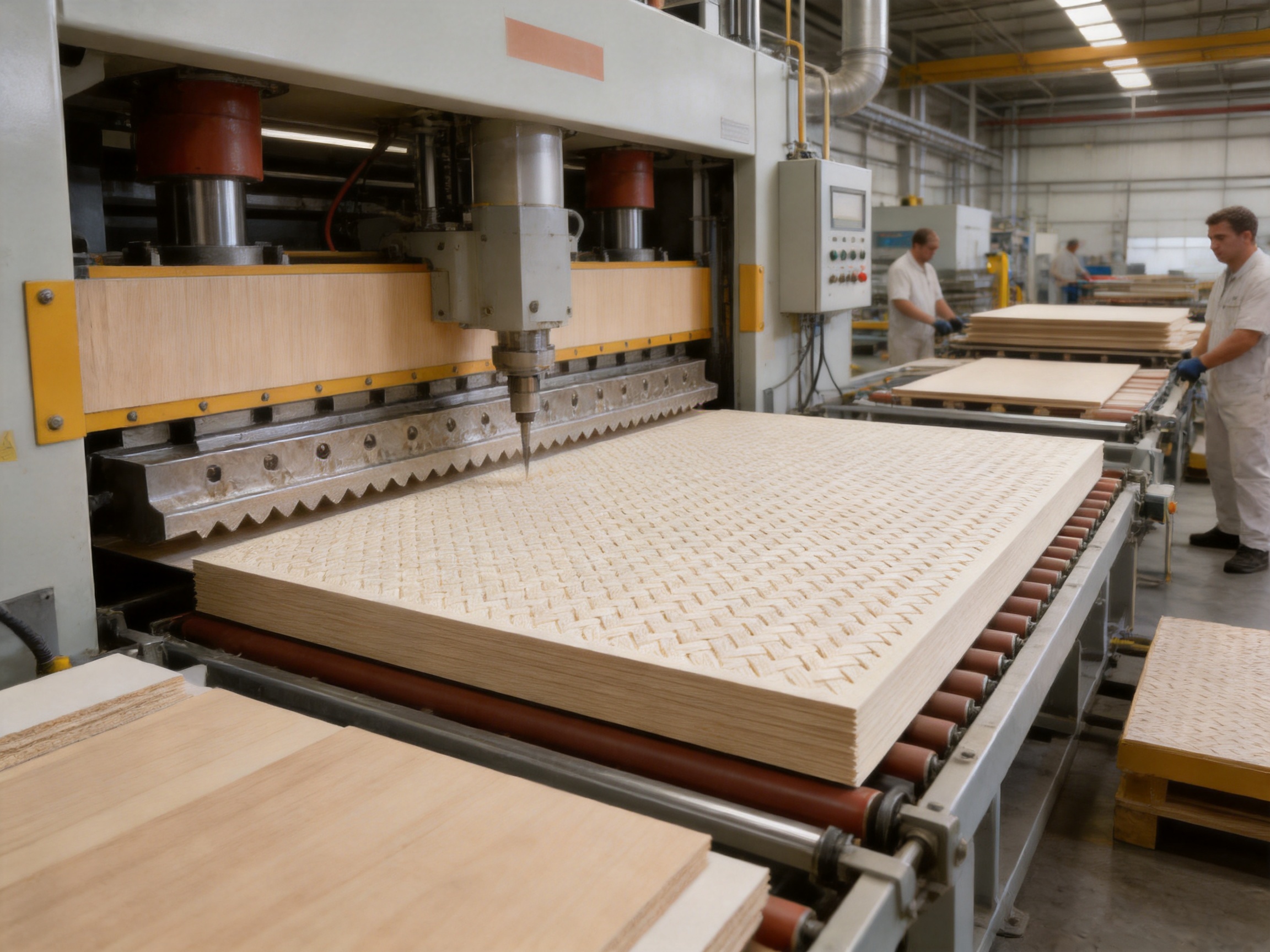
Creating a deep texture on a melamine-faced panel is more demanding than producing a flat or lightly textured surface. The press must transfer the pattern consistently across the panel, while the paper, resin, substrate, temperature, pressure, and pressing time must work together to produce a stable result.
PS01 uses deep embossing technology to transfer the woven structure into the finished panel. The purpose is not simply to make the pattern visible but to preserve the relationship between raised strips, recessed channels, intersection points, and edge shadows. Consistency across the sheet is essential because uneven relief can affect appearance, touch, machining, and installation.
The manufacturing process must also consider the relationship between surface depth and panel stability. A deeper embossing pattern can place greater demands on the substrate and on the bonding relationship between the melamine surface and the board core. If the substrate density is inconsistent or the pressing conditions are poorly controlled, defects such as uneven texture, warping, cracking, or delamination may occur.
Substrate Engineering
According to the product information, PS01 can be produced on multiple substrates, including LSB and SOSB, as well as MDF, HMR MDF, particleboard, fire-resistant board, wood veneer, and plywood. This flexibility allows the product to be adapted to different use environments and performance requirements.
For deep-embossed production, substrate uniformity is especially important. The company recommends LSB or MDF where consistent embossing depth and structural stability are priorities. These substrate choices can provide a more predictable pressing surface and help the decorative pattern transfer evenly.
SOSB, described as a custom small-chips substrate, is used to support structural stability in the deep-embossed process. The smaller chip structure can help create a more uniform board body, allowing pressure and heat to be distributed more consistently during pressing. This is particularly relevant when the design contains pronounced relief.
Temperature and Pressing Control
Temperature control is another critical factor in the production of melamine-faced panels. The resin-impregnated paper must form a stable bond with the substrate without compromising the appearance or dimensional integrity of the panel. Pressure and temperature need to be coordinated so that the surface can follow the embossing pattern while the board remains structurally stable.
PS01 uses precise temperature control during pressing. This manufacturing approach is intended to reduce the risk of cracking and deformation associated with deep textures. Stable processing also helps maintain the regularity of the woven pattern from one area of the panel to another.
MDI Adhesive Bonding and Process Integration
YAKCO’s company information identifies MDI medical adhesive bonding as one of its production capabilities. MDI-based bonding technology is associated with engineered wood products and can support strong, stable bonding performance when properly formulated and processed. In the context of decorative panels, adhesive selection is an important part of overall board quality because it affects strength, dimensional stability, and long-term performance.
The company also reports six core production processes and a focus on deep-pressing technology. Integrating substrate preparation, adhesive bonding, decorative-paper treatment, pressing, finishing, cutting, and quality control allows the product to be developed as a complete system rather than as a decorative paper applied to an ordinary board without further engineering.
Advantages Compared with Conventional Decorative Panels
More Tactile Than Printed Leather Grain
Many decorative panels create a leather impression through color and shallow surface patterning. While these products can be attractive, their tactile effect may be limited. PS01 creates a more pronounced physical structure through deep embossing, giving the woven pattern a stronger presence.
The difference becomes especially noticeable when the panel is used close to eye level or within reach. Users can feel the relationship between the interlaced strips instead of seeing only a printed image. This makes PS01 a stronger choice when the design concept depends on craftsmanship, material authenticity, or sensory engagement.
More Distinctive Than a Flat Melamine Board
Flat melamine boards are practical and versatile, but they may require additional decoration, applied moldings, inlays, or mixed materials to create visual depth. PS01 integrates the decorative effect directly into the panel surface. The woven pattern provides visual richness without requiring separate strips or manually assembled components.
This can simplify the design language of a project. A cabinet door, wall panel, or reception counter may achieve a high-end appearance through one coordinated surface rather than several applied layers. The result can be visually detailed while remaining relatively clean and controlled.
Lighter and More Scalable Than Solid Woven Leather
Natural woven leather is a premium material, but large-scale use can involve higher material costs, specialized fabrication, maintenance considerations, and installation complexity. PS01 translates the appearance of woven leather into a standardized panel format that can be manufactured in larger dimensions and processed using familiar panel-fabrication methods.
This makes the design concept more scalable. Instead of limiting woven leather to handles, drawer fronts, furniture inserts, or small decorative areas, designers can apply the aesthetic to walls, partitions, full-height cabinetry, commercial counters, and larger architectural surfaces.
Better Visual Concealment of Minor Scratches
The patterned surface can help make minor marks less immediately noticeable than they would be on a smooth solid-color board. The raised and recessed geometry breaks up reflections and adds visual variation, which may help disguise small surface imperfections caused by normal use.
This does not mean that the panel is scratch-proof or that normal maintenance can be ignored. However, the texture provides a practical visual advantage in busy environments where small marks may be more visible on uninterrupted, glossy, or uniform surfaces.
More Effective Large-Surface Rhythm
A large smooth wall often requires artwork, moldings, lighting effects, or additional finishes to avoid looking empty. PS01 supplies a built-in rhythmic pattern that can give a broad surface detail and identity without adding separate decorative elements.
The repeating weave can also help unify multiple panels. When the installation is planned carefully, the surface becomes a continuous visual field with a consistent design language. The panel therefore offers both decorative impact and a degree of design efficiency.
Product Stability and Quality Considerations
Deep embossing creates a technical challenge: the more pronounced the surface relief, the greater the potential stress placed on the panel. A successful product must balance expressive depth with structural stability. PS01 addresses this challenge through substrate selection, pressing control, and a stable bond between the melamine surface and the board core.
Warping can occur when moisture, heat, pressure, or internal stresses are distributed unevenly through a panel. Cracking may occur if the surface layer cannot accommodate the deformation created during pressing or later environmental changes. The stated use of custom SOSB substrate and controlled pressing conditions is intended to reduce these risks.
Substrate density and uniformity remain important during manufacturing and installation. An uneven board can produce inconsistent embossing depth, visible differences between areas, or difficulties during machining. For this reason, substrate selection should be matched to the intended application rather than treated as an interchangeable detail.
For demanding projects, buyers should confirm the selected core material, panel thickness, environmental rating, tolerances, color consistency, edge treatment, and recommended fabrication method with the manufacturer. Testing and sampling are particularly useful when PS01 is specified for large commercial installations or unusual structural applications.
Applications in Interior Architecture
Cabinet Doors and Wardrobes
Cabinet doors are one of the most natural applications for PS01. The woven pattern gives a flat door face greater visual interest while retaining the clean rectangular geometry needed for contemporary interiors. It can be used for kitchen cabinetry, wardrobes, media units, bathroom storage, reception cabinetry, and custom furniture.
Compared with a standard leather-grain surface, the woven structure introduces an additional layer of detail. Light can catch the raised crossings and create soft shadow transitions as the user moves around the room. This gives cabinet fronts a crafted appearance without requiring individually woven leather strips.
The product can work particularly well on large door panels because the regular pattern supports visual continuity. For smaller doors and drawer fronts, the texture can provide a focused luxury detail. Designers should consider pattern direction, joint alignment, handle placement, and edge-banding width when developing the final cabinet layout.
Accent Walls
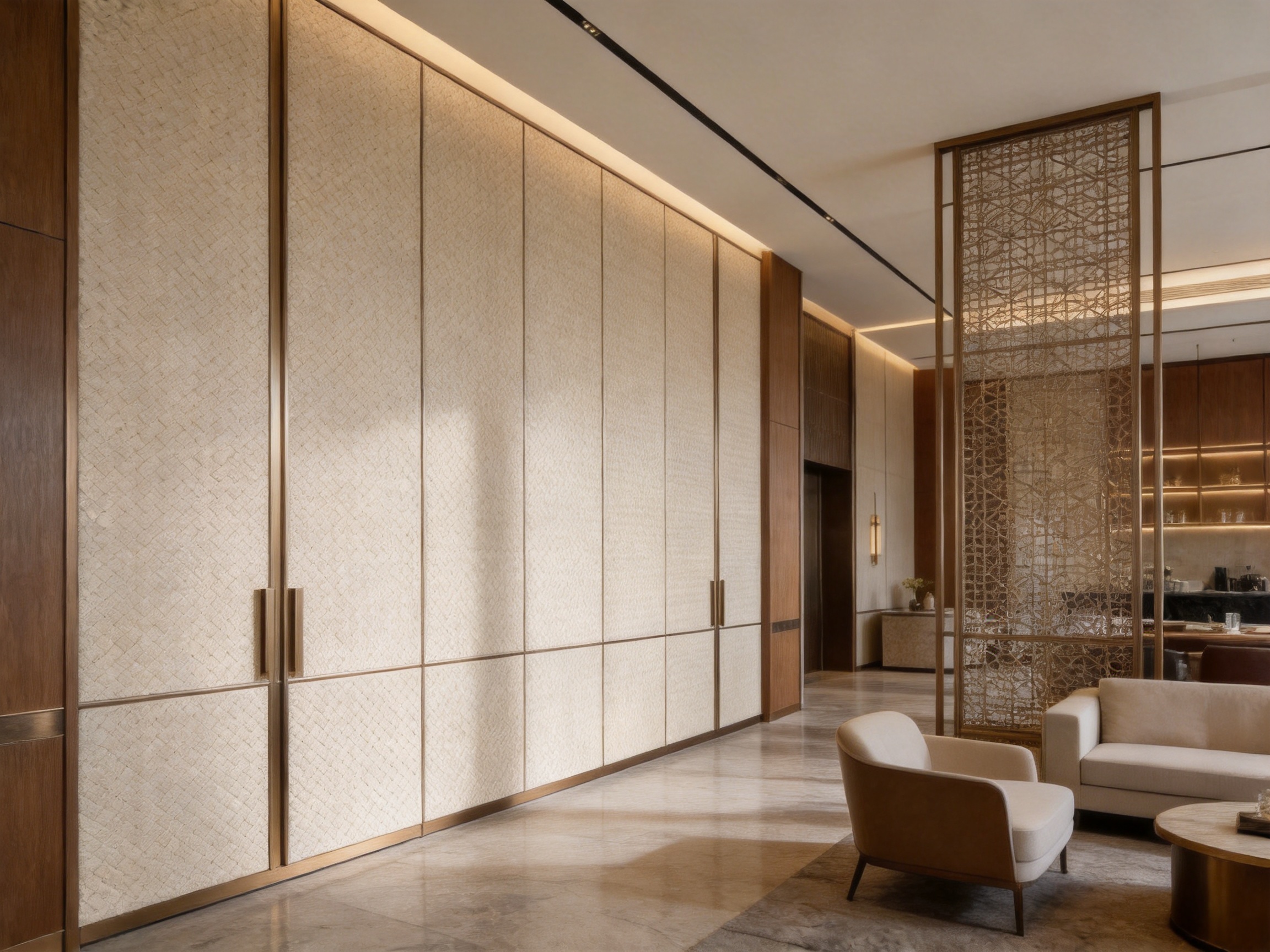
PS01 can transform an ordinary wall into a tactile feature surface. The repeating weave creates a controlled interplay of light and shadow, while the natural color supports a broad range of interior palettes. It may be used behind beds, sofas, reception desks, dining areas, television walls, or retail displays.
Accent walls benefit from the panel’s ability to create interest without relying on intense color. The natural woven leather appearance can remain warm and understated, allowing furniture, artwork, lighting, and architectural details to share attention with the wall.
When used on a large wall, installation planning is essential. Panel orientation, seams, corner details, electrical openings, and lighting angles should be coordinated before fabrication. A sample panel viewed under the planned lighting can help confirm the desired depth and shadow effect.
Screens and Partitions
Although the woven pattern is not genuinely transparent, it can create a visually airy and breathable impression. The regular intersections suggest openness and prevent a solid surface from feeling excessively heavy. This makes PS01 suitable for decorative screens, partial partitions, reception dividers, workspace separators, and residential zoning elements.
In open-plan spaces, a textured partition can define different functional areas without completely isolating them. The panel can contribute privacy, spatial rhythm, and visual separation while maintaining a lighter appearance than a fully solid, smooth wall.
For freestanding or semi-structural partitions, the supporting frame, fixing method, edge protection, and selected substrate should be carefully engineered. The decorative panel should be specified according to the actual structural and fire-performance requirements of the project.
Commercial Interiors
Retail shops, restaurants, hotels, offices, showrooms, and reception areas often require materials that communicate quality quickly. Woven leather is widely associated with refined furniture and luxury products, so PS01 can help create a warm and crafted atmosphere in commercial spaces.
The panel may be used on sales counters, display backdrops, hospitality walls, elevator lobbies, executive offices, private dining rooms, and branded interior zones. Its texture can help distinguish a space without depending exclusively on logos, graphics, or bright colors.
Because the pattern is integrated into the board, it can also support repeatable design across multiple locations. A commercial brand may use the same woven surface language in reception desks, cabinetry, wall panels, and display units while adjusting the substrate or thickness for each application.
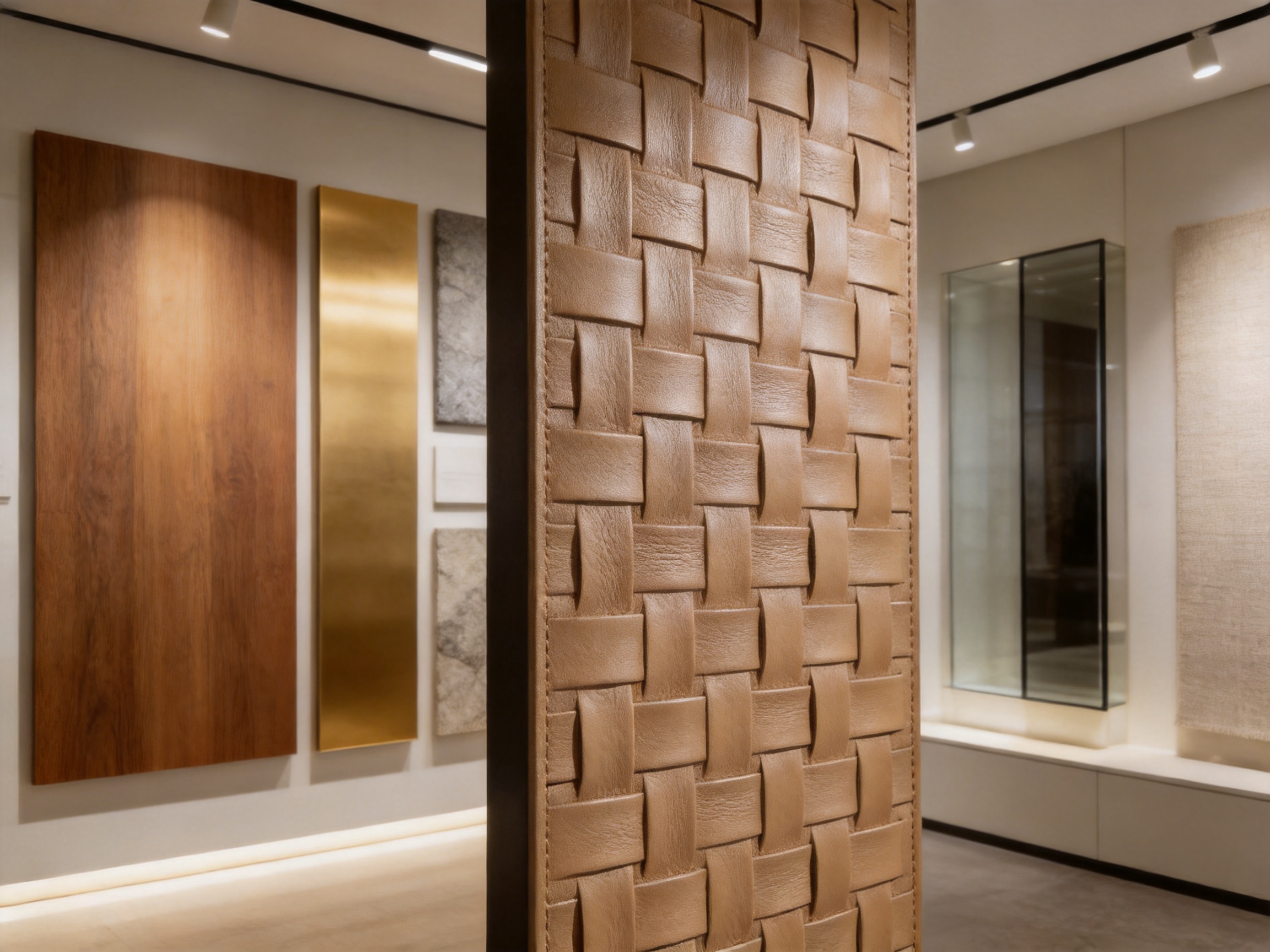
Compatibility with Interior Styles
Modern Luxury
Modern luxury interiors often combine restrained forms with carefully selected materials. PS01 suits this approach because its woven pattern offers complexity while its matte natural appearance remains controlled. When paired with metal and glass, the detailed surface contrasts with the simplicity of smooth, reflective materials.
Brushed brass, dark bronze, stainless steel, smoked glass, and stone can all emphasize different aspects of the panel. Warm metals may bring out the leather association, while cool metals can create a more contemporary contrast. The panel can therefore function as a soft counterpoint to harder architectural finishes.
Naturalism
The woven structure has an inherent connection to natural craft. It can be paired with microcement, timber, linen, stone, clay-toned finishes, and other materials that emphasize tactile authenticity. The combination can create interiors that feel warm and grounded without appearing traditionally rustic.
Naturalism does not require every surface to be untreated or visibly irregular. PS01 provides a regular, manufactured interpretation of natural weaving, making it suitable for projects that want organic references within a precise architectural framework.
Italian Minimalism
Woven leather details are familiar in Italian furniture, particularly in chair backs, sofa panels, cabinet fronts, and other carefully crafted elements. PS01 expands this design language into larger panel applications while maintaining the principles of proportion, restraint, and material refinement associated with Italian minimalism.
The panel can be used with simple cabinetry, slender furniture profiles, low-contrast color schemes, and carefully positioned lighting. Its decorative quality is present but not excessively ornamental, allowing the overall space to remain calm and sophisticated.
Contemporary Hospitality Design
Hotels, lounges, restaurants, and private clubs often seek materials that feel comfortable, refined, and memorable. The woven leather effect can communicate a sense of hospitality because it combines softness, craft, and visual warmth. The matte surface can also reduce glare in areas where decorative lighting is important.
PS01 may be used in guestroom furniture, headboards, lounge walls, bar fronts, host stands, corridor panels, and meeting-room interiors. The final suitability will depend on the project’s cleaning, fire, impact, and durability requirements, which should be confirmed during specification.
Fabrication and Installation Guidance
PS01 should be handled as a textured decorative panel. Before cutting, fabricators should inspect the surface, confirm the front and back orientation, verify the pattern direction, and plan all visible joints. The woven design may have a directional quality, so adjacent panels should be aligned consistently.
Panel cutting should be carried out with suitable tools and procedures for the selected substrate. Clean cutting is important around cabinet openings, electrical outlets, hardware recesses, and exposed edges. Fabricators should follow the manufacturer’s recommendations for blade selection, feed rate, support, and edge finishing.
Edge banding can be used to complete visible panel edges. The available matching edge-banding widths of 26 mm and 56 mm provide options for different edge details and component thicknesses. In a cabinet application, matching edge treatment can help the textured surface transition naturally around the door or carcass.
Storage and acclimatization are also important for engineered wood panels. Boards should be stored flat, protected from excessive moisture, and kept away from conditions that could create uneven temperature or humidity exposure. The project team should follow the applicable handling and installation instructions supplied for the selected substrate.
Large wall installations require attention to the supporting wall, fixing system, movement joints, corners, and transitions to other materials. A qualified installer should verify that the substrate and fixing method are appropriate for the panel size and application. For partitions and screens, the supporting framework should be designed independently of the decorative surface requirements.
Environmental and Material Considerations
PS01 is listed with E0, E1, and P2 environmental ratings in the provided product information. These designations relate to different standards or classifications used for engineered wood and panel products. The exact rating available may depend on the selected substrate, production specification, and destination market.
Project buyers should request current technical documentation and confirm the applicable formaldehyde-emission classification, testing method, fire performance, and environmental declarations before final approval. Such confirmation is especially important for schools, healthcare facilities, offices, hotels, and residential projects with strict indoor-air-quality requirements.
The use of a melamine-faced panel can provide a resource-efficient alternative to applying solid leather or multiple decorative layers across a large area. A standardized panel may also improve production consistency and reduce the labor associated with individually assembling woven leather strips. However, responsible specification still requires attention to substrate composition, adhesives, production waste, transport, and end-of-life considerations.
YAKCO identifies environmentally friendly performance and compliance with the international ENF formaldehyde standard as part of its product-development focus. Purchasers should verify the current certification documents and the exact grade supplied for each order.
Why Choose YAKCO as a Manufacturing Partner?
YAKCO New Materials (Jiangsu) Co., Ltd. was established in 2007 and operates from No. 17, Furong Road, Baimao, Guli Town, Changshu City, Jiangsu, China. The company covers approximately 50 acres and has a modern standard factory building of more than 30,000 square meters.
The company specializes in high-end decorative panels and wall panels for residential and commercial interiors. Its product-development focus includes three-dimensional decorative-panel technology, deep pressing, substrate engineering, and decorative surface innovation. This specialization is relevant to PS01 because the product depends on more than color matching or ordinary melamine lamination.
The company reports six core production processes and MDI adhesive bonding capability. These resources support a more integrated approach to panel manufacturing. By combining substrate preparation, bonding, embossing, pressing, finishing, and quality management, YAKCO can develop products that balance appearance with manufacturability.
YAKCO established its brand in 2016 and is committed to supplying building materials for residential and commercial spaces. Its experience since 2007 provides a manufacturing background for customers seeking a long-term supplier rather than a short-term decorative-product source.
The product range also includes rock designs, fabric and textile designs, leather designs, art deco surfaces, wood designs, melamine board substrates, wood panels, grain cloth surfaces, and frosted three-dimensional panels. This broader portfolio can help designers coordinate multiple textures within one project or develop a complete decorative-material schedule through one manufacturer.
Customization Capacity
PS01 supports production on different substrates, thicknesses, and dimensions. This is valuable for projects with varied fabrication requirements. A furniture manufacturer may need one substrate for cabinet doors, while a commercial wall project may require a different core or fire-related specification.
Customization also extends to color and edge coordination, subject to production requirements. Matching edge banding helps maintain a unified appearance, while substrate selection can be adjusted according to machining, stability, and performance needs.
For large orders, customers should provide drawings, application details, target dimensions, substrate requirements, environmental standards, and expected production volumes during the quotation stage. Early technical communication can help determine whether the standard product is suitable or whether a customized specification is required.
How PS01 Supports Efficient Design Development
Design development often involves balancing a distinctive appearance with practical production constraints. A highly handcrafted finish may be visually desirable but difficult to reproduce across many components. PS01 offers a repeatable woven pattern that can be incorporated into standardized panel fabrication workflows.
The surface can be applied to multiple project elements while maintaining a consistent material identity. Cabinet fronts, wall panels, reception desks, screens, and furniture components can share the same woven leather language. This coordination can make an interior feel more deliberate and cohesive.
The regular pattern also provides a clear basis for modular planning. Designers can establish panel grids, align joints, repeat dimensions, and coordinate lighting around the surface rhythm. While the pattern should still be reviewed at corners and transitions, its geometric organization can make it easier to develop a controlled installation strategy than a highly irregular decorative surface.
Because the panel combines the decorative finish and the board substrate, it may reduce the need for separate surface application processes. This can simplify procurement and help manufacturers estimate cutting, edging, and assembly operations more efficiently. The actual production benefits will depend on the project’s design and the selected board specification.
Maintenance and Long-Term Appearance
The matte, textured surface can help reduce the visibility of minor marks, but routine care remains important. Dust can collect in recessed areas of any three-dimensional panel, so cleaning should be carried out using methods appropriate for melamine-faced surfaces and the selected substrate.
Harsh abrasives, aggressive solvents, excessive water, and sharp tools should generally be avoided unless specifically approved by the manufacturer. Cleaning procedures should be tested in an inconspicuous area before being applied across a visible installation.
In commercial settings, the cleaning schedule should be coordinated with the use environment. High-contact areas such as reception counters, cabinet handles, and hospitality furniture may require more frequent cleaning than decorative wall zones. The final maintenance protocol should be based on the project’s operational conditions and the technical recommendations supplied with the product.
Lighting design can also influence long-term visual satisfaction. Because the woven relief creates shadows, directional lighting may emphasize the texture more strongly than diffuse lighting. Designers should review the panel under the actual illumination conditions to ensure that the result matches the intended atmosphere.
Specification Checklist for Buyers and Designers
Before ordering PS01, project teams should define the intended application and confirm the required thickness, dimensions, core material, edge treatment, environmental rating, and quantity. The selection should consider whether the panel will be used horizontally, vertically, as a cabinet component, or as part of a freestanding construction.
A physical sample is recommended because color, texture depth, matte reflection, and shadow behavior can be difficult to evaluate from digital images alone. The sample should be viewed under the project’s proposed lighting and beside adjacent materials such as wood, metal, stone, glass, or textile.
Designers should also confirm whether the woven pattern must run in a particular direction. Pattern orientation can influence the visual relationship between adjacent panels, cabinet doors, and edge banding. A cutting layout should be prepared before production to minimize waste and maintain consistent direction.
For commercial or public buildings, the project team should request current documents covering fire performance, formaldehyde emissions, substrate composition, cleaning recommendations, and installation guidance. Compliance requirements can vary according to country, building type, and application location.
For custom projects, buyers should discuss minimum order quantities, lead times, color matching, prototype approval, packaging, transportation, and replacement-panel availability. Early coordination can reduce the risk of unexpected variation between sample approval and mass production.
Frequently Asked Questions
What makes PS01 different from a standard leather-grain melamine board?
PS01 uses a woven leather pattern with deeper physical relief rather than relying only on a printed or shallow leather grain. The interlaced strips create stronger tactile depth, more visible edge shadows, and a more detailed handcrafted impression.
Is PS01 made from real leather?
No. PS01 is a melamine-faced decorative panel inspired by woven leather. Its finish uses melamine-impregnated paper pressed onto an engineered or other specified board substrate. It reproduces the visual and tactile character of woven leather without being a sheet of natural leather.
Which substrate is recommended for deep embossing?
The product information recommends LSB or MDF where consistency and stability are priorities. Other substrates, including SOSB, HMR MDF, particleboard, fire-resistant board, wood veneer, and plywood, may also be available depending on the application and production requirements.
Can PS01 be used on large walls?
Yes. Its regular woven pattern and large available dimensions make it suitable for accent walls and other broad surfaces. Installation planning should address panel joints, pattern direction, corners, lighting, fixing systems, and the condition of the supporting wall.
Can PS01 be used for cabinet doors?
Yes. Cabinet doors are one of the primary applications for the product. The surface adds visual depth to flat doors and can be coordinated with matching edge banding. The selected thickness and substrate should be matched to the cabinet construction and hardware requirements.
Does the texture make the panel difficult to clean?
The recessed portions may require careful dust removal, as with any three-dimensional decorative surface. Routine cleaning should follow the manufacturer’s recommendations. Abrasive cleaners, aggressive chemicals, and excessive moisture should be avoided unless specifically approved.
Is the surface glossy?
PS01 is designed with a matte, subdued luster. The matte finish helps reduce a plastic-like appearance and allows the embossed weave to look more natural. Lighting direction will still influence the visibility of the raised and recessed areas.
Can the product be customized?
The product supports different substrates, thicknesses, dimensions, and matching edge-banding options. Custom color, substrate, and production requirements should be discussed with YAKCO before ordering, particularly for large projects or specialized applications.
What sizes are available?
The standard dimension is 1220 × 2745 mm. Additional listed dimensions are 1220 × 2800 mm, 1220 × 3050 mm, and 1220 × 3300 mm. Availability should be confirmed for the selected substrate, thickness, and order quantity.
What thicknesses are offered?
Listed thicknesses include 1.5 mm, 9 mm, 12 mm, 18 mm, 22 mm, and 25 mm. The appropriate option depends on whether the product is being used as a decorative layer, cabinet component, wall panel, furniture element, or other construction part.
Is PS01 suitable for partitions?
It can be used for decorative screens and partitions when installed on an appropriate supporting frame or construction system. The panel itself should not be assumed to provide structural support unless the selected specification and engineering design explicitly allow it.
How does the texture help disguise minor scratches?
The repeated relief interrupts uninterrupted reflections and adds visual variation. As a result, small marks may be less immediately visible than they would be on a smooth, uniform surface. The panel is not scratch-proof and should still be handled and maintained appropriately.
Who manufactures PS01?
PS01 is manufactured by YAKCO New Materials (Jiangsu) Co., Ltd., a company based in Changshu City, Jiangsu, China. The company specializes in high-end decorative panels, wall panels, three-dimensional surfaces, deep pressing, and engineered substrate solutions.
What should be confirmed before placing an order?
Buyers should confirm the substrate, thickness, dimensions, environmental classification, color, texture consistency, edge-banding requirements, quantity, delivery schedule, packaging, installation method, and any fire or performance documentation required by the project.
Conclusion
PS01 Woven Leather Texture Panel-Natural brings the visual language of luxury woven leather into a scalable melamine-faced panel format. Its primary strengths are the deep three-dimensional weave, tactile richness, matte surface, regular visual rhythm, broad substrate compatibility, and suitability for both residential and commercial interiors.
Compared with flat boards, printed leather-grain surfaces, and manually assembled woven-leather components, PS01 offers a stronger combination of visual identity, physical texture, manufacturing repeatability, and large-format usability. It can create a crafted appearance on cabinet doors, accent walls, partitions, screens, reception counters, hospitality furniture, and other architectural surfaces.
The technical value of the product depends on the manufacturing system behind it. Deep embossing requires careful control of substrate density, temperature, pressure, bonding, and panel stability. YAKCO’s experience in decorative-panel production, three-dimensional surface technology, deep pressing, MDI adhesive bonding, and multiple substrate solutions supports the development of a product intended to combine premium appearance with practical production performance.
For designers seeking a material that feels refined without becoming visually heavy, PS01 offers a balanced solution. It combines the warmth of leather, the rhythm of weaving, the efficiency of engineered panels, and the design flexibility needed for contemporary interior architecture.
References
YAKCO New Materials (Jiangsu) Co., Ltd. Product information for PS01 Woven Leather Texture Panel-Natural.
YAKCO New Materials (Jiangsu) Co., Ltd. Technical information on melamine-faced decorative panels, deep pressing, substrates, and matching edge banding.
YAKCO New Materials (Jiangsu) Co., Ltd. Company profile and manufacturing information, including factory facilities, production processes, and material-development focus.
General principles of engineered wood-panel manufacturing, melamine surface treatment, substrate stability, and decorative-surface fabrication.
General interior-design references concerning woven leather, tactile materials, modern luxury, naturalism, Italian minimalism, and commercial interior applications.