中文简体



Previous Post
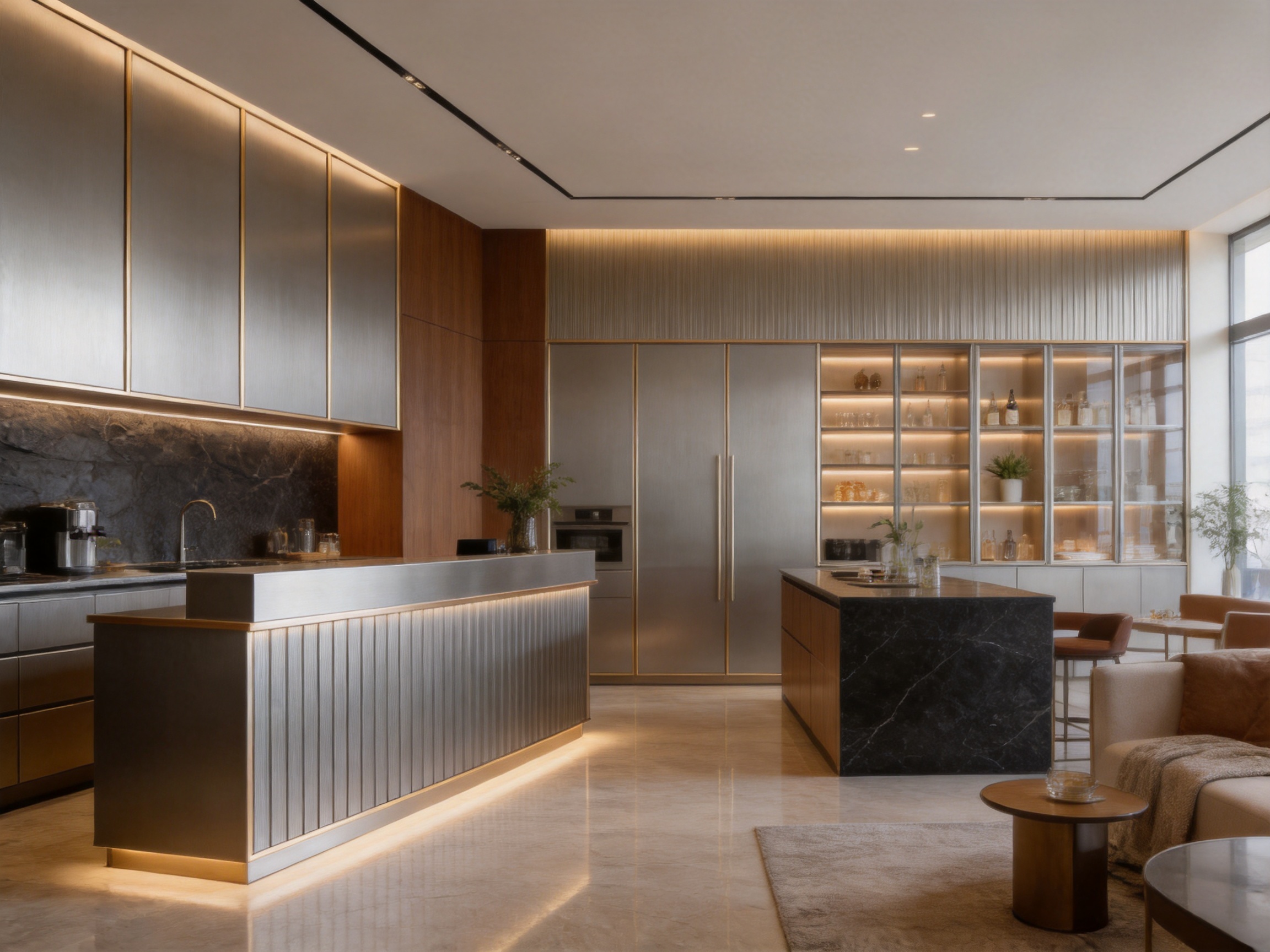
In contemporary interior design, metal finishes remain popular because they communicate precision, strength, sophistication, and modernity. Brushed metal, satin metal, and softly reflective surfaces are widely used in luxury residences, retail environments, hospitality projects, offices, and custom furniture. However, real metal is not always the most practical material for interior applications. It can be heavy, expensive, difficult to process, cold to the touch, vulnerable to scratches, and demanding to install.
The ZQ45 Metal Texture Panel was developed to capture the most attractive visual and tactile qualities of metal while avoiding many of the problems associated with traditional metal panels, aluminum foil laminates, and metal veneers. Manufactured by YAKCO New Materials (Jiangsu) Co., Ltd., the panel combines a three-dimensional melamine decorative surface with a wood-based substrate. The result is a panel that offers metallic visual depth, a refined semi-matte finish, practical workability, and the warmth of wood-based materials.
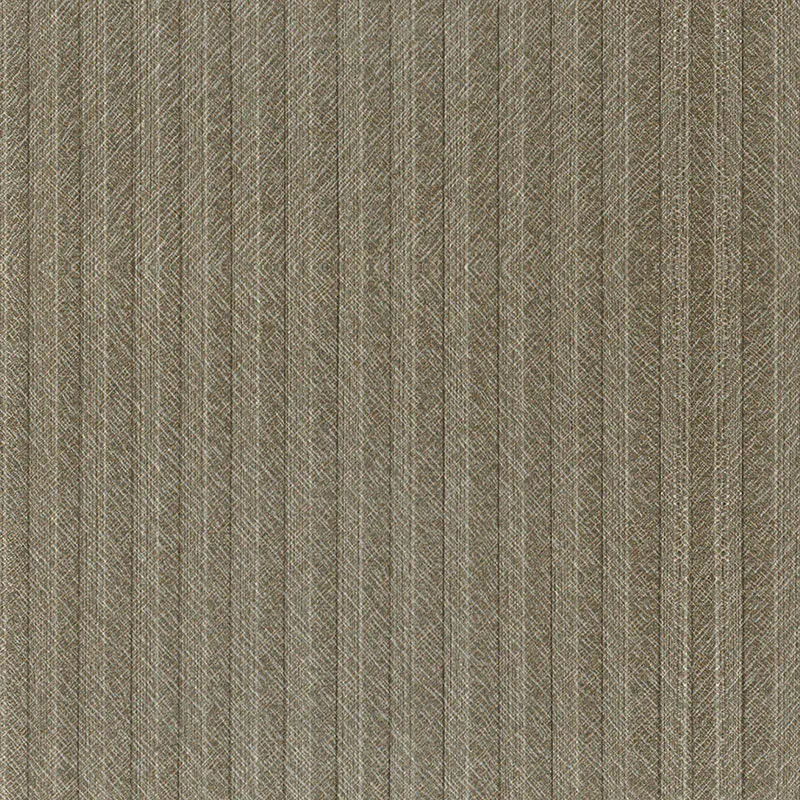
Rather than attempting to imitate polished stainless steel through a flat printed image, ZQ45 creates a more convincing three-dimensional impression. Micron-sized metal powder is incorporated into the decorative paper, while horizontal satin and vertical brushed textures are pressed into the surface. Depending on the angle of the light, the panel can display soft diffusion, directional highlights, and a layered tactile effect.
This combination makes the product particularly suitable for light luxury interiors, industrial-inspired spaces, contemporary furniture, modern retail projects, feature walls, cabinet doors, kitchen islands, and commercial interiors. It provides designers with the appearance of metal without requiring the same fabrication methods, structural reinforcement, or maintenance routines.
Understanding the ZQ45 Metal Texture Panel
ZQ45 is a decorative melamine-faced panel with a metal-inspired surface finish. Its design does not rely solely on color. Instead, its appearance is created through the interaction of decorative printing, metal powder, surface embossing, and controlled pressing technology.
The surface is described as a semi-matte brushed metal texture. This finish is intentionally more restrained than a highly polished metallic surface. It retains a subtle luster but avoids excessive glare, making it easier to use across large areas. The low-reflection appearance is valuable in spaces where strong lighting, display illumination, or daylight could make a glossy material visually overwhelming.
The panel includes two visual directions within its texture system. The horizontal satin effect softens reflected light and contributes to a calm, orderly appearance. The vertical brushed effect introduces direction, movement, and a sense of precision. When these effects overlap, the surface appears more dimensional than a conventional flat metallic print.
The material is available in several thicknesses, including 1.5 mm, 9 mm, 12 mm, 18 mm, 22 mm, and 25 mm, depending on the application and substrate configuration. Standard dimensions are 1220 × 2745 mm, with additional dimensions of 1220 × 2800 mm, 1220 × 3050 mm, and 1220 × 3300 mm available for selected requirements.
The product information also identifies common board thicknesses of 9 mm, 12 mm, 18 mm, 22 mm, and 25 mm. This range allows the same decorative concept to be adapted for wall cladding, cabinet fronts, furniture components, partitions, doors, and other interior elements.
| Item | Product Information |
|---|---|
| Product name | ZQ45 Metal Texture Panel |
| Surface finish | Semi-matte brushed metal texture with horizontal satin and vertical brushed effects |
| Finish material | Melamine-impregnated decorative paper |
| Available thicknesses | 1.5 mm, 9 mm, 12 mm, 18 mm, 22 mm, and 25 mm |
| Standard dimensions | 1220 × 2745 mm |
| Additional dimensions | 1220 × 2800 mm, 1220 × 3050 mm, and 1220 × 3300 mm |
| Compatible substrates | LSB, SOSB, MDF, HMR MDF, particleboard, fire-resistant board, wood veneer, and plywood |
| Matching edge banding | 1 × 26 mm and 1 × 56 mm |
| Environmental classifications | E0, E1, P2, and product information referencing P2/F4 options |
| Manufacturing process | YAKCO 3D melamine board process using high-temperature, high-pressure pressing |
Why Metal-Inspired Surfaces Are Important in Interior Design
Metal is often used as a visual symbol of quality and precision. Stainless steel suggests cleanliness and technical performance. Brushed aluminum conveys lightness and modernity. Bronze, champagne, and darker metallic finishes introduce luxury and depth. These associations explain why metal-inspired materials continue to appear in furniture, wall systems, retail displays, reception areas, kitchens, and hospitality interiors.
However, the use of real metal can involve compromises. Sheet metal may require cutting, bending, welding, polishing, drilling, or specialized edge treatment. The finished component can be heavy, and a large metal cabinet door may place additional stress on hinges and mounting hardware. Highly reflective metal may also reveal fingerprints, dents, scratches, and installation marks.
A decorative board with an engineered metal texture offers a different approach. It allows designers to specify the appearance of metal while using familiar woodworking equipment and established furniture manufacturing methods. The panel can be integrated into a project using processes that are closer to those used for standard melamine-faced boards.
This distinction is especially important for manufacturers producing multiple pieces of furniture or interior components. Instead of developing a separate metal fabrication workflow, they can use cutting, drilling, edge banding, and assembly techniques already available in a woodworking facility.
Three-Dimensional Surface Design
The principal visual advantage of ZQ45 is its three-dimensional surface system. A flat metallic image can look artificial because the eye expects a relationship between color, reflection, and physical texture. If the printed pattern remains completely smooth, it may not respond convincingly when viewed from different directions or under changing light.
ZQ45 addresses this issue by combining metal powder with textured decorative paper. The metal powder contributes fine reflective particles, while the surface embossing establishes a physical pattern. The result is not simply a silver or colored image applied to a board. It is a coordinated surface in which light interacts with both the decorative layer and the micro-relief of the finish.
The horizontal satin texture performs a practical visual function. It breaks up direct reflection and prevents the entire panel from behaving like a mirror. This makes the finish more comfortable in brightly illuminated spaces and helps preserve a calm appearance over large surfaces.
The vertical brushed texture adds directionality. It can visually elongate a cabinet door, emphasize the height of a wall, or reinforce the clean lines of a contemporary interior. When used on furniture, the direction of the brushing can be coordinated with the geometry of the component to create a more intentional design language.
Because the metallic effect is integrated into the decorative paper and surface texture, it is less dependent on a perfectly flat visual image. Small changes in viewing angle can reveal different levels of sheen, producing a surface that feels more active and material-like.
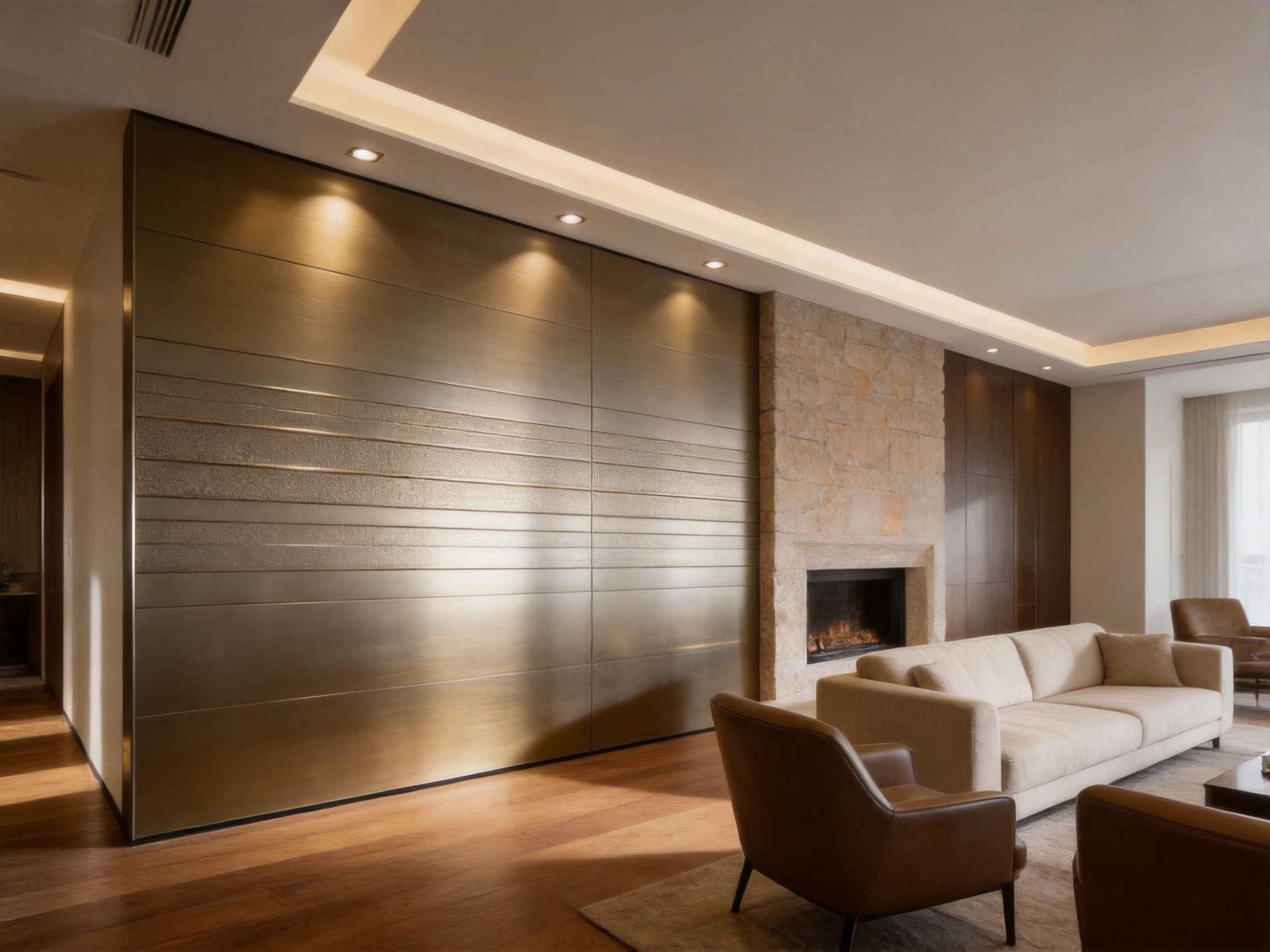
ZQ45 Metal Texture Panel - Light Luxury
Retaining the Attractive Qualities of Metal
Controlled Luster
One of the strongest qualities of metal is its ability to interact with light. A completely dull surface may look ordinary, while a bright mirror finish can become distracting. ZQ45 aims to occupy the middle ground. Its semi-matte surface offers a controlled luster that is visible under light but does not produce an aggressive glare.
This balance makes the panel suitable for areas where visual refinement is more important than dramatic reflection. It can be used behind reception desks, on cabinet fronts, in retail display systems, or across a feature wall without overwhelming nearby colors and materials.
Sense of Order and Direction
Brushed metal is associated with regularity and technical precision. The linear texture creates a strong sense of order, which is valuable in minimalist and modern interiors. ZQ45 reproduces this quality through the combination of horizontal and vertical surface effects.
Designers can use the texture direction to support the proportions of a space. Vertical brushing may help emphasize height, while horizontal satin lines can make a component feel wider or more stable. This flexibility is useful when the panel is incorporated into cabinetry, wall paneling, doors, counters, or built-in furniture.
Material Strength in Appearance
Metal often communicates durability even when it is used mainly as a decorative surface. The structured grain and restrained sheen of ZQ45 create a similar impression. The panel can therefore support design concepts that require a visual suggestion of strength, technology, or precision without introducing the weight and temperature of a fully metallic construction.
Eliminating Common Problems Associated with Real Metal
Reduced Weight
Metal cabinet doors and furniture panels may become difficult to handle as their size increases. Their weight can affect hinges, sliding systems, connectors, and supporting structures. Over time, heavy doors may sag or place excessive pressure on hardware.
Melamine-faced wood-based panels are generally lighter than comparable solid metal components. This makes them easier to transport, position, install, and operate. Lower weight can also simplify the design of cabinet hardware and reduce the structural demands placed on the furniture carcass.
The actual weight of a ZQ45 component depends on the selected substrate, thickness, dimensions, and construction method. Nevertheless, the availability of substrates such as MDF, particleboard, LSB, and plywood gives manufacturers the ability to balance weight, strength, dimensional stability, and cost for a specific project.
Improved Fingerprint Resistance
Fingerprints are a common maintenance issue on smooth metal surfaces, especially in kitchens, retail environments, elevators, offices, and other high-contact spaces. Highly reflective metal can show marks immediately, causing the surface to look untidy even shortly after cleaning.
The ZQ45 finish is designed to reduce the visibility and inconvenience of fingerprints. Its semi-matte texture and directional surface pattern help disguise minor contact marks compared with a mirror-like finish. This does not eliminate the need for cleaning, but it can make routine maintenance less demanding.
Greater Resistance to Everyday Scratching
Scratches on exposed metal may be difficult to repair without refinishing, polishing, or replacing the affected component. Scratches can also interrupt the direction of a brushed finish and become highly visible under directional lighting.
ZQ45 is designed with a hard melamine surface that provides resistance to the everyday wear expected in furniture and interior applications. Its performance depends on the substrate, edge treatment, usage conditions, and care practices, but the integrated decorative surface offers a practical alternative to vulnerable metal laminates.
As with any decorative panel, abrasive tools, sharp impacts, and improper cleaning agents should be avoided. The most appropriate cleaning method is generally a soft cloth with a mild cleaning solution, followed by removal of excess moisture.
Warmer Tactile Experience
Metal can feel cold when touched, particularly in rooms with low ambient temperatures or when it is used across large areas. This quality may be appropriate for some industrial environments, but it can make residential interiors feel less welcoming.
ZQ45 combines a metal-inspired appearance with a wood-based substrate. The result retains some of the visual authority of metal while offering a warmer and more familiar tactile experience. This makes it useful in spaces that seek industrial or luxury detailing without becoming visually or physically cold.
Advantages Over Aluminum Foil Laminates
Traditional decorative metal panels are sometimes produced by applying aluminum foil or a thin metal layer over a substrate. This approach can provide an authentic metallic surface, but it may also introduce technical risks. If the laminate is not bonded correctly, bubbling, peeling, edge lifting, or delamination may occur.
Thin metal layers can also be vulnerable during transportation and installation. Bending, impact, incorrect stacking, or contact with sharp objects may leave permanent marks. Warping can become another concern when the panel experiences changes in temperature, humidity, or internal stress.
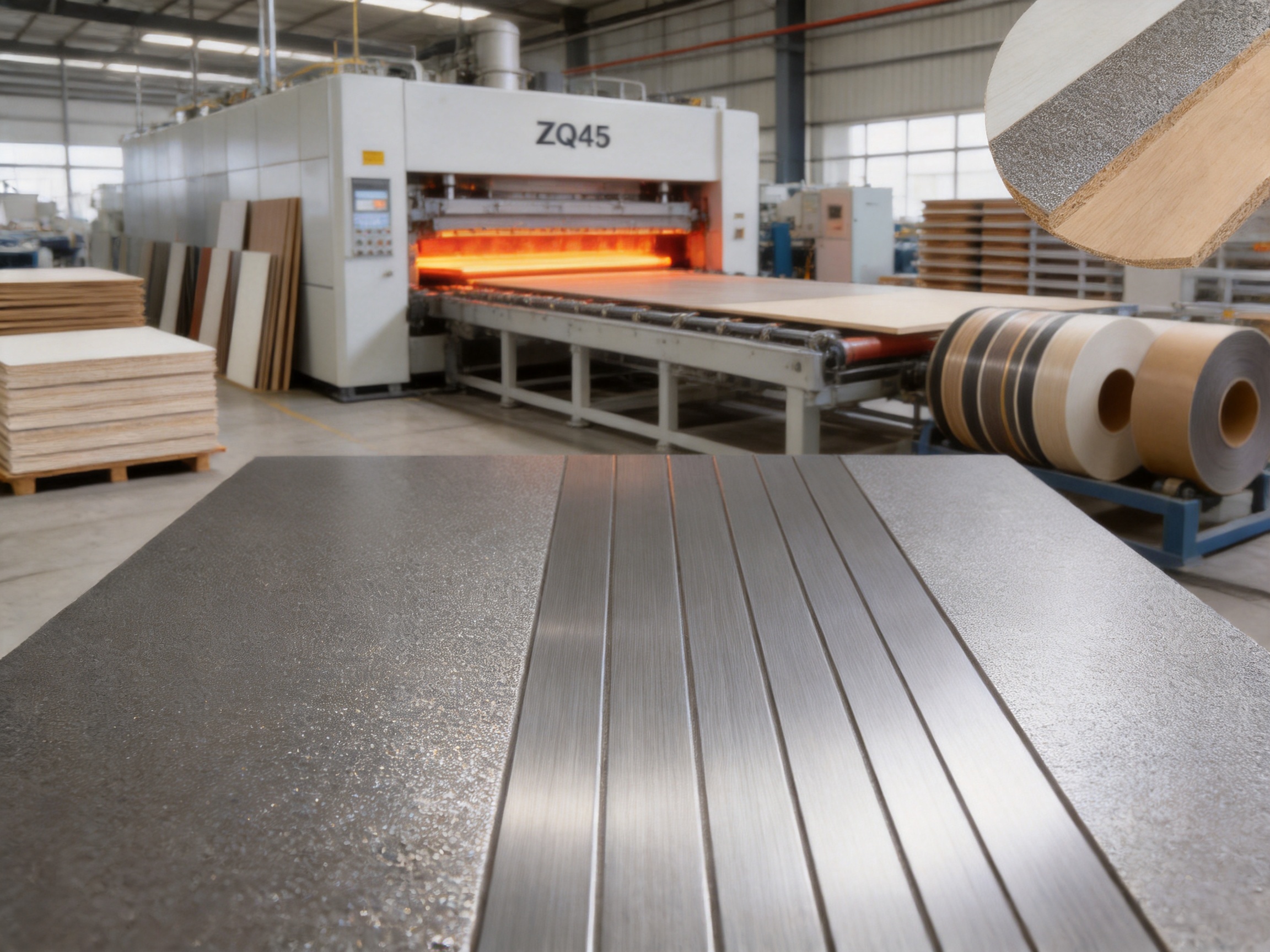
ZQ45 uses a high-temperature, high-pressure single-step lamination and pressing process. Rather than applying a separate decorative metal foil that remains vulnerable as an independent layer, the brushed and satin textures are formed into the surface during pressing. This approach is intended to create a more stable relationship between the decorative layer and the panel structure.
The production temperature is controlled between approximately 160 and 180 degrees Celsius, while pressing pressure is stated at approximately 20 to 25 kg/cm². These parameters support the consolidation of the decorative surface and substrate under controlled manufacturing conditions.
The process is designed to reduce common problems such as bubbling, edge curling, surface irregularities, and weak adhesion. Consistent results still depend on substrate preparation, moisture control, pressing conditions, storage, and quality inspection, but the integrated manufacturing method provides an important advantage over less stable decorative laminates.
Substrate Options for Different Applications
A major benefit of the ZQ45 system is that the same surface concept can be combined with different base materials. This allows project teams to choose a substrate according to structural, environmental, machining, and budget requirements rather than treating the decorative finish as a fixed construction.
LSB for Large and Stable Components
LSB uses oriented large wood strands or chips arranged in a layered structure. This construction can provide strong dimensional stability and useful structural performance. It is particularly suitable for large cabinet doors and panels where movement control is important.
Large-format doors are often more sensitive to warping, hinge loads, and changes in humidity. Choosing a substrate with appropriate internal structure can help improve the reliability of the finished component. The specific suitability of LSB should always be evaluated in relation to dimensions, edge construction, hardware, and local environmental conditions.
MDF for Smooth Machining
MDF is widely used in furniture and interior manufacturing because of its uniform structure and smooth machining behavior. It can be routed, drilled, grooved, and shaped with standard woodworking equipment. Its consistent surface is also useful when producing clean edges and precise panel components.
For ZQ45 applications, MDF can be considered for cabinet fronts, decorative wall elements, furniture parts, doors, and other components requiring a stable, machinable base. The selected density and thickness should be matched to the intended use.
HMR MDF for More Humid Areas
HMR MDF is designed for applications where improved moisture resistance is required compared with standard MDF. It may be considered for kitchens, utility areas, commercial interiors, and other spaces where humidity levels are elevated.
Moisture-resistant board should not be interpreted as waterproof board. Correct edge sealing, ventilation, installation detailing, and protection from standing water remain important. However, HMR MDF can provide an additional level of suitability when used within its technical limitations.
Particleboard for Cost-Efficient Furniture
Particleboard is frequently selected for furniture and cabinetry because it offers a cost-effective combination of workability and panel availability. When correctly specified and protected, it can serve as an efficient substrate for decorative applications.
ZQ45 on particleboard can help manufacturers create a premium visual effect while maintaining a familiar and economical furniture construction. The edge treatment and hardware selection should be carefully considered because particleboard performance varies according to density, grade, and manufacturing quality.
Plywood and Wood Veneer Options
Plywood can be selected where cross-laminated construction, screw retention, or structural performance is especially important. Wood veneer can be used when a project requires a particular balance between natural material character and engineered decorative performance.
The ability to use different substrates helps designers and manufacturers avoid sacrificing structural performance for appearance. A suitable base can be chosen for wall cladding, furniture, cabinets, partitions, counters, or commercial fixtures while retaining the same ZQ45 surface language.
Manufacturing Strengths of YAKCO New Materials
YAKCO New Materials (Jiangsu) Co., Ltd. was established in 2007 and operates from a production base in Changshu, Jiangsu, China. The company covers approximately 50 acres and has a modern standard factory building of more than 30,000 square meters.
The company specializes in decorative panels and wall panels for residential and commercial spaces. Its development focus includes three-dimensional decorative panel technology, deep-pressing methods, and engineered surface systems designed to provide stronger visual depth, texture, stability, cuttability, and deformation resistance.
The YAKCO brand was established in 2016. Since then, the company has continued to position itself around high-end decorative materials and panel innovation. Its product development approach combines design research with manufacturing engineering rather than treating decorative appearance as a separate layer from structural performance.
Focus on Three-Dimensional Decorative Technology
Many decorative panels depend primarily on printed color. YAKCO’s stated focus on 3D decorative panel technology adds physical depth to the product concept. In the case of ZQ45, the visual effect is supported by surface texture, metal powder, and pressing technology.
This approach is important because physical texture changes how a panel behaves under real lighting. A surface with depth can appear different in the morning, under artificial retail lighting, or beside directional spotlights. It can also create a more tactile experience when users touch a cabinet door or wall surface.
Deep-Pressing and Controlled Surface Formation
Deep-pressing technology is used to create stronger relief, more visible layering, and a clearer relationship between pattern and light. The pressing process must be controlled carefully to maintain consistent texture depth across a panel and to avoid defects in the decorative layer.
For ZQ45, the surface texture is not merely printed on top of an otherwise smooth board. The pressing stage contributes to the horizontal satin and vertical brushed effects. This supports the product’s objective of delivering an engineered three-dimensional metal texture rather than a flat metallic image.
Multiple Core Production Processes
YAKCO describes its manufacturing platform as including six core production processes. While the exact sequence may vary according to product structure and substrate, a complete decorative panel workflow typically requires careful control of material selection, substrate preparation, decorative paper treatment, pressing, finishing, sizing, and quality inspection.
The presence of multiple coordinated processes is significant for buyers seeking consistent supply. Surface appearance, thickness, adhesion, dimensional accuracy, edge condition, and environmental performance must all be managed together. A visually attractive panel is not sufficient if it cannot be processed or installed reliably.
MDI Medical Adhesive Bonding
The company also identifies MDI medical adhesive bonding as part of its technical capabilities. Adhesive selection influences bond strength, emissions, durability, moisture response, and long-term panel stability. A well-controlled bonding system can contribute to the reliability of the finished board, particularly when the panel is used in demanding furniture or architectural applications.
Adhesive technology should always be evaluated together with the substrate, pressing parameters, storage conditions, and environmental classification. Nevertheless, the emphasis on controlled adhesive bonding reflects the company’s broader objective of combining decorative design with engineered material performance.
Processing and Installation Advantages
One of the practical advantages of ZQ45 is that it can be worked using standard woodworking equipment. Depending on the selected substrate and project requirements, manufacturers can cut, drill, edge, groove, and assemble the panel using familiar processes.
Real metal may require welding, polishing, specialized bending equipment, metal-specific abrasives, or additional surface protection. These operations increase labor requirements and may require specialized subcontractors. ZQ45 can reduce the number of special processes required, especially for furniture and cabinet manufacturers already equipped for panel processing.
Edge Banding
YAKCO has developed matching edge banding strips in corresponding colors and textures. The stated matching sizes include 1 × 26 mm and 1 × 56 mm. Matching edge treatment is important because exposed edges can otherwise reveal the difference between a premium decorative surface and a standard edge material.
Coordinated edge banding helps create a more complete visual result on cabinet doors, shelves, partitions, and furniture components. It also makes the product easier to integrate into standard panel manufacturing workflows. Installers can approach the edge finishing process in a way similar to ordinary melamine-faced boards rather than relying on specialized metal fabrication.
Cutting and Bending
The product information states that ZQ45 can be cut and bent using standard woodworking equipment, subject to the requirements of the selected substrate and component design. Correct tooling, feed speed, support, blade selection, and edge protection remain important for minimizing chipping or surface damage.
Manufacturers should perform a production trial before beginning a large order. Trial processing helps confirm cutting quality, edge appearance, bending radius, drilling behavior, hardware compatibility, and the direction of the brushed texture.
Transport and Site Handling
The integrated pressing structure is intended to provide more reliable transportation than fragile foil-laminated surfaces. Even so, panels should be stored flat or according to the supplier’s recommendations, protected from moisture, and separated from abrasive materials.
During installation, protective packaging should remain in place for as long as practical. Finished surfaces should not be dragged across rough floors or stacked with exposed screws, metal brackets, or other sharp components. Good handling practices protect the investment in both the panel and the finished interior.
Environmental and Safety Considerations
The ZQ45 series is described as meeting E0, E1, and P2 environmental classifications, while the product information also references P2/F4 options. Environmental grades can vary according to substrate, production specification, market, and certification system, so buyers should request the relevant technical documentation for the exact product configuration.
Lower formaldehyde emissions are important for indoor applications, especially in bedrooms, children’s spaces, offices, schools, kitchens, healthcare environments, and other areas where occupants spend significant time. The company states that its products are designed to meet international ENF formaldehyde requirements and to offer environmentally responsible performance.
The melamine surface is also described as resistant to bacterial growth. This property can be useful in spaces where cleanability and hygienic surfaces are important, including kitchens, medical facilities, childcare environments, and commercial interiors. The precise test standard, laboratory method, and performance conditions should be confirmed through the product’s available certification documents.
Environmental performance is not determined by the decorative paper alone. It depends on the complete panel construction, including the substrate, adhesive, pressing process, coating or impregnation system, and manufacturing controls. For this reason, procurement teams should evaluate the documentation for the complete board rather than relying only on the appearance of the finished surface.
Applications for Residential Interiors
Kitchen Cabinet Doors
ZQ45 is well suited to selected kitchen cabinet fronts where designers want a metallic accent without covering the entire room in cold, reflective material. It can be paired with wood grain, stone-effect panels, solid colors, stainless steel, glass, or dark cabinetry.
The semi-matte finish helps reduce the visual intensity often associated with polished metal. Its fingerprint-resistant character is also useful in high-contact areas. When used for cabinet doors, the substrate, hinges, door dimensions, and edge treatment should be selected to support long-term stability.
Kitchen Islands
A kitchen island can become a strong focal point when finished with a metal-inspired panel. ZQ45 may be used on the sides, end panels, or selected drawer fronts of an island. Pairing it with a natural wood countertop or warm lighting can prevent the area from feeling overly industrial.
For worktops and areas subject to direct cutting, heat, standing water, or heavy impact, the suitability of the selected construction should be confirmed carefully. In many projects, the most appropriate use is on vertical decorative surfaces rather than as an exposed cutting surface.
Feature Walls
A metallic feature wall can introduce depth and refinement without requiring a large quantity of expensive metal. ZQ45 can be used behind a television, in a dining area, behind a bed, in a home office, or at the entrance of a residence.
Lighting design is especially important. Grazing light can emphasize the three-dimensional surface, while softer frontal light can produce a quieter appearance. Designers should test the panel under the actual project lighting because the perceived color and texture may change with light direction.
Furniture and Storage Units
The panel can be incorporated into sideboards, wardrobes, shelving systems, media units, display cabinets, and custom storage. It works particularly well when used as an accent within a larger composition of wood, stone, textile, glass, or colored panels.
Applications for Commercial and Hospitality Spaces
Retail Environments
Showrooms, clothing stores, jewelry boutiques, and lifestyle shops often need a high-end appearance that can be installed quickly and maintained efficiently. ZQ45 can support display walls, counters, fitting room doors, shelving backs, product plinths, and reception areas.
The directional texture can reinforce brand presentation by creating a consistent material language throughout the shop. Because the panel can be processed with standard woodworking equipment, it may also help shorten the production schedule for custom fixtures.
Cafes and Restaurants
Metal details are common in cafes and restaurants, particularly in industrial, contemporary, and light luxury concepts. ZQ45 can be used on bar fronts, host stands, decorative columns, wall accents, booth backs, and cabinet doors.
In food-service environments, cleaning requirements and exposure to moisture should be considered carefully. The panel is best installed in suitable locations with properly sealed edges and appropriate separation from direct water, steam, heat, or aggressive chemicals.
Offices and Reception Areas
A reception desk or feature wall finished with a subdued metallic texture can communicate professionalism without appearing excessively formal. ZQ45 can be combined with warm timber, acoustic fabric, stone, or indirect lighting to create a balanced workplace interior.
Its visual precision is appropriate for technology companies, financial offices, design studios, hospitality headquarters, and other spaces that want a contemporary identity. The lighter weight of wood-based construction may also simplify the fabrication of large decorative elements.
Showrooms and Exhibition Spaces
Exhibition spaces often need materials that look distinctive under changing lighting conditions. The three-dimensional surface of ZQ45 can create subtle movement as visitors walk around a display. It can also provide a high-end backdrop for products without competing with them through excessive reflection.
Interior Styles That Suit ZQ45
Light Luxury
Light luxury design relies on refined materials, controlled contrast, and carefully selected details. ZQ45 fits this style because it provides a metallic accent without becoming excessively bright or ornate. It can be paired with champagne tones, warm gray, cream, dark walnut, marble, fluted glass, or soft textiles.
Industrial Style
Industrial interiors frequently use metal, concrete, brick, dark wood, and exposed structural references. Real metal can sometimes make these spaces feel severe or cold. ZQ45 adds the expected metallic visual language while introducing a warmer wood-based tactile quality.
Modern Minimalism
Minimalist interiors depend on proportion, surface quality, and subtle detail. A large area of plain color can appear flat if there is no variation in texture. The brushed and satin effects of ZQ45 provide detail without adding a busy pattern.
Contemporary Hospitality
Hotels, restaurants, lounges, and serviced apartments often seek materials that appear luxurious but remain practical for repeated use. ZQ45 can be used selectively to add visual hierarchy to a lobby, bar, corridor, guestroom headboard, or custom furniture element.
How ZQ45 Compares with Common Alternatives
| Material | Visual Character | Processing Requirements | Typical Concerns | Potential ZQ45 Advantage |
|---|---|---|---|---|
| Solid metal sheet | Authentic metallic appearance with strong reflection | May require metal cutting, bending, welding, and polishing | Weight, cost, cold touch, fingerprints, dents, and scratches | Lower-weight panel construction and easier woodworking processing |
| Aluminum foil laminate | Metallic surface with thin foil layer | Requires careful lamination and edge treatment | Bubbling, peeling, warping, and transport damage | Integrated pressed texture and more stable decorative structure |
| Flat printed melamine board | Metallic color or image without substantial relief | Standard panel processing | May look visually flat and less convincing under changing light | Three-dimensional texture and directional reflection |
| Painted MDF | Uniform color with optional sheen | Painting, drying, sanding, and quality control | Potential chipping, inconsistent finish, and longer production time | Ready decorative surface with tactile metal-inspired texture |
| ZQ45 metal texture panel | Semi-matte, brushed, layered metallic appearance | Compatible with standard woodworking equipment | Requires correct substrate, edge treatment, and care | Combination of metal aesthetics, wood warmth, processing convenience, and matching edge banding |
This comparison does not mean that ZQ45 replaces every form of metal or every decorative panel. Real metal remains appropriate when maximum heat resistance, structural metal performance, or an authentic metal construction is required. Instead, ZQ45 offers a practical alternative for interior applications where the appearance and tactile impression of metal are the primary design objectives.
Specification and Purchasing Considerations
When specifying ZQ45, buyers should identify the intended application before selecting thickness and substrate. A cabinet door, wall panel, countertop side, partition, and commercial fixture may require different structural characteristics.
Important questions include the finished component size, expected loading, hinge type, moisture exposure, fire requirements, edge configuration, installation method, and local environmental regulations. The correct substrate can then be matched to the performance needs of the project.
Buyers should also confirm the available thickness, dimensions, environmental classification, surface color, texture direction, edge banding, and minimum order requirements. Because product information may vary by production batch or market, the technical specification for the final purchase should be used for approval.
Samples are strongly recommended. A sample allows the design team to evaluate the metallic effect under project lighting, compare the texture with other materials, inspect edge banding, and test compatibility with hardware and adjacent finishes.
Quality Control and Long-Term Performance
Consistent decorative panels require more than a visually attractive design. Quality control should cover the substrate, surface uniformity, texture depth, color consistency, dimensional accuracy, adhesion, edge condition, and packaging.
The high-temperature, high-pressure pressing method used for ZQ45 is intended to control surface formation and reduce defects. However, panel performance also depends on correct storage and installation. Boards should be protected from excessive humidity, direct rain, uncontrolled temperature changes, and uneven support.
During fabrication, the decorative texture direction should be recorded and maintained. Mixing vertical and horizontal directions unintentionally can create an inconsistent appearance across doors or adjacent panels. Production teams should mark the back of components or use a cutting plan that clearly indicates orientation.
Edges should be sealed or banded according to the application. An exposed board edge may absorb moisture or look visually unfinished. Matching edge banding can improve both appearance and practical protection.
Maintenance Recommendations
Routine maintenance is generally straightforward. Dust and light surface contamination can be removed with a soft, dry cloth. For more noticeable marks, use a soft cloth slightly dampened with water or a mild neutral cleaning solution.
Strong solvents, abrasive powders, steel wool, rough scouring pads, and highly concentrated chemicals should be avoided unless specifically approved by the supplier. Cleaning should not involve excessive water, particularly around edges, joints, drilled holes, or unsealed cutouts.
Objects with sharp metal edges should not be dragged across the surface. Although the melamine finish is designed to resist everyday scratching, deliberate impact or abrasive contact may damage any decorative panel.
Designing with Warmth Instead of Coldness
The most distinctive design idea behind ZQ45 is the separation of appearance from physical temperature and weight. A room can include metal-inspired elements without becoming dominated by cold, hard, reflective surfaces.
Designers can balance ZQ45 with natural oak, walnut, or other wood tones. Textiles, leather, soft gray paint, warm lighting, and matte stone can further moderate the metallic effect. The result can retain the sophistication of metal while remaining comfortable and welcoming.
This approach is particularly valuable in residential interiors. A homeowner may appreciate industrial or light luxury design but still want the kitchen, bedroom, or living room to feel warm. Using ZQ45 on one wall, a row of cabinet doors, or the side of an island can create a strong visual accent without making the whole room feel commercial.
Q&A About the ZQ45 Metal Texture Panel
What is the ZQ45 Metal Texture Panel?
ZQ45 is a melamine-faced decorative panel designed to provide a three-dimensional metal-inspired appearance. It combines metal powder in the decorative paper with horizontal satin and vertical brushed surface textures.
Does ZQ45 contain real metal?
The product uses metal powder within the decorative paper to help create a metallic visual effect. It is not intended to replace a structural metal sheet or function as a solid metal component.
Is ZQ45 glossy or matte?
ZQ45 has a semi-matte brushed metal finish. It provides controlled luster rather than a mirror-like reflection, helping reduce glare in large installations.
What substrates are available?
Compatible substrates include LSB, SOSB, MDF, HMR MDF, particleboard, fire-resistant board, wood veneer, and plywood. The specific substrate should be selected according to the application and required performance.
What thicknesses are available?
Listed thicknesses include 1.5 mm, 9 mm, 12 mm, 18 mm, 22 mm, and 25 mm. Availability may depend on the substrate, production configuration, and order requirements.
Can the panel be used for cabinet doors?
Yes. ZQ45 is suitable for cabinet doors when the thickness, substrate, dimensions, hinges, and edge treatment are correctly selected. LSB may be especially useful for larger doors because of its dimensional stability.
Can ordinary woodworking tools be used?
The product is designed to be cut and processed with standard woodworking equipment. Tool selection, feed speed, support, and trial production should be determined according to the chosen substrate and component design.
Does it require welding or polishing?
No specialized welding or metal polishing is generally required for standard panel fabrication. This is one of the product’s advantages over solid metal components and certain metal veneer systems.
Is matching edge banding available?
Yes. Matching edge banding is available in stated sizes of 1 × 26 mm and 1 × 56 mm, helping coordinate the edges with the color and texture of the main panel.
Is ZQ45 suitable for humid areas?
It may be suitable for selected humid environments when paired with an appropriate substrate, correctly sealed edges, and proper installation. HMR MDF can provide an option for increased moisture resistance, but the panel should not be treated as waterproof.
Can it be used in kitchens?
Yes. It can be used for cabinet doors, island sides, backsplashes outside direct wet zones, and decorative furniture elements. Direct heat, standing water, sharp impact, and unsealed edges should be avoided.
Is the surface fingerprint-resistant?
The semi-matte finish is designed to reduce the visibility and maintenance difficulty of fingerprints compared with highly reflective metal surfaces. Regular gentle cleaning is still recommended.
How should the panel be cleaned?
Use a soft cloth, water, or a mild neutral cleaning solution. Avoid abrasive pads, harsh solvents, concentrated chemicals, and excessive water around edges and joints.
What environmental grades are available?
The product information identifies E0, E1, and P2 classifications and also references P2/F4 options. Buyers should request the certification and technical documentation for the exact substrate and product specification being purchased.
How does ZQ45 differ from aluminum foil laminate?
ZQ45 uses a high-temperature, high-pressure single-step pressing process in which the surface texture is formed as part of the panel construction. This is intended to reduce risks such as bubbling, peeling, edge curling, and transport-related surface damage associated with some foil laminates.
What interior styles suit the product?
ZQ45 is particularly suitable for light luxury, industrial, modern minimalist, contemporary, and commercial hospitality interiors. It can also be combined with traditional materials to create contrast.
Where is the manufacturer located?
YAKCO New Materials (Jiangsu) Co., Ltd. is located in Changshu City, Jiangsu, China. Its facility includes a modern factory building of more than 30,000 square meters on approximately 50 acres.
Conclusion
The ZQ45 Metal Texture Panel offers a carefully balanced interpretation of metal for interior design. It retains the visual qualities that make metal attractive—luster, direction, order, strength, and modernity—while reducing several practical disadvantages associated with solid metal and thin metal laminates.
Its three-dimensional surface is created through metal powder, decorative paper, horizontal satin texture, vertical brushing, and controlled high-temperature pressing. This gives the panel a more layered appearance than a flat metallic print and allows it to respond dynamically to changing light.
The product also benefits from a choice of substrates, standard woodworking compatibility, matching edge banding, a lighter construction than many metal alternatives, and a warmer tactile character. These qualities make it appropriate for cabinet doors, feature walls, furniture, retail fixtures, hospitality interiors, offices, kitchens, and custom residential projects.
Behind the product is YAKCO’s focus on three-dimensional decorative technology, deep-pressing processes, adhesive bonding, engineered substrates, and controlled manufacturing. The company’s production scale and experience in decorative panels support its ability to serve both design-led and performance-oriented projects.
For designers and manufacturers seeking a metallic aesthetic without the full weight, cost, coldness, and fabrication complexity of real metal, ZQ45 provides a practical and visually distinctive alternative. Its strongest value lies not in pretending to be solid metal, but in translating the most desirable aspects of metal into a stable, workable, and warmer wood-based panel system.
References
1. YAKCO New Materials (Jiangsu) Co., Ltd. Product specification information for the ZQ45 Metal Texture Panel.
2. YAKCO New Materials (Jiangsu) Co., Ltd. Technical descriptions of three-dimensional melamine board manufacturing and surface pressing processes.
3. YAKCO New Materials (Jiangsu) Co., Ltd. Company profile and manufacturing capability information.
4. General technical literature on melamine-faced wood-based panels, decorative papers, and engineered substrates.
5. General interior design references concerning brushed metal, satin finishes, light luxury interiors, and industrial-style materials.
6. General guidance on formaldehyde emission classifications, moisture-resistant boards, furniture panel processing, and interior material maintenance.