中文简体



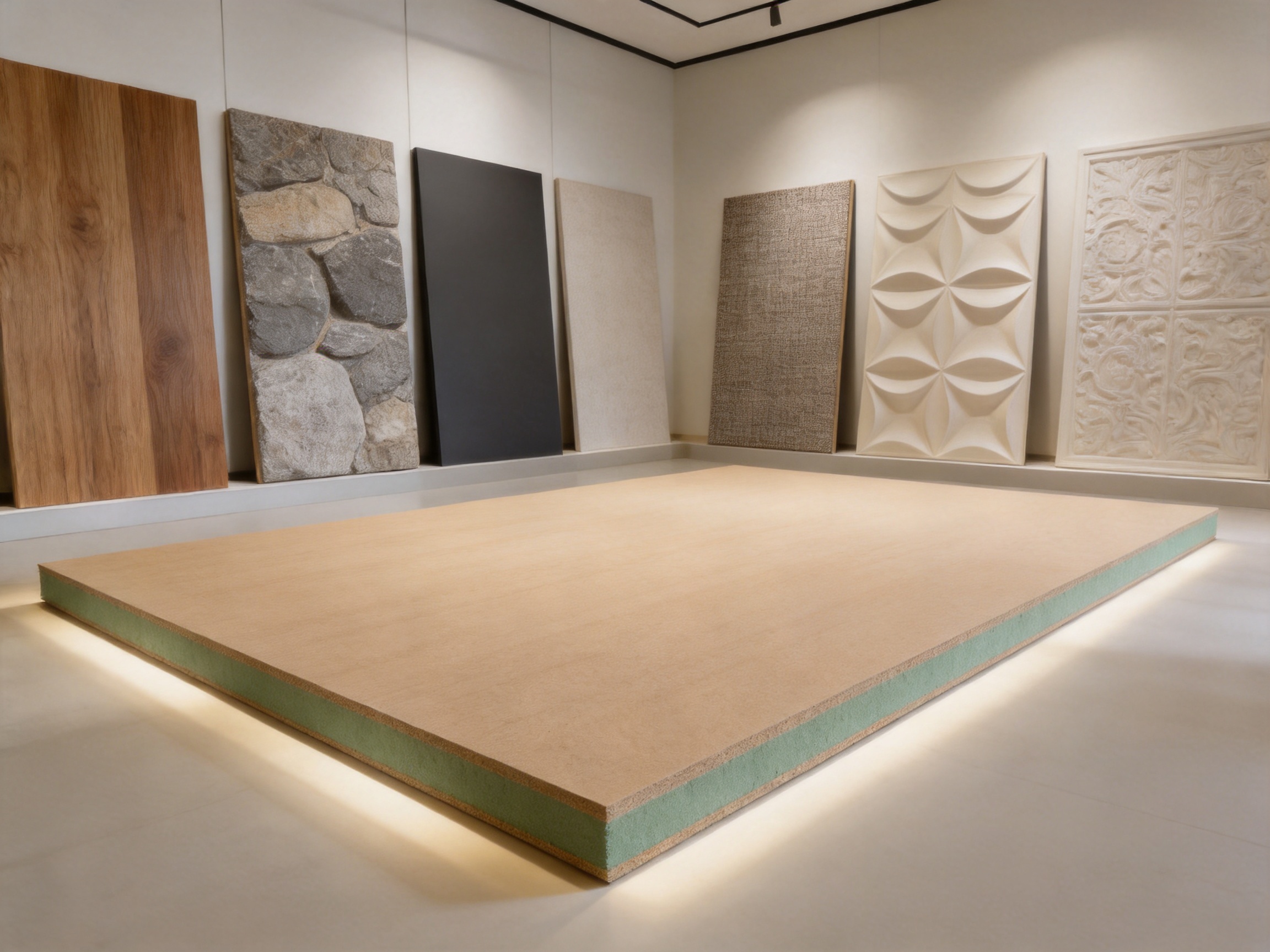
Previous Post
Introduction
Interior surfaces increasingly need to do more than provide a background. They are expected to create atmosphere, express a design concept, withstand daily use, and support efficient construction. The PZ02 Lychee Leather 3D Wall Panel responds to these requirements by combining a realistic leather-inspired surface with a structured three-dimensional profile and a durable melamine decorative finish. It is designed for residential interiors, hospitality environments, commercial spaces, furniture production, and feature-wall applications where texture and visual quality are important.
The panel reproduces the fine grain, pores, folds, irregularities, and subdued sheen associated with lychee leather. Instead of relying on genuine leather, it uses an engineered board structure and advanced embossing technology to create a repeatable surface with consistent appearance. This makes it a practical alternative for projects that require a luxurious visual effect but also need predictable dimensions, easier maintenance, competitive cost, and stable performance.
Manufactured by YAKCO New Materials (Jiangsu) Co., Ltd., the product belongs to a broader range of decorative melamine boards and wall panels developed for high-end residential and commercial spaces. The company combines deep-pressing technology, multiple core production processes, modern adhesive bonding, and large-scale manufacturing capabilities to produce decorative panels with strong texture, convenient processing characteristics, and improved environmental performance.
This article examines the construction, appearance, manufacturing process, performance advantages, applications, installation considerations, and purchasing value of the PZ02 Lychee Leather 3D Wall Panel. It also explains why a simulated leather surface can be more suitable than natural leather or conventional flat decorative boards for many interior projects.

PZ02 Lychee leather 3D Wall Panel
Product Overview
The PZ02 Lychee Leather 3D Wall Panel is a decorative melamine board with a leather-patterned surface and a three-dimensional embossed structure. Its design is inspired by lychee leather, a material recognized for its small natural pores, soft visual rhythm, gentle irregularity, and refined tactile quality. The pattern is intended to create a warm and sophisticated atmosphere without the visual heaviness sometimes associated with highly polished decorative materials.
The surface combines a graphic pattern with physical relief. This distinction is important. A printed leather image may appear realistic from a distance, but it usually remains visually flat and provides little tactile depth. The PZ02 panel uses embossing to form a deeper texture, allowing light and shadow to move across the surface as the viewing angle changes. This creates a more convincing leather impression and gives walls or furniture components a stronger sense of material authenticity.
The panel is available in several thicknesses and has a standard length and width of 2745 millimeters by 1220 millimeters. The listed thickness options are 9, 12, 18, 22, and 25 millimeters. This range allows designers and fabricators to select a configuration according to the intended use. Thinner versions may be suitable for decorative wall applications where weight and handling are important, while thicker versions can provide additional body and rigidity for furniture, partitions, built-in elements, or more substantial wall assemblies.
The product is offered with different substrate possibilities, including OSB, MDF, and particleboard. The selected substrate can influence machining behavior, screw-holding performance, weight, edge treatment, and overall project cost. Buyers should confirm the exact substrate, thickness, finish, and production specification before placing an order, especially when the panels will be integrated into a custom furniture or wall system.
Key Product Specifications
| Item | Specification |
|---|---|
| Product name | PZ02 Lychee Leather 3D Wall Panel |
| Decorative category | Leather Design Melamine Board |
| Standard panel size | 2745 × 1220 millimeters |
| Available thicknesses | 9, 12, 18, 22, and 25 millimeters |
| Substrate options | OSB, MDF, and particleboard, subject to project confirmation |
| Surface treatment | Three-dimensional embossed melamine leather texture |
| Environmental classification listed | P2/F4 |
| Primary applications | Feature walls, furniture, headboards, hospitality interiors, clubs, and commercial decoration |
Design Concept and Visual Character
The visual idea behind the PZ02 panel is to translate the qualities of leather into a stable architectural surface. Leather is traditionally associated with comfort, craftsmanship, luxury, and warmth. However, genuine leather can be expensive, sensitive to moisture, difficult to apply over large rigid surfaces, and demanding to maintain. A leather-effect decorative board preserves many of the visual benefits while adapting them to wall cladding and furniture manufacturing.
Lychee leather is characterized by a fine, closely arranged grain rather than a large, dramatic pattern. This makes the PZ02 design versatile. It can be used across a broad surface without becoming visually overwhelming, and it can also serve as a refined background for lighting, furniture, artwork, signage, or architectural detailing. The pattern offers enough variation to prevent a wall from appearing plain, while its relatively controlled scale supports coordinated interior compositions.
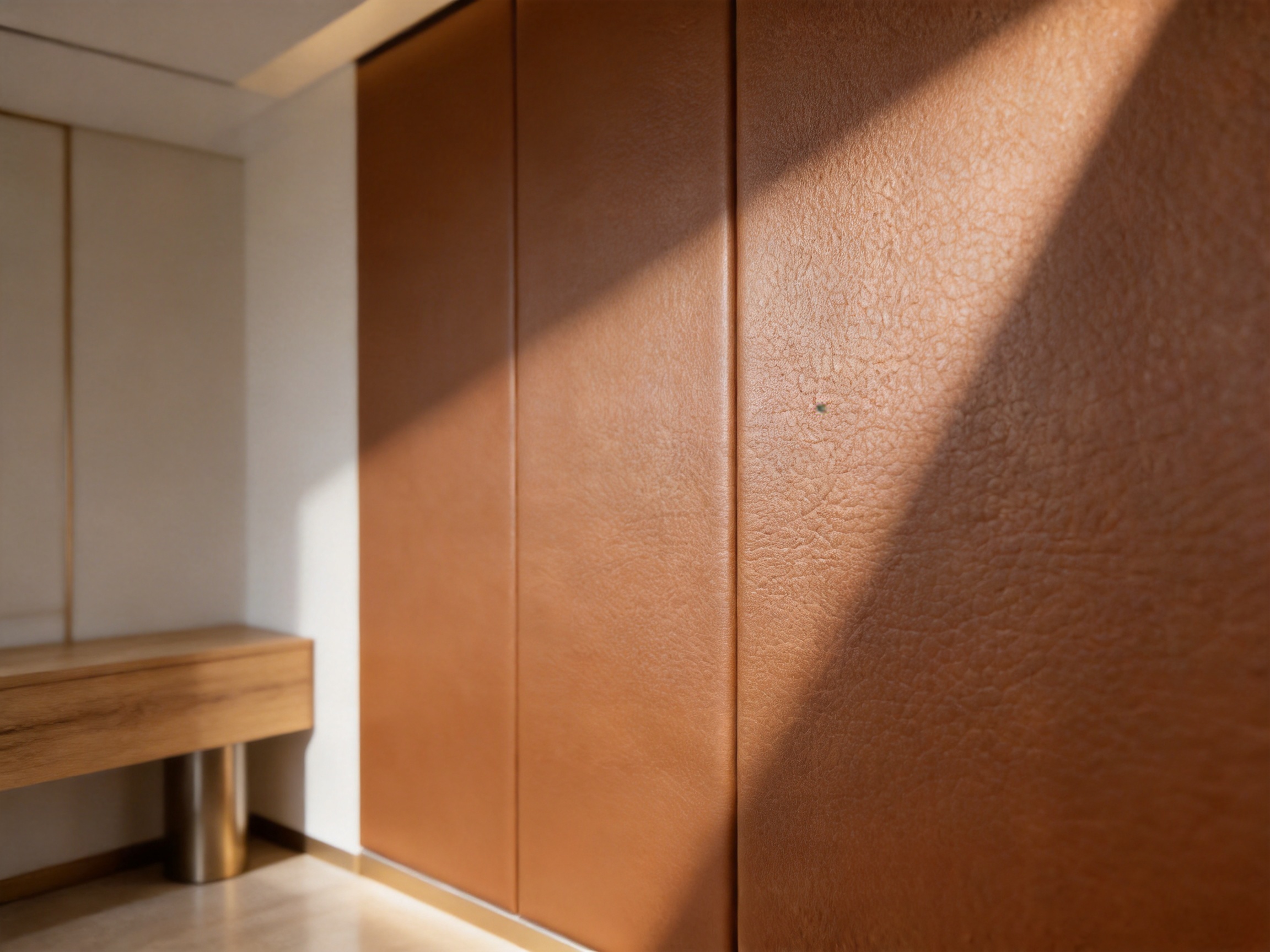
The three-dimensional structure adds another layer of design value. Embossed areas create highlights when exposed to direct or grazing light, while recessed areas produce subtle shadows. Under warm lighting, the surface can appear soft and intimate. Under cooler or brighter lighting, the relief becomes more defined and architectural. This adaptability allows the panel to participate actively in the mood of a space rather than functioning as a passive covering.
The surface may present a matte or gently lustrous effect depending on the selected decorative finish and production specification. A matte appearance generally emphasizes the tactile qualities of the grain and reduces distracting reflections. A controlled sheen can make the surface appear richer and can help highlight the depth of the embossing. Project designers should request finish samples when color, gloss, or lighting coordination is critical.
Because the panel is manufactured rather than individually cut from natural hides, its surface can be produced with greater consistency across a project. Repetition should still be planned carefully, particularly on large feature walls. Panel orientation, joint placement, and the relationship between adjacent grain fields can influence the final appearance. A professional layout can use the regularity of the manufactured texture as a design advantage.
Three-Dimensional Embossing Technology
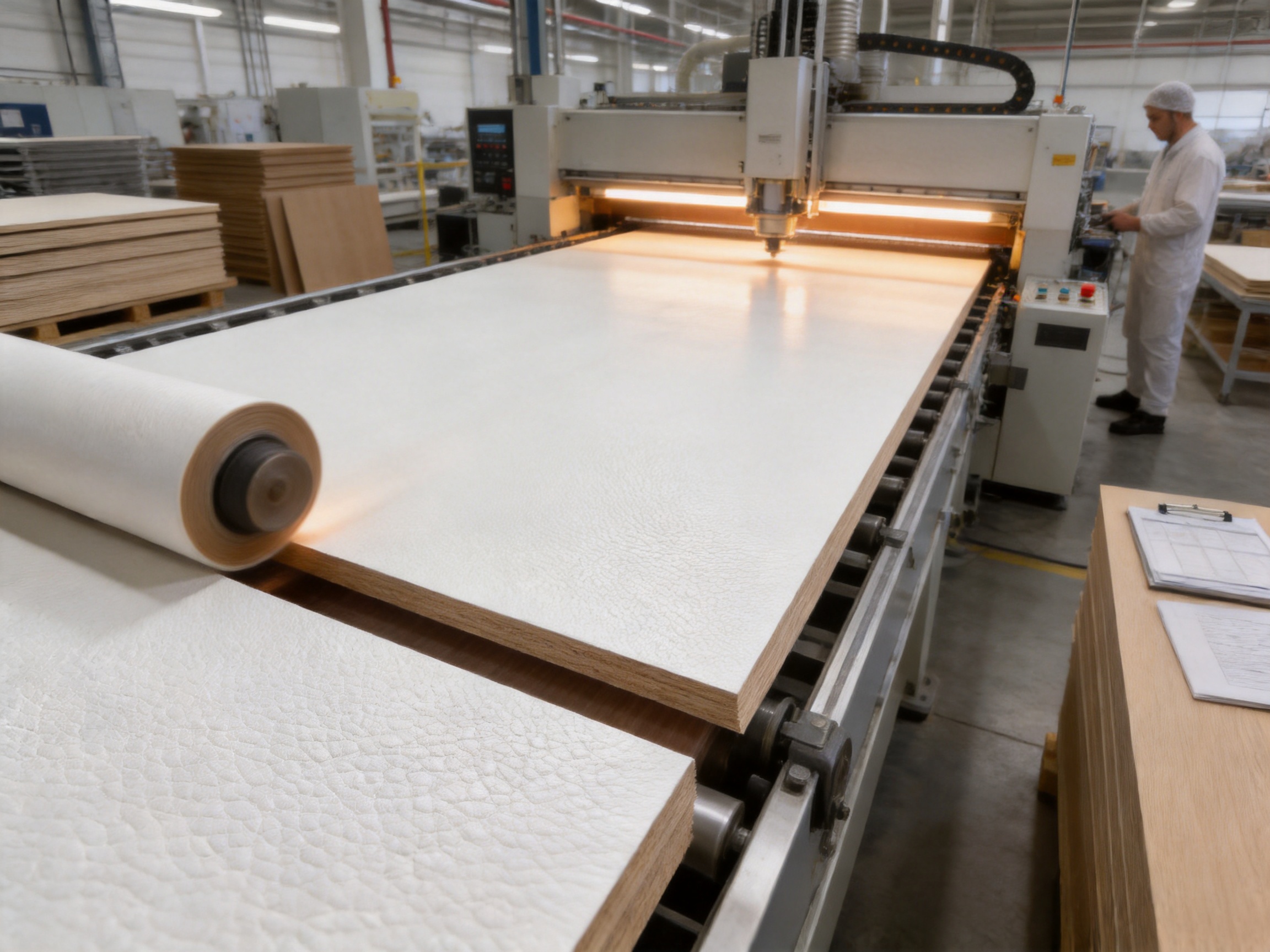
The principal technical feature of the PZ02 panel is its embossed leather grain. The manufacturing process typically begins with the preparation of a high-precision texture mold or embossing roller that contains the desired pattern. The mold reproduces the small pores, grain direction, folds, and surface irregularities associated with leather. During pressing, the decorative layers and substrate are subjected to controlled heat and pressure so that the pattern becomes fixed in the surface.
Precision is essential because leather patterns depend on subtle transitions rather than only on deep lines. If the pressure is too low, the grain may appear weak or incomplete. If it is too high, the pattern may become excessively sharp, the decorative layer may be damaged, or the surface may lose its natural appearance. The production process therefore needs to balance depth, definition, material stability, and visual softness.
Advanced three-dimensional embossing also improves the relationship between appearance and touch. A realistic surface should not only display a pattern; it should respond naturally when viewed and handled. The texture must have an appropriate scale, depth, and spacing. The PZ02 design uses a fine leather-inspired structure that can communicate quality without creating an excessively rough or difficult-to-clean surface.
The embossing process is coordinated with the board substrate and decorative layer. Different substrates respond differently to heat, pressure, moisture, and machining. A technically controlled production line helps reduce inconsistencies such as uneven depth, surface distortion, edge variation, or incomplete bonding. This is particularly important when multiple panels are installed next to one another or when the product is processed into cabinet doors, headboards, wall modules, or custom furniture components.
Hot Pressing Control
Hot pressing is a core stage in the production of the panel. Temperature, pressure, and pressing time must be matched to the composition and thickness of the board. Heat helps soften and activate the relevant layers, allowing them to conform to the embossing structure. Pressure transfers the grain pattern and supports adhesion between the decorative surface and the substrate. Pressing time allows the board to stabilize and retain its intended shape.
These parameters cannot be treated independently. Increasing temperature may shorten the required pressing time, but excessive heat can affect color, resin behavior, or dimensional stability. Increasing pressure may improve grain definition, but excessive pressure can produce unwanted marks or stress in the board. The manufacturer’s process knowledge is therefore a major factor in achieving a deep, clear, and durable leather texture.
For buyers, the benefit of controlled hot pressing is not limited to appearance. A stable process can support more consistent panel flatness, stronger layer bonding, longer-lasting texture, and improved production repeatability. In commercial projects, these qualities help reduce installation problems and make it easier to maintain a consistent finish across multiple rooms or buildings.
Product Structure and Raw Materials
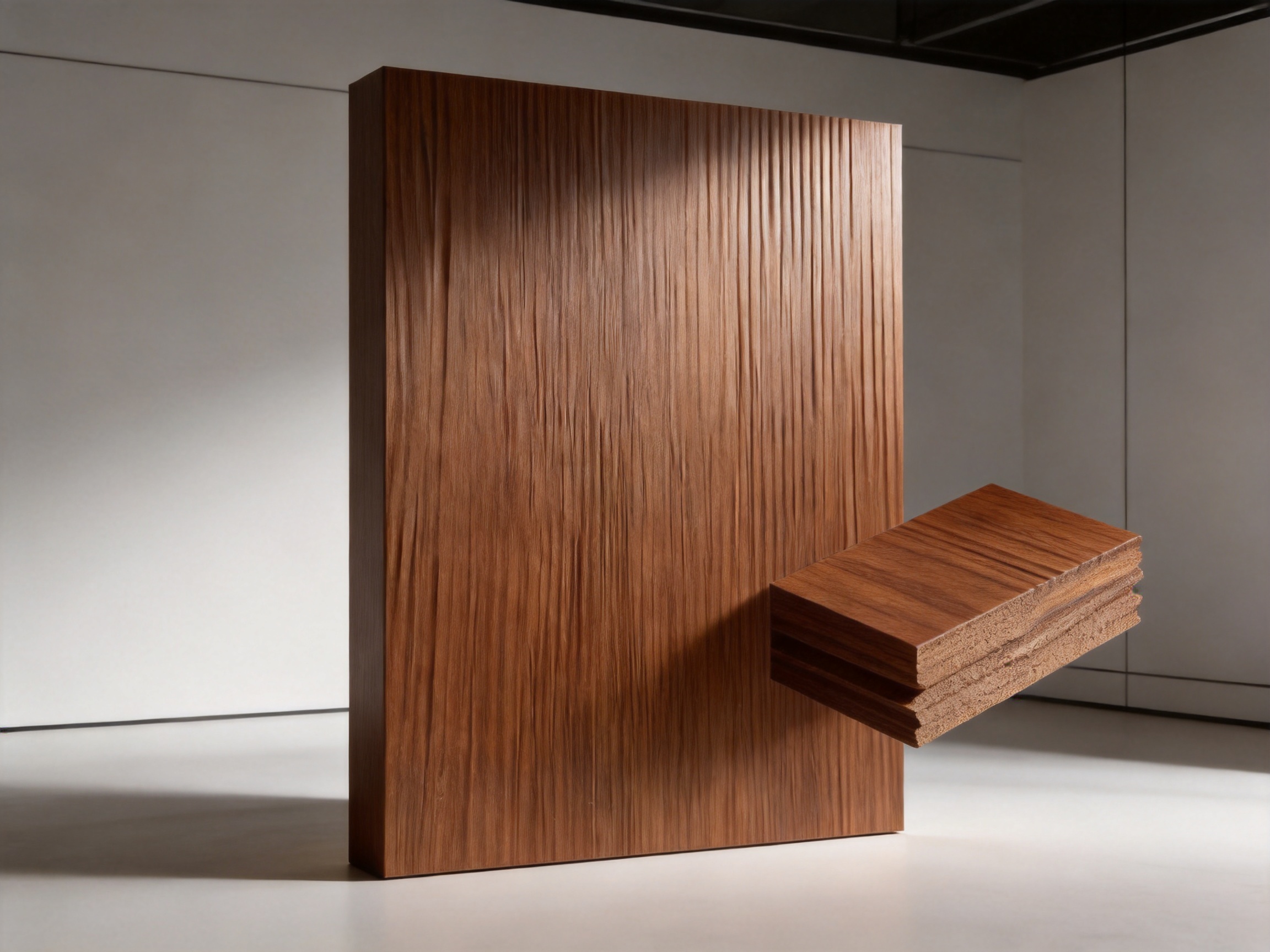
The PZ02 panel may be understood as a layered decorative board. Its structure can include a core substrate, a strengthening or bonding interface, and a leather-patterned surface layer. The exact structure depends on the selected board type and production specification. OSB, MDF, and particleboard each offer different physical characteristics and may be chosen for different project requirements.
MDF is commonly selected when a relatively smooth and uniform machining surface is important. It can be suitable for shaped furniture components, decorative panels, routed edges, and applications requiring controlled finishing. Particleboard can offer an economical solution for many interior uses, particularly when the board will be supported by a frame or installed as part of a larger system. OSB provides a different structural profile and may be considered where its panel characteristics and visual or engineering requirements are appropriate.
High-quality adhesives are important because the decorative surface must remain firmly attached to the substrate during cutting, installation, and long-term use. Weak or uneven bonding may lead to bubbling, delamination, edge lifting, or surface failure. The production information indicates that YAKCO uses MDI medical adhesive bonding in its broader panel manufacturing processes. This reflects an emphasis on strong layer integration and environmental performance, although the exact adhesive formulation and certification should be confirmed for each product order.
The decorative layer is responsible for both the visual effect and part of the surface protection. Melamine-based finishes are widely used in interior panels because they can provide a hard, cleanable, and wear-resistant surface when correctly manufactured and properly used. The combination of melamine decoration and three-dimensional pressing enables the PZ02 panel to deliver a textured appearance without requiring a separate leather covering operation at the installation site.
The board’s layered construction also makes it suitable for repeatable industrial production. Natural leather varies in color, grain, thickness, and surface condition. A manufactured decorative panel can offer more predictable size and texture, which is valuable when a project requires many coordinated panels. The use of standardized sheets can simplify estimating, cutting plans, prefabrication, transport, and installation sequencing.
Advantages Compared with Conventional Alternatives
Compared with Genuine Leather
Genuine leather offers a distinctive natural character, but it may not be the most practical surface for every architectural application. Large wall areas require substantial quantities of leather, careful stretching or bonding, and detailed edge treatment. Genuine leather can also be affected by sunlight, humidity, abrasion, stains, and changes in temperature. Its cost may rise significantly when premium hides, custom colors, specialized backing, and skilled installation are required.
The PZ02 panel provides a more economical and structurally convenient way to introduce a leather-inspired appearance. It arrives as a rigid board that can be measured, cut, fixed, and integrated into standard interior construction methods. The melamine surface is easier to wipe and does not require the conditioning routines associated with some natural leather finishes. The panel also avoids the variability of individual hides and can provide a more uniform appearance across a large project.
This does not mean that a decorative board is identical to genuine leather. Natural leather remains unique in touch, aging behavior, and organic variation. The advantage of the PZ02 panel is that it offers a deliberately engineered interpretation of leather, optimized for repeatability, maintenance, wall installation, and furniture production.
Compared with Flat Melamine Boards
Flat melamine boards can provide excellent color and pattern options, but they generally offer less tactile depth. A flat printed surface depends mainly on two-dimensional graphics. The PZ02 panel adds actual relief, helping the surface interact with light and creating a more noticeable sensory experience.
For feature walls, reception areas, headboards, and premium furniture, this additional depth can improve the perceived value of the installation. It can also help divide a large surface into a coherent design element without adding complex applied moldings or multiple layers of decorative material.
Compared with Applied Wall Coverings
Fabric, vinyl, wallpaper, and other flexible coverings can create attractive interiors, but they may require careful substrate preparation and specialized application. Seams, wrinkles, adhesive selection, impact resistance, and future replacement can become important considerations. A rigid three-dimensional panel provides a different installation approach and can be prefabricated before delivery.
The PZ02 board can be used as part of a panelized wall system, allowing designers to coordinate joint lines, reveals, trims, and lighting details in advance. This can improve construction organization and reduce wet trades on site. The final result depends on correct support conditions and installation workmanship, but the material itself is designed for efficient panel fabrication.
Durability, Maintenance, and Daily Use
A primary benefit of a melamine decorative surface is the relative ease of routine cleaning. Dust can generally be removed with a soft, dry cloth, while ordinary surface marks may be addressed with a lightly dampened cloth and a mild cleaning solution. The embossed pattern should be cleaned gently so that dirt is not pushed into recessed areas. Abrasive pads, harsh solvents, excessive water, and aggressive scrubbing should be avoided unless specifically approved by the manufacturer.
The leather grain provides visual variation that can help disguise minor dust or everyday marks more effectively than a completely smooth, high-gloss surface. However, the panel should not be treated as immune to damage. Sharp objects, heavy impact, prolonged moisture exposure, and excessive heat may affect the decorative layer or substrate. In areas subject to high traffic, designers should consider protective detailing, suitable edge treatments, and an appropriate installation method.
Durability also depends on the substrate and the environment. Interior spaces with stable humidity and temperature are generally more suitable than exposed outdoor locations or areas with direct water contact. Kitchens, bathrooms, spas, and other humid environments require careful specification. The product should be installed according to the supplier’s technical guidance, with adequate ventilation, suitable clearances, and protection from standing water.
When properly specified and maintained, the panel can offer a long service life with limited routine care. Its engineered construction provides greater consistency than many natural coverings, while its decorative surface helps retain the intended visual character over time. To preserve the appearance, furniture and wall components should be protected during construction, and the panels should be stored flat in a clean, dry environment before installation.
Environmental and Indoor Air Considerations
The listed environmental classification for the product is P2/F4. These classifications relate to board performance and formaldehyde emission requirements under relevant standards and should be interpreted according to the applicable testing system. Buyers should request current technical documents, test reports, and certification details for the exact substrate and production batch when environmental compliance is a project requirement.
YAKCO’s company information also states that its products are developed toward international ENF formaldehyde performance. Since environmental ratings can vary according to product construction, substrate, adhesive, market, and certification scope, project teams should distinguish between general company capabilities and the verified rating of a specific PZ02 configuration.
Responsible material selection involves more than a single label. It includes the substrate composition, adhesive system, production controls, packaging, transportation, installation method, and expected service life. A durable surface that remains attractive for many years may reduce the frequency of replacement and the material consumption associated with renovation. The PZ02 panel’s stable manufactured format can also support efficient cutting plans and reduce waste when layouts are prepared carefully.
For green-building projects, the product should be evaluated together with the full wall or furniture assembly. Designers may need information about recycled content, sourcing, indoor air emissions, fire behavior, moisture resistance, waste handling, and end-of-life options. The manufacturer or distributor should provide the appropriate documentation for the destination market and project specification.
Manufacturing Strengths and Quality Focus
YAKCO New Materials (Jiangsu) Co., Ltd. was established in 2007 and operates on a site of approximately 50 acres, with a modern standard factory building covering more than 30,000 square meters. This scale supports the development and production of decorative panels for both residential and commercial applications. It also provides a foundation for coordinating product research, tooling, pressing, quality control, storage, and order fulfillment.
The company focuses on high-end decorative panels and wall panels, with particular attention to three-dimensional surface technology. Its manufacturing approach includes innovative deep-pressing processes and six core production processes. For a textured product such as the PZ02 panel, this process-oriented structure is important because the final appearance depends on the coordination of substrate preparation, decorative layer handling, mold precision, hot pressing, cooling, trimming, inspection, and packaging.
Deep pressing is one of the areas that distinguishes a three-dimensional decorative board from an ordinary printed panel. The process must create sufficient relief while preserving surface integrity and dimensional stability. A manufacturer with dedicated experience in deep embossing is better positioned to manage the technical relationship between visual depth, pressing pressure, adhesive performance, and board behavior.
YAKCO also emphasizes MDI medical adhesive bonding within its production capabilities. Strong and stable bonding supports the service performance of multilayer decorative products. It can reduce the risk of separation between the surface and substrate and can contribute to a cleaner, more reliable finish during cutting and installation. As with all technical claims, the exact performance should be confirmed through product-specific documentation.
The company states that its panels are designed to provide enhanced depth, layering, texture, stability, easy cutting, deformation resistance, and environmentally friendly performance. These characteristics are particularly relevant to architects, interior designers, furniture manufacturers, contractors, and distributors who need both visual quality and practical workability.
The YAKCO brand was established in 2016 and continues to focus on decorative solutions for residential and commercial spaces. Its manufacturing background and specialized product direction provide a useful advantage when buyers are looking for more than a generic flat board. The combination of research, production capacity, tooling knowledge, and decorative-panel specialization supports consistent product development across multiple design categories.
Applications in Residential Interiors
Feature Walls
The PZ02 panel can transform a plain wall into a tactile focal point. It is suitable for living rooms, bedrooms, private studies, entrance areas, and entertainment spaces where a warm and refined surface is desired. A full-height installation can create a strong architectural backdrop, while a partial installation can frame a television, fireplace, seating area, artwork, or storage wall.
Designers can combine the panel with concealed lighting, timber trims, metal details, stone, glass, or painted surfaces. Grazing light from above or the side can emphasize the three-dimensional grain. Softer front lighting can create a more subdued effect. The panel can therefore support both dramatic and understated interior concepts.
Bedrooms and Headboards
The leather-inspired pattern is particularly appropriate for bedroom headboards and feature walls. Its visual warmth can make a room feel more comfortable and layered, while the rigid board format provides a clean, built-in appearance. A headboard can be designed as a single panel, a series of aligned modules, or a framed composition that integrates bedside tables and lighting.
Because the panel is easier to clean than many fabric surfaces, it can be attractive for hospitality bedrooms, serviced apartments, and residential projects where maintenance efficiency matters. Designers should still consider edge protection and impact risks around beds, furniture, and circulation areas.
Cabinetry and Furniture
The PZ02 surface can be used for selected furniture elements, cabinet fronts, wardrobe doors, reception desks, shelving back panels, and decorative partitions. Its application should be planned around the chosen substrate and thickness. Machining tests are recommended before large-scale production, especially when routing, drilling, edge-banding, or cutting through a deeply embossed area.
Furniture manufacturers can use the panel to introduce a luxury material effect without applying separate leather sheets to each component. This may simplify production and create better consistency between doors, side panels, drawer fronts, and adjacent wall surfaces.
Applications in Hospitality and Commercial Spaces
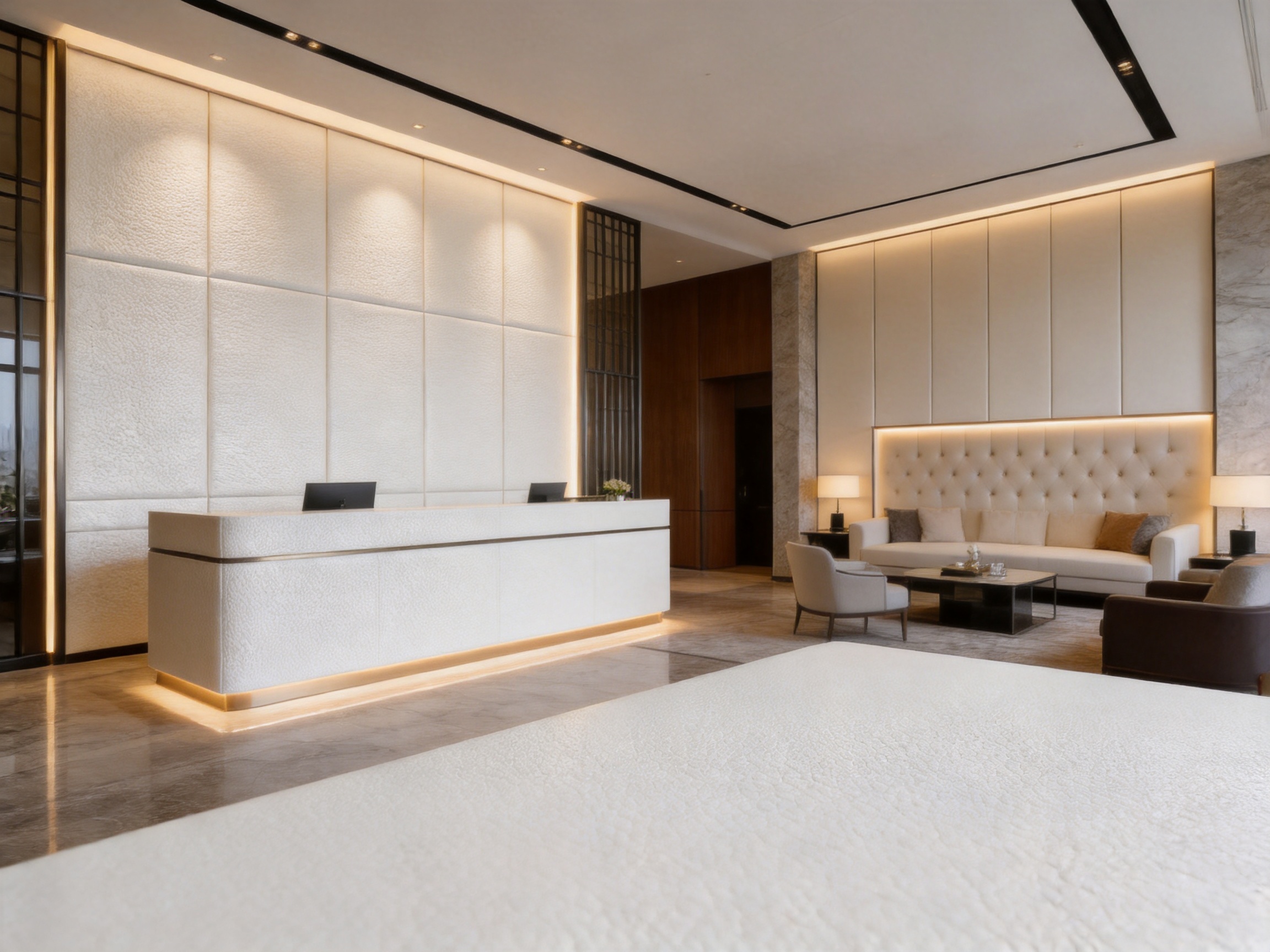
Hotels, clubs, restaurants, offices, showrooms, and executive reception areas often require materials that communicate quality immediately. A three-dimensional leather texture can support brand-neutral luxury, comfort, and sophistication. It can be used behind reception counters, in elevator lobbies, along corridors, inside lounges, or as a backdrop for signage and artwork.
In hospitality spaces, panelized construction can assist with project coordination. Wall modules can be prepared off site, delivered in sequence, and installed with planned joints and trims. This can be useful when schedules are tight or when multiple rooms need a consistent finish. The panel’s standard size also supports quantity estimation and production planning.
Commercial designers should evaluate the expected level of use, cleaning frequency, fire regulations, and impact exposure. If the product is intended for a public building, the project team should obtain the necessary fire, emissions, structural, and surface-performance documentation for the target jurisdiction. The decorative appearance is only one part of a successful commercial specification.
Installation and Fabrication Guidance
Before installation, panels should be inspected for damage, shade variation, edge condition, and surface consistency. They should be stored flat, supported evenly, and protected from moisture, direct sunlight, and construction dust. Acclimatization may be required depending on the substrate, climate, and installation environment. The installer should follow the supplier’s technical recommendations rather than relying on general board-handling assumptions.
The supporting wall or frame must be sufficiently flat, dry, clean, and structurally capable of carrying the panel system. Uneven support can transmit stress to the board and create visible alignment problems. For large panels, the installation team should plan lifting, temporary support, fixing points, joint treatment, and expansion considerations before work begins.
Cutting should be carried out with sharp, suitable tools and appropriate dust extraction. The correct blade and feed speed depend on the substrate and thickness. Poor tooling can cause chipping, overheating, rough edges, or damage to the decorative surface. When the panel is cut, exposed edges may require sealing, edging, framing, or another protective treatment according to the design and environmental conditions.
Joint design has a major influence on the final result. Panels can be installed with narrow joints, shadow gaps, trims, or framed divisions. The selected approach should account for dimensional movement, visual alignment, access to services, and maintenance. On a large feature wall, the layout should be dry-fitted or digitally coordinated to ensure that grain direction and major visual lines are balanced.
Adhesive fixing, mechanical fixing, or a combined system may be appropriate depending on the substrate, wall condition, panel weight, and project requirements. Mechanical fasteners should be positioned carefully to avoid visible damage and should be compatible with the panel and support structure. Installation products should be tested for adhesion, compatibility, curing behavior, and potential staining before broad use.
Purchasing and Specification Considerations
When requesting a quotation, buyers should identify the product code, surface design, panel dimensions, thickness, substrate, quantity, finish, edge requirements, packaging method, and destination market. The available price information is associated with different thicknesses, but final pricing may vary according to order volume, customization, packaging, freight, taxes, and other commercial terms.
Sample approval is strongly recommended. A physical sample allows the design team to evaluate color, grain depth, sheen, touch, edge appearance, and compatibility with other materials. Photography and digital screens may not accurately represent the relationship between the leather pattern and the lighting environment.
Buyers should also confirm production lead time and repeat-order consistency. If the product is being used across several phases, it is useful to discuss batch control, color tolerance, replacement panels, and reserve stock. Large commercial projects may benefit from approving a master sample and retaining a reference piece for quality comparison during delivery.
Technical documents should cover the selected substrate, formaldehyde or indoor-air classification, surface performance, recommended cleaning method, allowable environmental conditions, cutting guidance, and installation limitations. Where the panel will be used in regulated public spaces, additional fire and building-code documentation may be required.
Why the Product Offers Competitive Value
The competitive value of the PZ02 Lychee Leather 3D Wall Panel comes from the balance between appearance, manufacturing efficiency, and practical performance. It offers a distinctive leather-inspired texture without the cost and installation complexity of applying genuine leather over large rigid surfaces. It provides more tactile depth than a standard flat decorative board, while retaining the dimensional predictability needed for panel fabrication.
The product can also reduce the number of separate operations required to achieve a premium finish. Instead of installing a structural board, adding a separate leather covering, applying protective treatment, and completing detailed edge work, the decorative effect is integrated into a manufactured panel. This can simplify coordination between designers, furniture makers, contractors, and installers.
Its range of thicknesses supports multiple design scenarios, from lightweight decorative cladding to more substantial furniture or partition components. The availability of OSB, MDF, and particleboard options can help buyers match the board to machining, budget, structural, and application needs. The final choice must be confirmed with the supplier, but the range creates useful specification flexibility.
Most importantly, the panel is supported by a manufacturer that specializes in three-dimensional decorative surfaces. Experience with deep pressing, precision molds, multilayer bonding, and high-volume production can be more valuable than a low initial price when project quality, repeatability, and delivery reliability are important.
Frequently Asked Questions
What is the PZ02 Lychee Leather 3D Wall Panel?
It is a decorative melamine board with a three-dimensional embossed surface designed to reproduce the fine grain and visual character of lychee leather. It is intended for wall decoration, furniture, headboards, commercial interiors, and other applications requiring a warm, textured finish.
What panel sizes are available?
The listed standard size is 2745 by 1220 millimeters. Available thicknesses are 9, 12, 18, 22, and 25 millimeters. Buyers should confirm current availability and exact tolerances before ordering.
Which substrates can be used?
The product information lists OSB, MDF, and particleboard as substrate options. The most suitable substrate depends on the intended use, machining method, weight requirements, and budget. The selected substrate should be specified clearly in the purchase order.
Is the surface real leather?
No. The product uses an engineered decorative surface that simulates the appearance and texture of leather. This provides a consistent, easier-to-maintain, and more economical alternative for many wall and furniture applications.
How is the three-dimensional texture created?
The surface is formed through controlled embossing and hot pressing. Precision molds or related embossing equipment transfer the leather-inspired grain into the decorative layer while heat, pressure, and time stabilize the board structure.
Is the panel suitable for wet areas?
The panel is primarily intended for interior decorative use. It should not be assumed suitable for direct water exposure, outdoor installation, or continuously humid conditions without written technical confirmation. Wet-area use requires careful review of the substrate, edges, joints, ventilation, and installation system.
How should the panel be cleaned?
Routine cleaning can generally be performed with a soft dry cloth or a lightly dampened cloth and mild cleaning solution. Abrasive cleaners, aggressive solvents, excessive water, and rough scrubbing should be avoided. Always test a cleaning method on an inconspicuous area first.
Can the panel be cut and machined?
Yes, the product is designed as a board material and can generally be cut or processed with suitable tools. However, machining results depend on the substrate and thickness. Fabricators should conduct a trial cut and use proper dust extraction, sharp tooling, and protective procedures.
What environmental rating is listed?
The product information lists P2/F4. The exact meaning and applicability should be verified against current test reports and the requirements of the destination market. The selected substrate, adhesive system, and production specification should all be included in the documentation review.
What makes the product different from a flat melamine board?
The primary difference is the physical depth of the embossed leather texture. A flat board mainly provides a printed visual pattern, while the PZ02 panel combines graphic appearance with tactile relief, stronger light-and-shadow variation, and a more material-like surface effect.
Where is the product manufactured?
The product is manufactured by YAKCO New Materials (Jiangsu) Co., Ltd. in Changshu City, Jiangsu, China. The company operates a modern factory and specializes in decorative boards and wall panels for residential and commercial applications.
How can buyers request more information?
Buyers can contact the manufacturer for samples, current quotations, technical documentation, substrate confirmation, production lead times, and project-specific recommendations. The company contact information provided for this product includes the email address yakco@jsix.com and telephone number +86-13358024856.
Conclusion
The PZ02 Lychee Leather 3D Wall Panel is a practical interpretation of a luxurious material. Its fine leather-inspired grain, three-dimensional embossing, engineered board structure, and melamine surface create a decorative solution that is visually refined, repeatable, and easier to maintain than many traditional leather applications.
Its advantages are particularly clear in projects that require a strong tactile identity without the cost, variability, and installation complexity of genuine leather. Compared with flat decorative boards, it offers greater depth and stronger interaction with lighting. Compared with flexible wall coverings, it provides a rigid, panelized format that can support prefabrication and coordinated installation.
The product is available in several thicknesses and can be produced with OSB, MDF, or particleboard substrates according to project needs. Its performance is supported by manufacturing capabilities that include deep pressing, precision surface formation, multilayer bonding, and large-scale decorative-panel production. YAKCO’s experience in three-dimensional panel technology and its focus on residential and commercial materials make it a suitable manufacturing partner for designers, distributors, furniture producers, and construction professionals seeking a distinctive textured finish.
Successful use depends on correct specification, sample approval, suitable storage, professional fabrication, and installation appropriate to the substrate and environment. When these factors are properly managed, the PZ02 panel can add warmth, sophistication, and tactile character to walls, furniture, bedrooms, hotels, clubs, reception spaces, and other contemporary interiors.
References
1. Product specification information for PZ02 Lychee Leather 3D Wall Panel, including dimensions, thickness options, substrate options, and environmental classification.
2. Manufacturer-provided company profile for YAKCO New Materials (Jiangsu) Co., Ltd., including factory capacity, product focus, deep-pressing technology, and adhesive bonding information.
3. General technical principles of melamine decorative boards, engineered wood panels, hot pressing, and three-dimensional embossing.
4. General interior design and construction guidance for decorative wall panels, furniture boards, surface cleaning, storage, and installation planning.
5. General environmental assessment principles for engineered wood products, formaldehyde emission classifications, adhesive systems, and indoor material selection.