中文简体



Previous Post
In contemporary interior design, material selection is no longer based only on color, thickness, or price. Designers, manufacturers, and property owners increasingly look for surfaces that combine visual character, tactile quality, durability, processing efficiency, environmental responsibility, and consistent supply. The PZ02 Leather2 Texture Panel responds to this demand by bringing the visual warmth and refined touch of leather to a stable melamine-faced panel format.
PZ02 is a decorative panel inspired by natural leather. Its surface reproduces the fine pores, soft irregular wrinkles, subtle grain, and gentle friction associated with leather, while avoiding many of the maintenance and cost challenges of genuine leather. It is not intended to imitate leather in every respect or replace genuine leather in applications where natural material is essential. Instead, it translates the most desirable aspects of leather into a panel material that can be cut, drilled, installed, and edge-banded like a conventional board.
This combination gives PZ02 a distinctive position in the decorative materials market. Compared with smooth melamine boards, it offers greater tactile depth and a more sophisticated visual effect. Compared with genuine leather, it provides easier maintenance, broader construction possibilities, more predictable dimensions, and a lower material cost. Compared with ordinary printed woodgrain or single-color panels, it creates a more expressive surface language for furniture, wall systems, commercial interiors, and hospitality environments.
What Is the PZ02 Leather2 Texture Panel?
PZ02 is a leather-design melamine board manufactured with a decorative surface that recreates the character of natural leather. The finish is based on a lychee leather texture, featuring small pores and softly transitioning creases rather than a flat or mechanically repetitive pattern. The result is a micro-matte surface with visible depth and a warm, tactile quality.
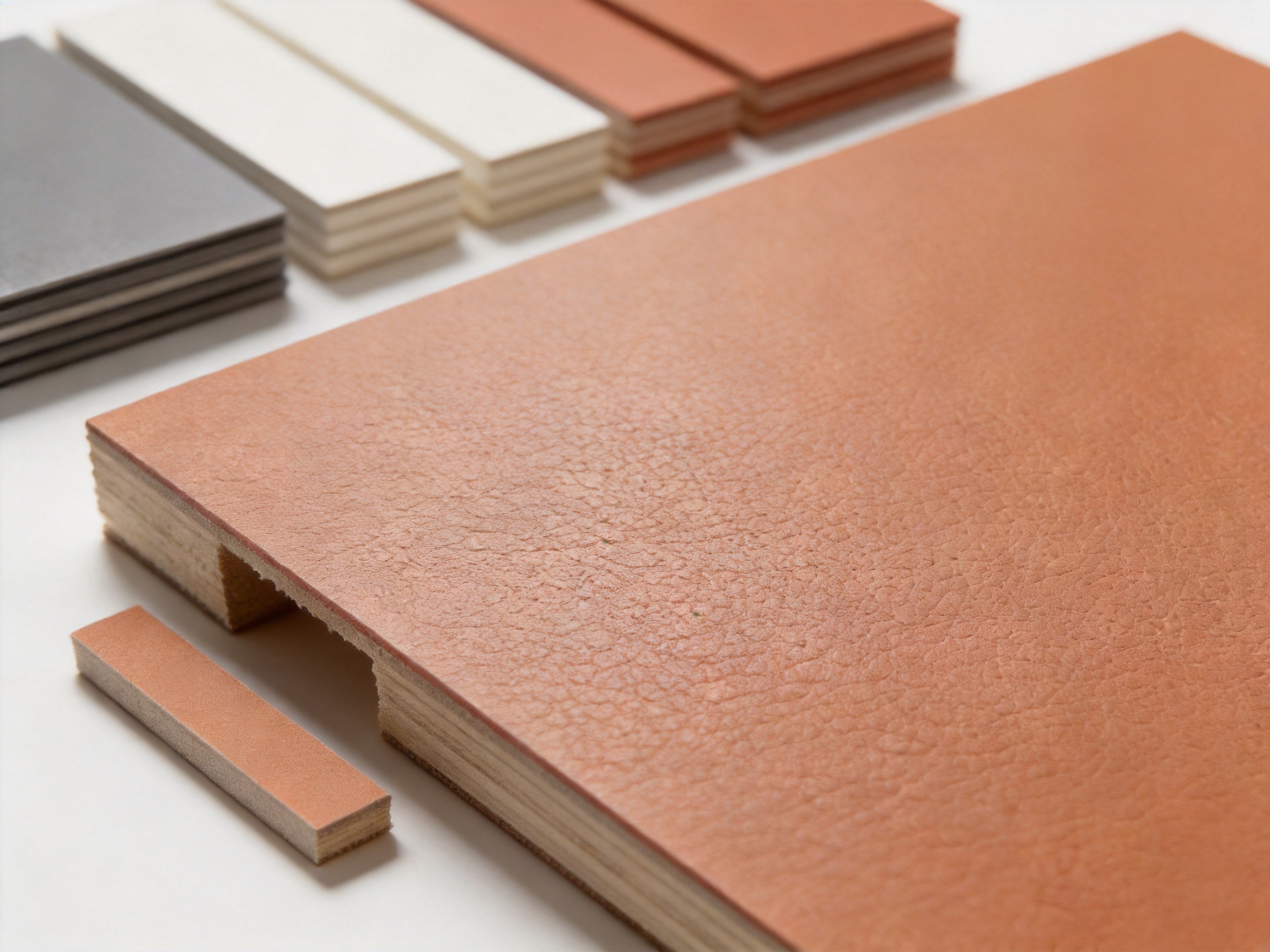
The panel is available with multiple substrate options, including LSB, SOSB, MDF, HMR MDF, particleboard, fire-resistant board, wood veneer, and plywood. Product information also identifies OSB, MDF, and particleboard as common substrate choices. This flexibility allows the same surface design to be adapted for different structural, moisture-resistance, fire-performance, weight, and machining requirements.
Available thicknesses include 1.5 mm, 9 mm, 12 mm, 18 mm, 22 mm, and 25 mm in the product specifications. The commercial size information lists 9 mm, 12 mm, 18 mm, 22 mm, and 25 mm panels in a standard 2745 mm by 1220 mm format. Additional dimensions include 2800 mm, 3050 mm, and 3300 mm lengths, depending on production requirements and order arrangements.
The decorative surface is made from melamine-impregnated paper. During the manufacturing process, the paper design is pressed and bonded to the selected board substrate. The result is a ready-to-use decorative panel that does not require upholstery, leather stretching, surface coating at the installation site, or complicated finishing procedures.
Matching edge-banding strips are available in widths such as 26 mm and 56 mm. These edge-banding options are designed to coordinate with the panel’s color, texture, and gloss level, helping fabricators achieve a visually continuous appearance across doors, shelves, cabinet sides, partitions, and other components.
The Design Philosophy Behind a Leather-Texture Panel
Every decorative material communicates a different sensory message. Wood is often associated with warmth, nature, and authenticity. Metal suggests precision, coolness, and technical strength. Stone conveys permanence and weight. Solid colors provide clarity and visual restraint. Leather introduces a different combination of sophistication, softness, friction, and understated luxury.
The attraction of leather is not limited to its appearance. A leather surface changes subtly as light moves across it. Its pores create small variations in reflection. Its grain provides a gentle resistance under the fingertips. Its warmth and flexibility can make furniture feel more personal and inviting. These qualities explain why leather is frequently used in executive offices, luxury vehicles, boutique hotels, premium retail spaces, and high-end residential interiors.
However, genuine leather is not always practical for architectural panels or large areas of built-in furniture. It can be expensive over a large surface. It may require specialist installation and maintenance. Scratches, stains, drying, stretching, and color variation can become concerns. Its use is also often associated with upholstered forms, which may limit the geometry and construction methods available to designers.
PZ02 approaches this challenge as a material translation rather than a simple imitation. It transfers the visual and tactile language of leather to a rigid, dimensionally stable panel. This allows designers to create leather-inspired walls, cabinet doors, counters, desks, and partitions using familiar woodworking processes.
The concept is particularly relevant to the idea of light luxury. Light luxury does not depend on excessive decoration or conspicuous ornament. Instead, it relies on refined materials, carefully controlled color, subtle texture, and details that reveal their quality through use. The PZ02 surface supports this approach by providing a restrained yet recognizable material identity.
Surface Appearance: Fine Pores and Natural Soft Wrinkles
One of the most important characteristics of PZ02 is the relationship between its visual pattern and its tactile texture. The decorative paper is printed with the fine pore structure and irregular wrinkles associated with natural leather. These details are not intended to create a strongly dramatic or artificial relief. Their purpose is to establish a soft, layered surface that changes gently with lighting and viewing distance.
The pore pattern adds visual complexity without becoming overwhelming. From a distance, the panel reads as a sophisticated solid or subtly textured color. At closer range, the surface reveals its fine grain, allowing users to experience a more intimate material effect. This dual reading makes PZ02 suitable for both large architectural applications and small furniture components.
The soft wrinkle pattern contributes to the impression of natural material. Repetitive textures can make decorative panels appear mechanically manufactured, particularly when used across large doors or wall areas. PZ02 is designed around irregular transitions, helping reduce the visual monotony associated with simple repeating prints.
Lighting also plays an important role. The micro-matte surface reduces excessive glare while allowing the texture to remain visible. Under warm bedroom lighting, the panel can appear calm and enveloping. Under office lighting, it can communicate stability and professionalism. In retail interiors, directional lighting can emphasize the subtle movement of the grain and make the background material support the displayed merchandise.
Because the texture is integrated into a melamine-faced panel system, the visual effect is more consistent than many manually applied leather finishes. Large projects can be planned around a repeatable decorative specification, helping designers achieve a coordinated appearance across multiple furniture units and architectural elements.

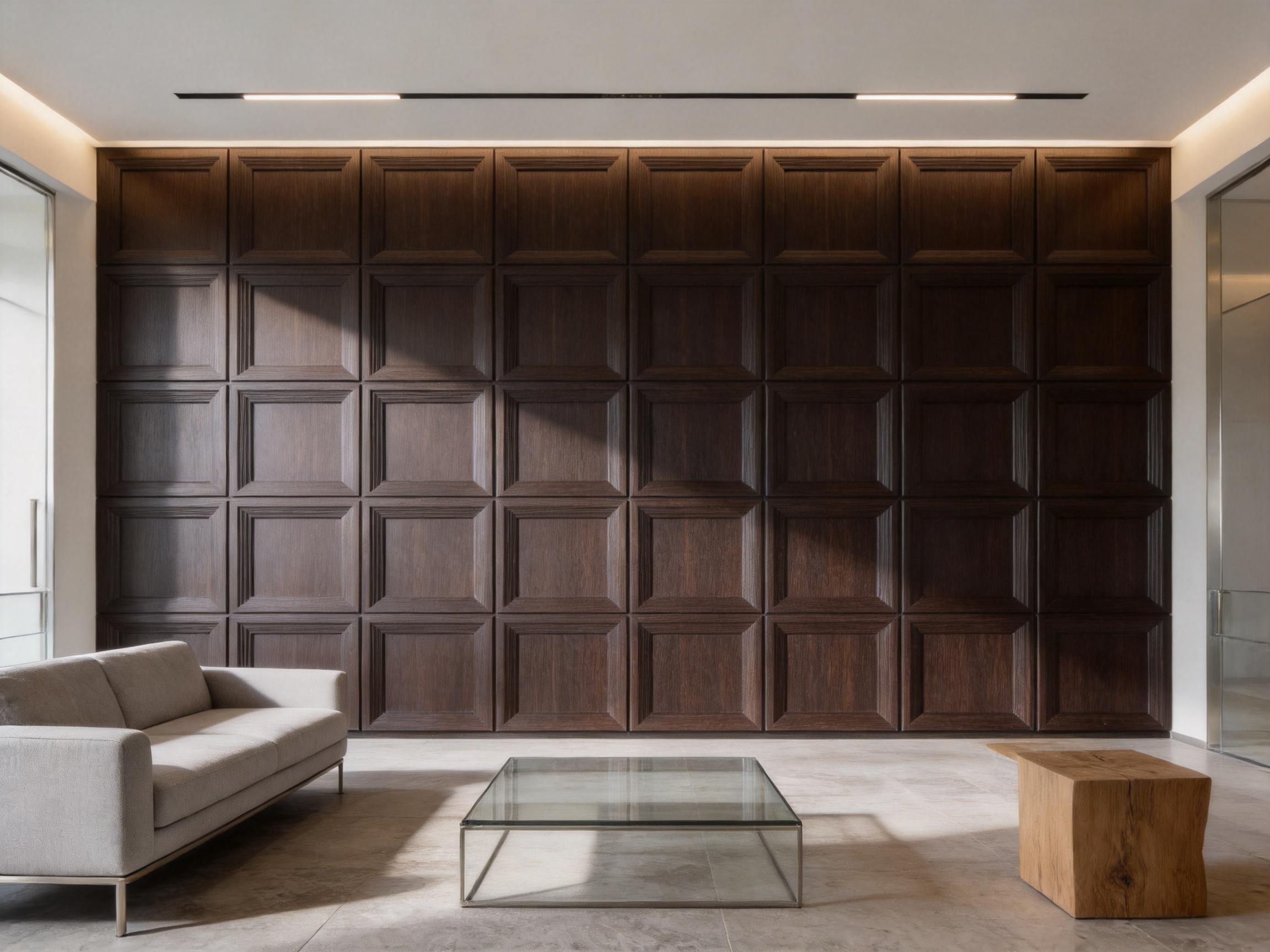
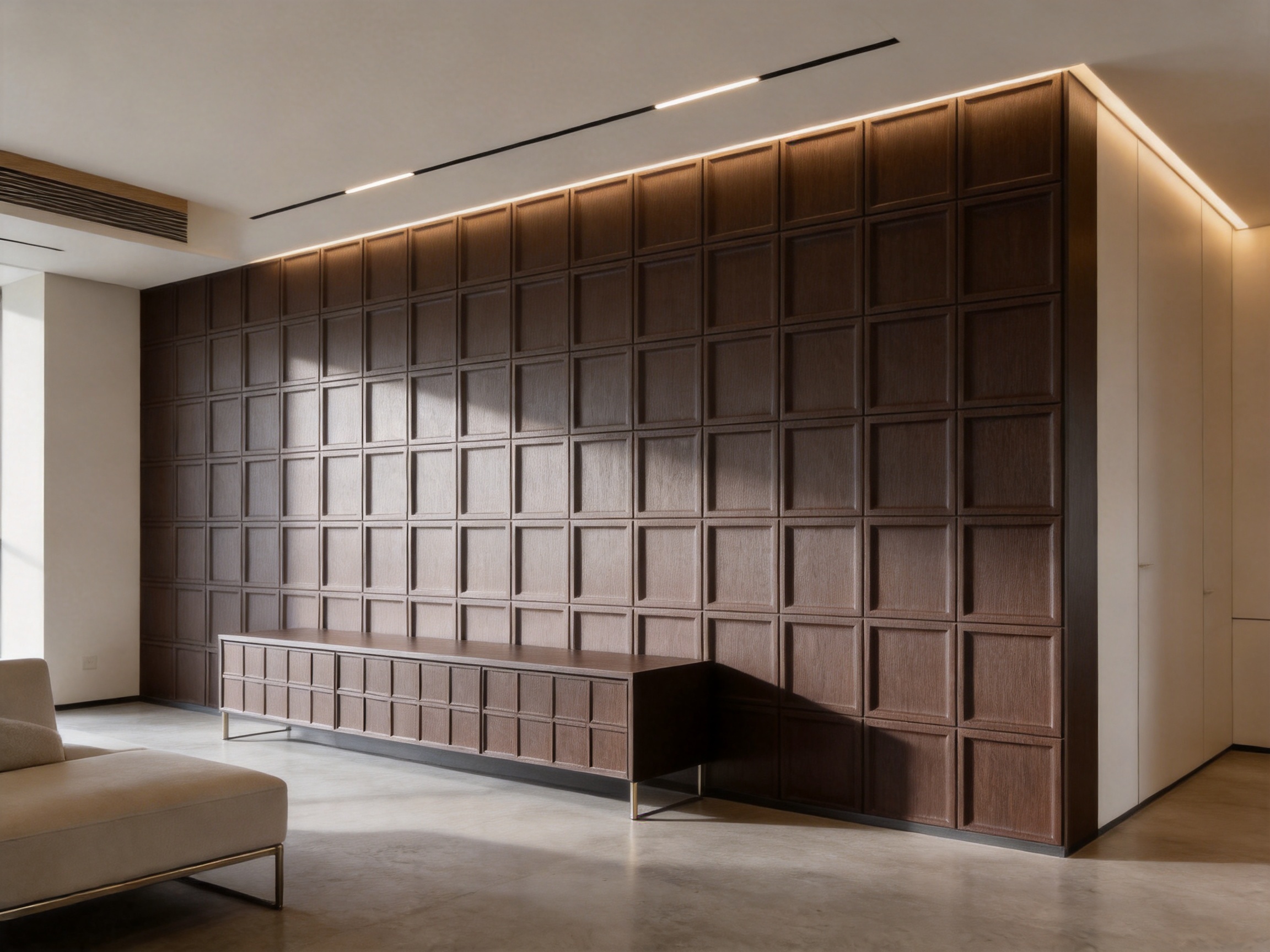
PZ02 Leather2 Texture Panel - Light Luxury
Tactile Comfort and Everyday Usability
A decorative surface is experienced not only through sight but also through touch. This is especially important for furniture that users handle every day, including cabinet doors, drawers, desks, reception counters, headboards, and conference tables. PZ02 is designed to make these interactions feel warmer and more substantial than contact with a completely smooth, hard, or glossy surface.
The leather-inspired surface offers a degree of natural friction. Items placed on a desk or tabletop are less likely to slide than they would on a highly polished finish. Papers, notebooks, folders, and small accessories can remain more stable during normal use. This does not mean that the panel is a non-slip industrial surface, but its micro-texture creates a more controlled contact experience.
The texture can also contribute to writing comfort. On a smooth, hard tabletop, paper may move easily and the wrist may rest directly against a rigid surface. The subtle damping effect of PZ02 creates a more comfortable tactile relationship between the user, the writing material, and the furniture. This makes it appropriate for study desks, executive desks, conference rooms, and home-office environments.
In bedrooms, the same quality can be used on headboard wall panels and bedside furniture. The surface does not have the cold visual impression sometimes associated with stone, glass, or metal. Its leather-like grain introduces a quieter and more enveloping character while retaining the clean geometry of a panel system.
For commercial interiors, tactile quality can influence how visitors perceive a brand. A reception counter with a refined leather texture can appear more considered than one finished in a basic solid laminate. A boutique wall panel can make a display area feel more premium without competing visually with clothing, accessories, or other merchandise.
Durability Compared with Genuine Leather
Natural leather has valuable aesthetic and artistic qualities, but it also requires care. Its surface may be vulnerable to scratches, abrasion, liquid staining, sunlight, temperature changes, and long-term drying. Maintenance procedures vary according to leather type, coating, finish, and use conditions. For large-scale architectural installations, these requirements can create additional operating costs.
PZ02 is designed to provide a more stable and practical surface for daily interior use. The melamine resin layer offers resistance to ordinary scratching, staining, and fingerprints. It also seals the decorative layer, helping prevent moisture and grease from penetrating into the printed surface during normal use.
Unlike untreated or lightly protected leather, the melamine surface does not depend on periodic conditioning to preserve its basic appearance. Routine cleaning can generally be handled with appropriate soft cloths and mild cleaning methods suitable for decorative panels. Abrasive pads, harsh solvents, excessive water, and unsuitable chemical cleaners should still be avoided, as they may damage any decorative surface.
The hard-wearing nature of the finish is particularly valuable on desks, cabinet fronts, public counters, and commercial wall systems. These areas may experience repeated contact with hands, bags, cups, documents, and cleaning activity. A panel that maintains its color and texture under regular use can reduce the need for frequent replacement or refinishing.
It is important to distinguish durability from indestructibility. PZ02 is a decorative panel, not an armor coating. Heavy impact, sharp tools, prolonged moisture exposure, or improper cleaning may still damage the surface. Nevertheless, its melamine finish offers a more practical balance of texture and resistance than many delicate natural finishes.
Color Development for Light-Luxury Interiors
Color is central to the success of a leather-inspired surface. Natural leather is usually associated with nuanced tones rather than extremely bright or highly saturated colors. The PZ02 palette focuses on shades suitable for light-luxury, executive, hospitality, and contemporary residential settings.
Representative color directions include cashmere, smoky gray, off-white, and terracotta. Cashmere tones create warmth without appearing overly yellow. Smoky gray supports modern, business-oriented interiors and can be paired with dark metals, glass, or natural wood. Off-white offers brightness and visual calm while allowing the texture to remain visible. Terracotta introduces warmth and character, making it suitable for feature furniture, boutique displays, and hospitality settings.
Color development involves more than selecting a digital reference. Printed decorative paper, resin, substrate, lighting, and surrounding materials can all influence the perceived result. The PZ02 colors are described as having undergone repeated prototyping and calibration to refine saturation, brightness, and consistency under different lighting conditions.
This controlled approach is useful for projects in which several furniture components must work together. A color that appears attractive on a small sample may look too strong across a full wall or too dull beside a particular floor material. Subtle color calibration helps the final panel remain balanced when installed over a larger area.
Designers should still evaluate physical samples under the actual project lighting. Daylight, warm LED lighting, cool commercial lighting, and indirect illumination can produce different impressions. Sample review is especially important when matching PZ02 with wood, metal, stone, paint, textiles, and upholstery.
Advanced Surface Technology
The primary technical value of PZ02 lies in the controlled relationship between printed design, embossing or texturing, resin protection, and board construction. The product is described as a YAKCO 3D Melamine Board, reflecting a manufacturing approach that emphasizes surface depth and tactile definition rather than relying on a completely flat print.
Each pore is intended to function as an independent indentation, while the soft creases transition naturally across the surface. This approach helps the panel avoid the artificial appearance that can result when a pattern is repeated at a fixed interval. The micro-matte finish also supports the visual depth of the design by controlling reflected light.
The melamine resin layer performs several functions at once. It protects the printed decorative paper, contributes to surface hardness, helps resist ordinary stains, and seals the textured surface against the penetration of moisture and grease during normal use. At the same time, its gloss and light transmission must be carefully controlled so that the underlying leather pattern remains visible.
This balance is technically demanding. A finish that is too glossy may create glare and reduce the sense of softness. A finish that is too opaque may obscure the decorative pattern. A coating that is too thin may not provide sufficient protection, while excessive coating can reduce tactile clarity. The PZ02 concept depends on precise coordination between these factors.
YAKCO New Materials describes its broader manufacturing capabilities as including innovative deep-pressing processes, six core production processes, and MDI adhesive bonding. These technologies are intended to support improved texture depth, structural stability, easy cutting, deformation resistance, and environmental performance. For a leather-textured panel, stable pressing and reliable bonding are particularly important because the final appearance depends on the consistent relationship between the surface layer and the substrate.
Substrate Options and Structural Flexibility
A decorative surface can only perform effectively when it is matched with a suitable substrate. Different projects require different combinations of stiffness, weight, screw-holding performance, moisture resistance, fire behavior, machinability, and cost. PZ02 can be specified on several board types to accommodate these requirements.
Medium-density fiberboard, or MDF, provides a smooth and uniform base that is well suited to cabinet doors, furniture components, wall panels, and detailed machining. Its consistent structure supports clean routing and shaping when the panel design requires grooves, openings, or concealed hardware.
High-moisture-resistant MDF can be considered for interiors where humidity levels may be elevated, subject to the specific board grade and installation conditions. It should not be treated as a substitute for a fully waterproof material, but it can provide an additional level of resistance compared with standard interior MDF in appropriate applications.
Particleboard offers an economical and widely used substrate for cabinetry, shelving, furniture carcasses, and commercial fit-outs. LSB and SOSB options can provide alternative structural properties and may be useful where greater directional strength, screw retention, or panel performance is desired.
Plywood and fire-resistant board expand the product’s suitability for specialized projects. Plywood can be selected where layered structural strength or reduced weight is important. Fire-resistant board may be considered in commercial or public environments with enhanced fire-performance requirements, provided the complete tested system meets the applicable local regulations.
Wood veneer is also listed among the possible base materials. This can be useful when the project requires a particular structural or visual construction strategy, although the exact combination of veneer, decorative paper, and finishing process should be confirmed with the manufacturer before specification.
The range of substrates gives designers greater freedom than a single fixed board construction. Instead of changing the visual concept when a structural requirement changes, the same PZ02 leather texture may be adapted to a different panel core.
Dimensions, Thicknesses, and Edge-Banding
The standard commercial size is listed as 2745 mm by 1220 mm, with additional length options of 2800 mm, 3050 mm, and 3300 mm. These dimensions allow efficient planning for tall cabinet doors, wall panels, partitions, and long furniture elements. Longer boards may reduce the number of horizontal joints in a design, although handling, transportation, lifting, and site access must be considered.
Product specifications identify thicknesses of 1.5 mm, 9 mm, 12 mm, 18 mm, 22 mm, and 25 mm. The 1.5 mm option may be relevant to specific overlay or decorative applications, while thicker boards provide greater rigidity for furniture, doors, counters, and architectural components. The appropriate thickness depends on span, hardware, support spacing, edge treatment, weight limitations, and project standards.
According to the supplied commercial information, listed panel sizes and reference prices include the following:
| Panel Size | Reference Thickness | Reference Price |
|---|---|---|
| 2745 mm × 1220 mm | 25 mm | 56 USD |
| 2745 mm × 1220 mm | 22 mm | 51.60 USD |
| 2745 mm × 1220 mm | 18 mm | 46 USD |
| 2745 mm × 1220 mm | 12 mm | 40 USD |
| 2745 mm × 1220 mm | 9 mm | 36.50 USD |
These figures should be treated as reference information rather than a universal quotation. Final pricing may depend on substrate, thickness, finish, order quantity, edge-banding, packaging, freight, production schedule, and destination.
Matching edge-banding is a significant advantage for a textured product. If a leather-grain door has a plain or mismatched edge, the visual effect can be interrupted. Color-matched and texture-matched edge strips help create a more unified component. The transition between the panel face and the edge can appear smoother, especially on cabinet doors and exposed shelves.
Fabricators should confirm the correct edge-banding width for each component. The listed options of 1 × 26 mm and 1 × 56 mm may serve different panel configurations and edge conditions. Production samples should be checked before large-volume manufacturing.
Processing Efficiency for Furniture and Interior Projects
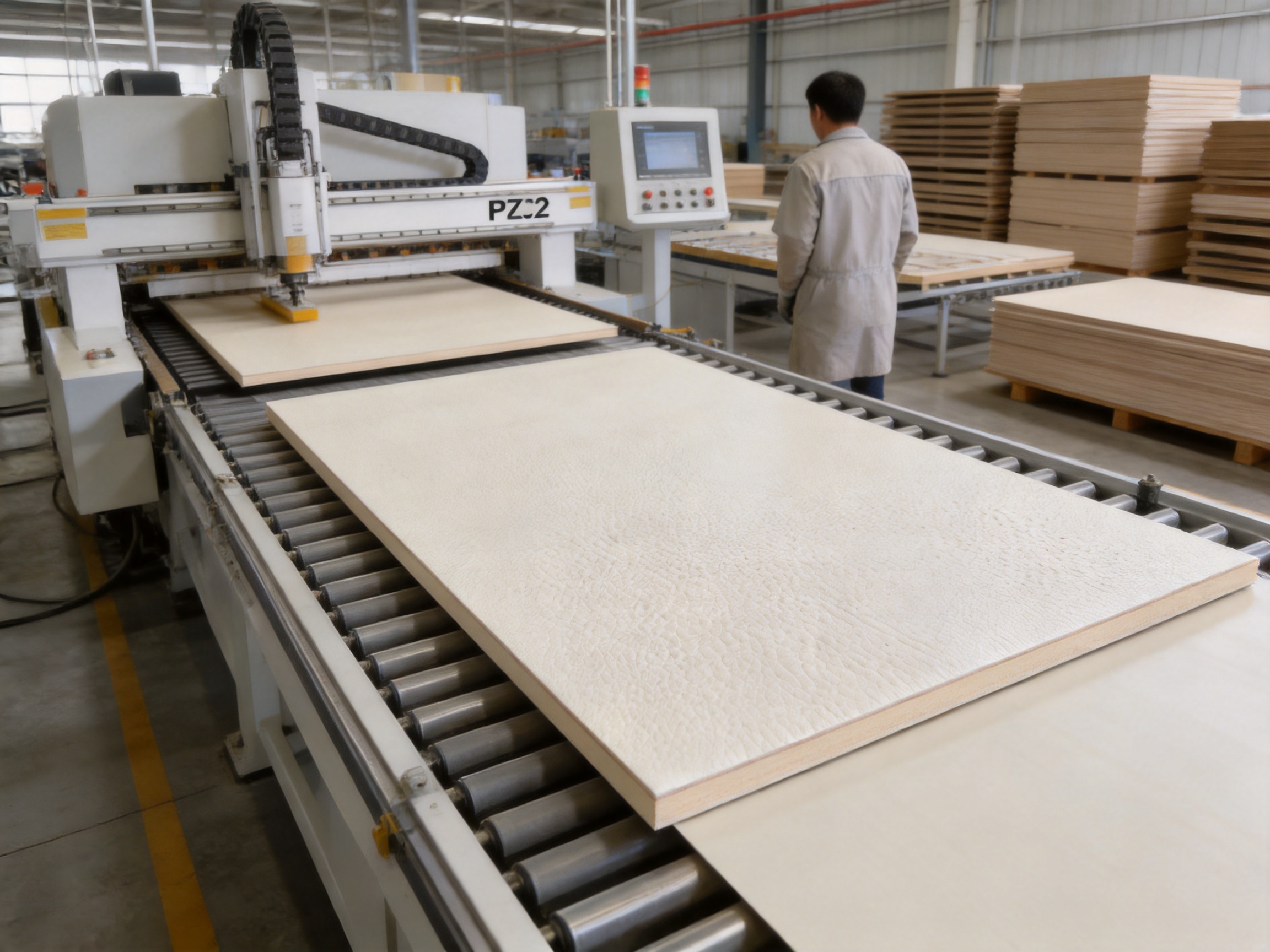
One of PZ02’s strongest competitive advantages is that it can be processed using methods familiar to panel manufacturers and cabinetmakers. Cutting, drilling, routing, assembly, and edge-banding can generally be planned in a manner similar to other melamine-faced boards, subject to the selected substrate and the manufacturer’s processing recommendations.
This is significantly different from a project that uses genuine leather as a surface finish. Genuine leather may require stretching, adhesive selection, sewing, folding, trimming, corner management, and specialist upholstery skills. Curved forms, exposed corners, seams, and large panels can involve additional labor and quality-control challenges.
PZ02 allows designers to use rigid panel geometry without giving up the visual warmth of leather. Cabinet doors can be manufactured with concealed hinges. Shelves can be produced with standard panel construction. Wall panels can be fixed using established installation systems. Desks and partitions can be detailed using conventional joinery and edge treatments.
Normal panel processing does not eliminate the need for care. Sharp tooling, appropriate cutting direction, clean work surfaces, and correct handling remain important. The decorative face should be protected from sliding debris, impacts, and unnecessary abrasion during fabrication. Edge-banding temperatures and pressures should be compatible with the selected strip and panel construction.
For large projects, the availability of familiar processing methods can improve production scheduling. A furniture factory may not need to create a separate upholstery line. A contractor may not need to coordinate a specialist leather installer. A joinery workshop can integrate PZ02 into its existing cutting and assembly workflow after validating the material on sample parts.
Processing efficiency also increases design freedom. Because the material is not restricted to upholstered shapes, it can be used in rectangular, modular, framed, recessed, slatted, or carefully routed compositions. This makes it appropriate for both minimal contemporary interiors and more decorative executive or neoclassical environments.
Applications in Residential Interiors
Wardrobe Doors and Walk-In Closets
PZ02 can give wardrobe doors a refined, furniture-like presence. Large leather-textured doors create a tactile experience each time they are opened or closed. In walk-in closets, repeated doors in cashmere, smoky gray, or off-white can establish the atmosphere of a boutique showroom.
The material is particularly suitable for projects that seek a premium appearance without using upholstered panels. The rigid construction supports concealed hinges, sliding systems, integrated handles, and other standard wardrobe hardware. Matching edge-banding helps maintain the appearance of a continuous leather-inspired surface around the door perimeter.
Bedroom Headboard Walls
Headboard walls benefit from materials that feel warm and calm. PZ02 offers a more textured and substantial alternative to painted drywall or conventional wallpaper. Its leather-like grain can soften the visual impression of a large wall while maintaining a clean architectural composition.
In a bedroom with warm lighting, the micro-matte finish can appear quiet and sophisticated. The surface is visually more intimate than a high-gloss panel and less cold than glass or metal. Depending on the design, PZ02 may be combined with upholstered elements, timber, indirect lighting, or stone-effect surfaces.
Home Offices and Study Areas
Desks, drawer fronts, storage units, and wall-mounted shelves can all use the leather texture to create a cohesive home-office environment. The surface’s subtle friction can help keep papers and accessories in place, while the melamine finish supports regular cleaning and daily use.
Smoky gray and deep neutral variations are suitable for executive-style offices, while cashmere and off-white can support brighter residential studies. Terracotta may be used as an accent on a feature drawer bank, niche, or rear wall.
Applications in Commercial and Hospitality Interiors
Executive Offices and Conference Rooms
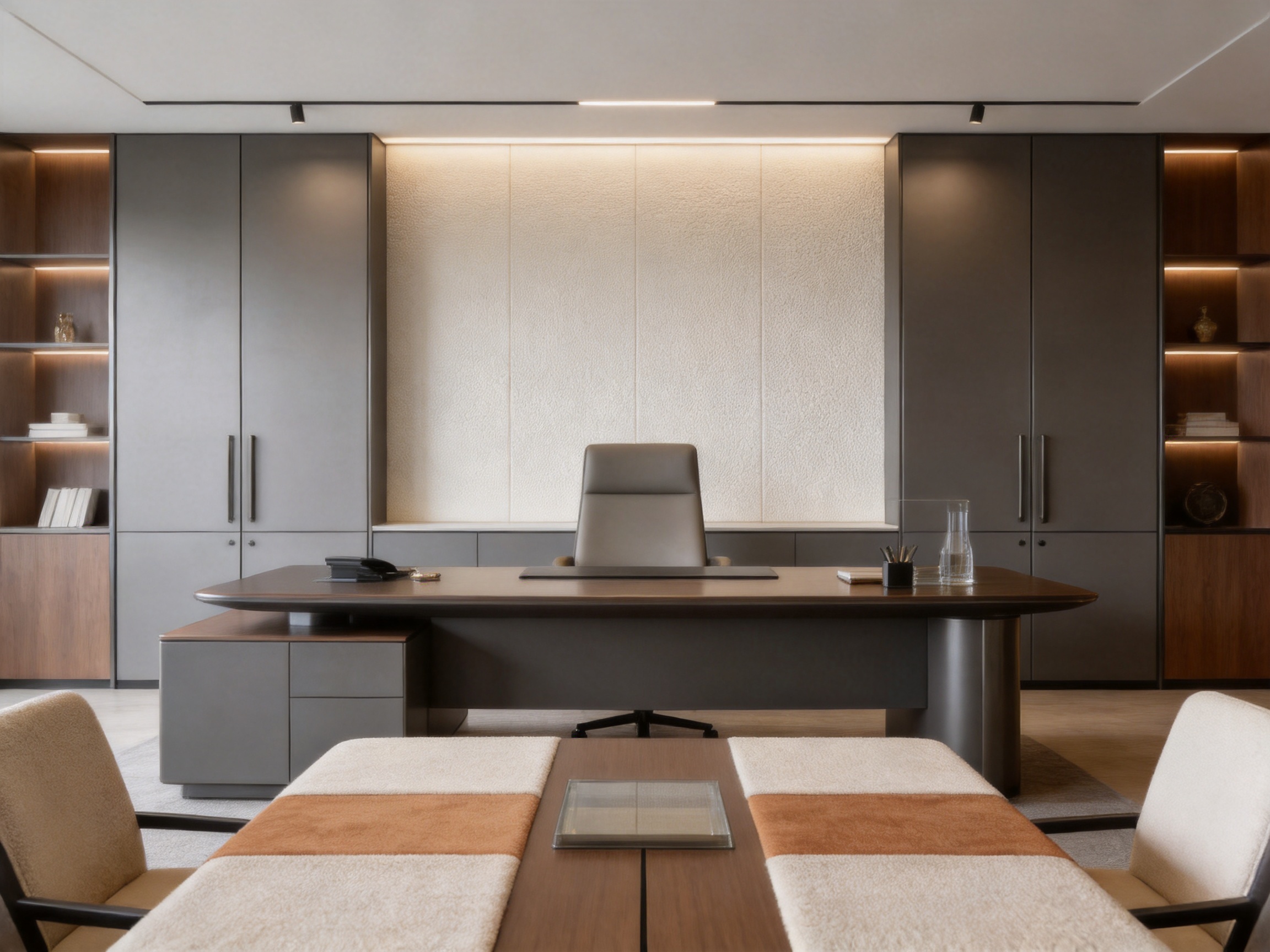
Leather has long been associated with executive furniture and professional environments. PZ02 offers a panel-based way to express that association across desks, conference tables, storage walls, reception counters, and partitions.
On a conference table, the leather-inspired texture can create a more comfortable writing experience and reduce the visual severity of a completely smooth surface. On storage doors and wall panels, it provides a sense of permanence and quality without requiring natural leather upholstery.
The material can also coordinate with metal frames, glass partitions, dark timber, acoustic fabrics, and neutral flooring. Its restrained texture allows it to contribute to the room’s identity without becoming visually dominant.
Boutiques and Showrooms
Retail interiors use walls, counters, display platforms, and cabinet systems to communicate brand values. A leather-textured background can suggest craftsmanship, quality, fashion, and exclusivity. PZ02 is especially appropriate for clothing, accessories, home goods, automotive-related retail, and premium lifestyle products.
Because the surface is available in large panel formats, it can be used for feature walls and display systems with fewer joints than smaller decorative components. The controlled color palette supports merchandise presentation by creating a refined background rather than competing with products.
Hotels and Restaurants
Hospitality environments require surfaces that look distinctive while tolerating repeated use and cleaning. PZ02 can be specified for reception desks, guestroom furniture, headboards, corridor wall panels, restaurant partitions, and decorative counters, provided the selected substrate and complete assembly meet project requirements.
The material’s tactile character can help create a more intimate atmosphere in lounges and guest areas. Terracotta tones can contribute warmth to restaurants and boutique hotels, while smoky gray and off-white can suit contemporary business hotels or executive lounges.
Reception Areas and Public Interiors
Reception counters are among the first surfaces visitors encounter. A leather-inspired front panel can communicate attention to detail and a premium standard. The panel format also makes it easier to coordinate the counter with nearby storage, wall cladding, doors, and signage elements.
In public interiors, designers should consider impact exposure, cleaning frequency, corner protection, and accessibility requirements. The selected board core and installation method should be reviewed as part of the complete design rather than evaluated only as a decorative finish.
Suitable Interior Styles
PZ02 is naturally suited to modern luxury interiors, where carefully chosen textures and muted colors create sophistication without excessive ornament.
It can also support Italian minimalism. In this style, the panel may be combined with simple geometry, concealed hardware, restrained color transitions, and high-quality lighting. The leather texture provides depth while the overall composition remains clean.
Business and executive interiors are another strong application. The material connects with the established visual language of leather furniture while providing the construction efficiency of a rigid melamine panel.
Neoclassical interiors can use PZ02 as a contemporary interpretation of traditional luxury. Framed doors, wall moldings, brass details, and warm lighting can be paired with the subtle leather surface to create a richer layered composition.
The panel may also work in contemporary residential, boutique industrial, transitional, and hospitality styles. Its final appearance depends heavily on color, scale, lighting, adjacent materials, and detailing.
Environmental and Manufacturing Considerations
The supplied product information identifies environmental grades including E0, E1, P2, and F4 in different product descriptions. Environmental classification may vary according to the selected substrate, production specification, and applicable testing system. Buyers should request current technical documents and confirm which rating applies to the exact panel construction being ordered.
YAKCO New Materials describes its products as being developed for environmentally conscious building applications and states that its technologies support performance aligned with international ENF formaldehyde requirements in relevant product lines. As with all composite wood products, the exact emissions performance should be verified through current certificates, laboratory reports, and project documentation.
The company’s use of MDI medical adhesive bonding is presented as one part of its broader manufacturing approach. Adhesive selection can influence bonding strength, formaldehyde emissions, moisture behavior, and long-term panel stability. Reliable bonding is particularly important for decorative panels because delamination, bubbling, or edge separation can compromise both appearance and service life.
Environmental responsibility also includes durability. A surface that remains useful for a longer period may reduce the frequency of replacement and the associated consumption of materials, labor, transportation, and disposal resources. PZ02’s wear-resistant melamine finish is therefore relevant not only to maintenance cost but also to lifecycle planning.
For green-building projects, the product should be assessed within the complete building specification. Relevant factors may include formaldehyde emissions, substrate composition, recycled content, responsible sourcing, indoor air quality, fire performance, durability, and end-of-life considerations.
Manufacturing Strengths of the Producer
YAKCO New Materials (Jiangsu) Co., Ltd. was established in 2007 and is based in Changshu City, Jiangsu, China. The company is described as occupying approximately 50 acres and operating a modern factory building of more than 30,000 square meters.
The company focuses on high-end decorative panels and wall panels for residential and commercial environments. Its development direction emphasizes three-dimensional decorative panel technology, deep pressing, surface texture, stability, and environmentally oriented production.
A significant strength is the integration of design and manufacturing. A leather-inspired panel requires more than a printed image. The pattern, surface relief, resin protection, substrate, pressing process, and edge treatment must work together. Experience with 3D decorative panel technology can help support this coordination.
The company also identifies six core production processes and innovative deep-pressing methods. These processes are intended to create enhanced depth and layering, helping decorative panels achieve a more convincing tactile effect than flat printed boards.
Manufacturing scale can provide additional advantages in supply consistency, production scheduling, quality control, and project support. For commercial projects, the ability to reproduce color, texture, thickness, and edge details across multiple orders is important. A consistent factory process can reduce variation between furniture components and project phases.
The company’s product portfolio includes rock designs, fabric and textile designs, leather designs, art deco patterns, wood designs, melamine substrates, wood panels, grain cloth designs, and frosted three-dimensional melamine boards. This broader range can help designers coordinate several decorative surfaces within a single project while working with one experienced panel supplier.
How PZ02 Compares with Alternative Materials
Compared with Smooth Melamine Boards
Smooth melamine boards are economical, versatile, and easy to clean, but they may lack tactile richness. PZ02 adds surface depth and a more expressive material identity while retaining the practical advantages of melamine construction.
Compared with Printed Woodgrain Panels
Woodgrain communicates natural warmth, but it is not always appropriate for interiors seeking a fashion-oriented, executive, or boutique atmosphere. PZ02 offers a different design vocabulary based on leather, allowing the project to move beyond familiar wood patterns.
Compared with Genuine Leather
Genuine leather offers authenticity and a unique natural aging process. PZ02 does not reproduce those qualities completely. Its advantages are different: lower expected material cost, simpler fabrication, easier cleaning, consistent panel dimensions, and compatibility with standard joinery and cabinetmaking.
Compared with Upholstered Wall Panels
Upholstered panels can provide softness and acoustic benefits, but they may require specialist labor, additional depth, fabric or leather seams, and careful corner detailing. PZ02 offers a rigid architectural surface that can be integrated into standard panel systems and used in thinner or more precisely dimensioned constructions.
Compared with Painted Surfaces
Paint provides almost unlimited color selection, but it does not naturally provide the pore structure, friction, or tactile depth of leather. PZ02 combines a controlled color palette with an integrated texture that is repeatable across manufactured components.
Specification and Installation Recommendations
Before placing a project order, designers and contractors should confirm the exact substrate, thickness, dimensions, environmental grade, edge-banding type, surface color, packaging, and production lead time. A physical sample should be reviewed under the final project lighting whenever possible.
Panel storage should follow standard best practices for decorative boards. Panels should be kept flat, dry, clean, and protected from direct exposure to severe temperature or humidity changes. Improper storage can cause warping or damage before fabrication begins.
During cutting and machining, the decorative face should be protected from dust, debris, and sliding contact. Appropriate tooling should be selected for the chosen substrate and thickness. Test cuts are recommended before production, especially when using unfamiliar equipment or creating visible edge details.
Edges should be sealed or finished in accordance with the board type and application. In areas exposed to elevated humidity or frequent cleaning, particular attention should be given to joints, sink cutouts, floor contact, and other potential moisture-entry points.
Cleaning should be performed with a soft cloth and a mild, compatible cleaning solution. Abrasive powders, steel wool, aggressive solvents, and prolonged standing water should be avoided. Strong chemicals may alter the gloss, color, or texture of the melamine surface.
Fire, moisture, structural, and indoor-air requirements should be assessed for the complete assembly. A decorative face alone does not determine the performance of the entire wall, door, counter, or furniture system.
Frequently Asked Questions
1. Is PZ02 made from genuine leather?
No. PZ02 is a melamine decorative panel inspired by natural leather. Its surface reproduces leather-like pores, wrinkles, color depth, and tactile friction, but it is not genuine leather.
2. What is the main advantage of PZ02 over real leather?
PZ02 offers a leather-inspired appearance and feel in a rigid panel format. It is generally easier to cut, drill, edge-band, clean, and integrate into cabinet and wall systems. It also provides a more predictable panel construction and can be more economical for large areas.
3. Is PZ02 suitable for office desks?
Yes. The textured surface can provide comfortable friction for writing and help reduce the movement of papers and small objects. Its melamine finish is designed to resist ordinary wear, scratches, stains, and fingerprints during normal use.
4. Can PZ02 be used for wardrobe doors?
Yes. Wardrobe doors and walk-in closet systems are important applications. The material can be processed as a standard panel door, and matching edge-banding can help maintain a continuous appearance around the component.
5. What surface finish does PZ02 use?
The listed finish is a lychee leather texture. It combines fine pore details with soft, irregular wrinkles and a micro-matte visual effect.
6. What thicknesses are available?
The supplied specifications list 1.5 mm, 9 mm, 12 mm, 18 mm, 22 mm, and 25 mm. Commercial product information specifically lists 9 mm, 12 mm, 18 mm, 22 mm, and 25 mm panel options.
7. What panel sizes are available?
The standard size is listed as 1220 mm by 2745 mm. Other listed lengths include 2800 mm, 3050 mm, and 3300 mm, subject to production confirmation.
8. Which substrates can be used with PZ02?
Listed options include LSB, SOSB, MDF, HMR MDF, particleboard, fire-resistant board, wood veneer, and plywood. Commercial information also identifies OSB, MDF, and particleboard. The exact availability should be confirmed for each order.
9. Does PZ02 require specialist upholstery equipment?
No specialist upholstery equipment is normally required for its intended panel applications. It can be cut, drilled, assembled, and edge-banded using processes similar to those used for other melamine-faced boards. Fabricators should still conduct sample testing before mass production.
10. Is PZ02 waterproof?
PZ02 is not automatically waterproof. The melamine finish helps resist ordinary moisture and stains, but performance depends on the substrate, edges, joints, installation, and exposure conditions. It should not be used in continuously wet conditions unless the complete system has been specifically designed and approved for that environment.
11. Is PZ02 environmentally friendly?
The supplied information identifies environmental grades such as E0, E1, P2, and F4, while different substrates and product configurations may have different classifications. Buyers should request current certificates for the exact panel specification.
12. Can PZ02 be used in hotels and retail stores?
Yes. Its recommended applications include boutiques, showrooms, hotels, reception areas, conference rooms, and commercial furniture. The selected substrate and installation system should meet the project’s fire, durability, cleaning, and indoor-air requirements.
13. Does the leather texture repeat visibly?
The design is developed with irregular pores and softly transitioning creases to create a more natural appearance. However, all manufactured decorative panels have a design repeat or production pattern. Full-scale sample review is recommended for large installations.
14. How should the surface be cleaned?
Use a soft cloth and a mild compatible cleaning solution. Avoid abrasive materials, strong solvents, excessive water, and harsh chemicals. Any cleaning product should be tested in an inconspicuous area before regular use.
15. Why is edge-banding important for PZ02?
Leather-inspired texture is most convincing when the panel edges do not look unrelated to the face. Matching edge-banding coordinates color, texture, and gloss, helping cabinet doors, shelves, and furniture components appear more integrated.
Conclusion
PZ02 Leather2 Texture Panel brings a refined leather-inspired character to the practical world of melamine-faced boards. Its value comes from the combination of tactile design, micro-matte texture, fine pores, soft wrinkles, controlled colors, melamine durability, and standard panel-processing efficiency.
For designers, the product creates an alternative to conventional woodgrain, solid-color, and smooth laminate finishes. It can introduce a sense of light luxury into wardrobes, headboards, desks, conference tables, reception counters, boutiques, showrooms, hotels, and executive interiors.
For manufacturers and contractors, the rigid panel format supports familiar cutting, drilling, assembly, and edge-banding methods. The availability of multiple substrates and thicknesses allows the decorative concept to adapt to different structural and project requirements.
For building owners and users, the melamine finish offers a practical surface that is easier to maintain than many genuine leather applications and more resistant to ordinary daily wear. It does not attempt to replace the artistic value of natural leather. Instead, it makes the visual and tactile language of leather available in a broader range of architectural and furniture applications.
Supported by three-dimensional decorative panel technology, deep-pressing capabilities, adhesive-bonding expertise, and large-scale manufacturing experience, PZ02 represents a carefully engineered approach to material translation. It combines the emotional appeal of leather with the consistency, adaptability, and production efficiency of a modern decorative panel.
References
1. Product specification materials for the PZ02 Leather2 Texture Panel, including surface finish, substrates, dimensions, thicknesses, edge-banding, and environmental classifications.
2. Manufacturer-provided information concerning YAKCO New Materials (Jiangsu) Co., Ltd., its factory facilities, production history, product portfolio, and decorative panel technologies.
3. Technical descriptions of melamine-impregnated decorative papers, resin surface protection, scratch resistance, stain resistance, and panel fabrication methods.
4. General interior design principles concerning tactile materials, light-luxury aesthetics, commercial furniture, hospitality interiors, and executive workplace design.
5. General guidance for composite wood panel storage, machining, edge treatment, cleaning, installation, and indoor-environment assessment.