中文简体



Previous Post

ZZ01 Grid Pattern 3D Wall Panel
Interior architecture increasingly demands materials that do more than cover a wall. Contemporary spaces require surfaces that contribute to visual identity, improve spatial organization, withstand daily use, and support efficient installation. The ZZ01 Grid Pattern 3D Wall Panel responds to these demands through a carefully controlled combination of geometric relief, melamine surface technology, engineered board substrates, and hot-press manufacturing.
Designed around a regular square-grid pattern, the panel creates a disciplined decorative rhythm without overwhelming the surrounding interior. Its three-dimensional texture produces changing light and shadow across the surface, while the orderly arrangement makes the product easy to coordinate with furniture, flooring, lighting, metal, glass, stone-look materials, and other architectural finishes. The result is a decorative panel suitable for modern residential interiors, offices, retail environments, hospitality projects, and other commercial spaces.
The product belongs to the wood design melamine board category, while its visual character is defined by a 3D embossed or deeply textured surface. It can be used as a wall panel, ceiling finish, furniture facing, partition surface, or decorative accent. Depending on the selected substrate and thickness, it can also be adapted to different project requirements involving strength, stability, weight, machining, and installation.
1. Product Overview
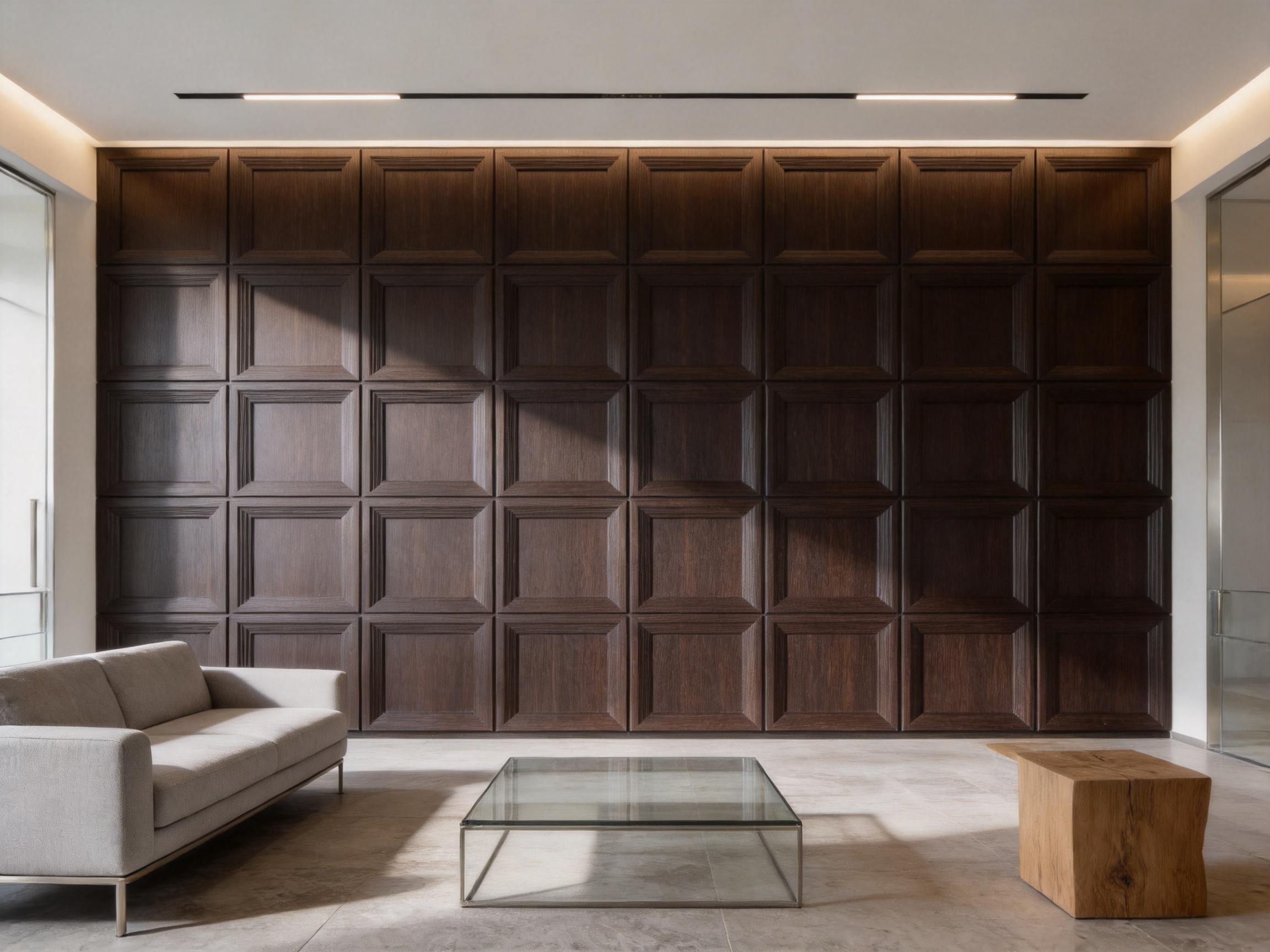
The ZZ01 Grid Pattern 3D Wall Panel is a decorative engineered board featuring a clear, regular grid pattern. The grid consists of straight lines and repeated square fields, with intersections forming visual nodes across the entire surface. This pattern gives the panel a clean and organized appearance while adding physical depth that cannot be achieved by a completely flat printed finish.
The panel is manufactured in a large format of 2745 mm by 1220 mm, with several available thickness options. The listed thicknesses are 9 mm, 12 mm, 18 mm, 22 mm, and 25 mm. This selection allows designers, fabricators, and contractors to choose a specification appropriate to the intended application. Thinner boards may be useful for decorative cladding and weight-sensitive installations, while thicker boards may provide a more substantial appearance and increased rigidity for demanding wall or furniture applications.
The surface design is based on geometric order. Rather than relying on irregular natural variation, the grid pattern uses repetition and alignment to establish a predictable visual language. This makes it particularly suitable for interiors where proportion, spacing, and modular coordination are important. The pattern can reinforce the lines of a building, echo the geometry of furniture, or divide a large surface into visually manageable sections.
Although the panel is categorized under wood design melamine board, its application is not limited to traditional wood-style interiors. The grid texture can support industrial, contemporary, minimalist, office, retail, and modern residential design schemes. Depending on the selected color and surrounding materials, the same pattern may appear warm and architectural, restrained and professional, or bold and graphic.
2. The Design Value of a Regular Grid
Geometric patterns have long been used in architecture and interior design to create order, proportion, and visual continuity. The square grid is especially adaptable because it is easy to understand and can be aligned with horizontal and vertical architectural elements. On the ZZ01 panel, the grid is not merely printed as a two-dimensional image. Its surface relief gives the pattern a tactile and dimensional presence.
The regularity of the grid creates balance. Each square relates to the next, allowing the eye to move across the panel without encountering an uncontrolled or distracting composition. This is helpful in commercial and workplace environments where a calm, organized background is often preferred. In residential applications, the pattern can add character to a feature wall while remaining sufficiently neutral for long-term use.
The three-dimensional surface also changes the way light interacts with the wall. Natural daylight, ceiling lights, linear fixtures, and accent lighting can emphasize the edges of the grid. Depending on the lighting direction, the recessed and raised portions may create fine shadows, stronger contrast, or a soft textured effect. As a result, the panel can contribute to the atmosphere of a room without relying on complicated ornamentation.
The grid can also support spatial organization. A continuous installation may unify a large wall, while selected sections can be used to identify reception zones, display areas, seating areas, circulation paths, or private workspaces. On a ceiling, the pattern may help reinforce a planning module or create a transition between different functional areas.
Compared with highly irregular relief panels, a grid-based design is generally easier to coordinate with cabinetry, shelving, doors, acoustic elements, wall lighting, and modular furniture. Straight lines can be aligned with architectural joints and furniture edges, giving the completed space a more intentional appearance.
3. Construction and Raw Materials
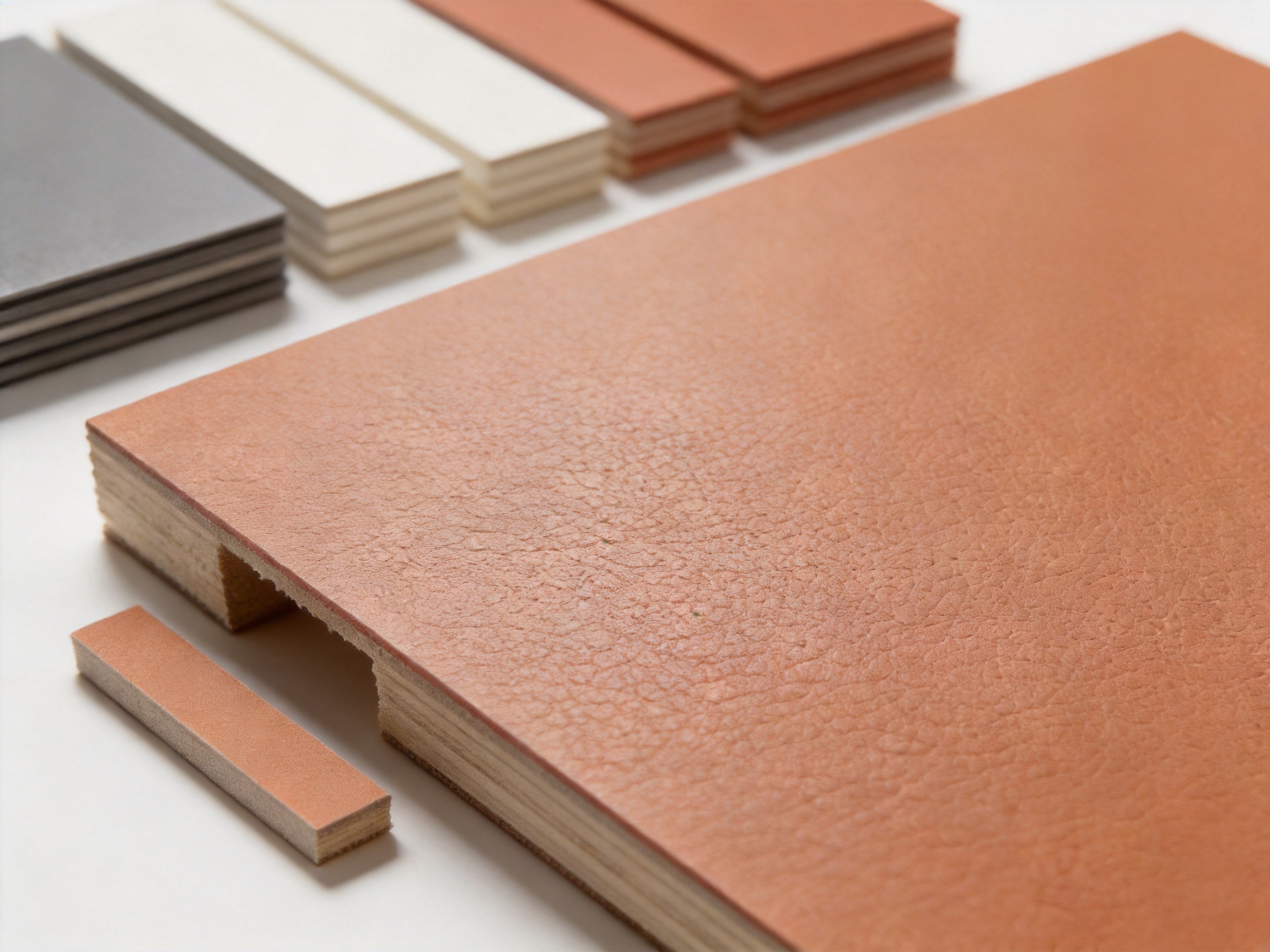
The product structure may use a multilayer engineered-board configuration designed to improve dimensional stability and durability. The available substrate options are listed as OSB, MDF, and particleboard. Each substrate has distinct characteristics, allowing the product to be specified according to the performance requirements of the project.
MDF provides a smooth and relatively uniform fiber structure that is well suited to decorative machining, profiling, and surface finishing. Its consistent composition can support clean edges and a refined appearance when the panel is cut or processed. MDF is frequently selected for interior wall applications, furniture components, display systems, and other uses where surface uniformity is important.
Particleboard can offer an economical engineered-board solution for suitable interior applications. It is commonly used in furniture, cabinetry, decorative panels, and fit-out projects. When combined with an appropriate melamine surface and correctly handled during installation, it can provide a practical balance between cost and decorative performance.
OSB is characterized by oriented wood strands arranged in layers. It can provide a distinctive structural composition and may be selected when a particular stiffness, board behavior, or material specification is required. The appropriate substrate should be confirmed according to the project’s moisture conditions, fixing method, span, loading, edge treatment, and local construction requirements.
Environmentally conscious adhesive systems are used in the manufacturing concept described for the product. The stated environmental grades are P2 and F4. The final suitability of a panel for a particular project should always be confirmed through the applicable technical documentation, testing records, and local regulations, but these classifications indicate that environmental performance is considered as part of the product specification rather than treated as an afterthought.
The combination of an engineered substrate, decorative surface, and embossed texture gives the product a functional structure. The board is not simply a printed sheet applied to a wall. Its value comes from the relationship between the core, the surface layer, the pattern-forming process, and the pressing conditions used during manufacture.
4. Manufacturing Technology
4.1 Plate Making and Printing Techniques
One production route for the grid pattern series uses sophisticated plate-making and printing techniques. Plate preparation is important because the pattern must remain clear, regular, and consistent across a large-format panel. Small errors in line spacing, registration, or pattern transfer can become highly visible when a panel is installed across a broad wall.
Controlled plate making helps ensure that the square fields maintain a consistent relationship with one another. Accurate pattern preparation also supports repeatability between production batches. For projects involving multiple panels, repeatability is essential because irregular changes in grid scale or alignment could interrupt the visual continuity of the finished installation.
Printing technology can contribute to the decorative character of the surface, including color, tonal variation, and wood-inspired visual effects. When a printed design is combined with physical relief, the image and texture work together. The printed pattern provides visual depth and material expression, while the embossed structure supplies tactile depth and a more convincing three-dimensional appearance.
4.2 Advanced Mould Embossing
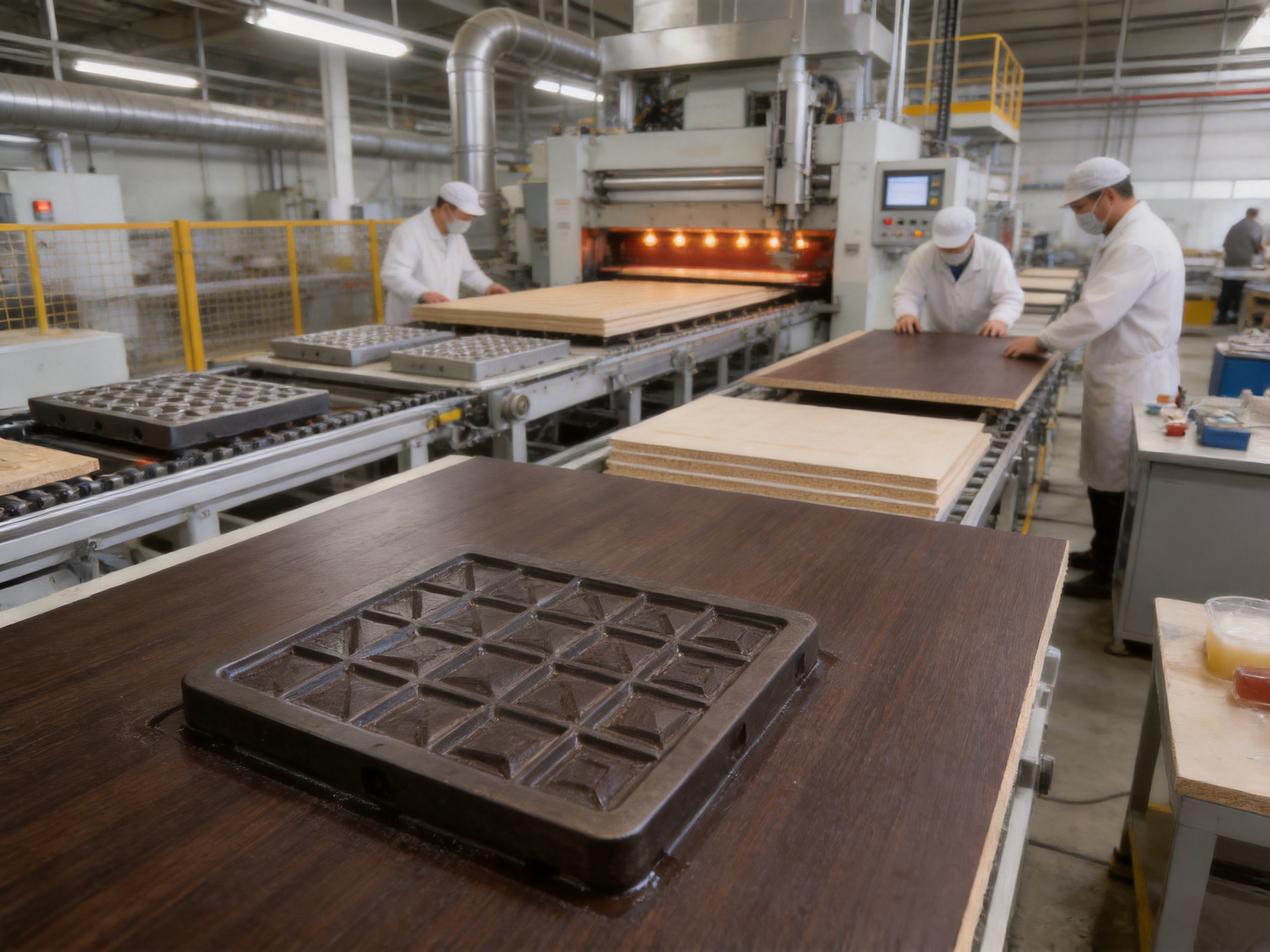
Another important production method is advanced mould embossing. A mould is used to transfer the grid geometry into the panel surface under controlled pressure and temperature. This method is particularly valuable for creating regular relief because the mould establishes the shape of the pattern rather than depending only on surface printing.
Embossing can make the intersections, edges, and recessed fields of the pattern more defined. A well-controlled moulding process helps maintain the intended depth and shape over the full panel area. This is one of the main differences between a true 3D decorative board and a flat board carrying only a printed grid image.
Deep or pronounced embossing can improve the visual response to directional lighting. It can also make the surface feel more substantial when touched. In applications where the panel is used as a feature wall or furniture accent, this tactile quality can strengthen the perceived value of the overall interior.
4.3 Hot Pressing
Hot pressing is a central part of the manufacturing process. During pressing, temperature and pressure must be controlled carefully so that the panel material is heated and compressed uniformly. The objective is to embed the grid pattern firmly into the surface while maintaining the board’s flatness and structural integrity.
Uniform heating helps the surface layer and substrate respond consistently. Uneven temperature distribution could affect pattern transfer, bonding, surface appearance, or dimensional stability. Controlled pressure is equally important because insufficient pressure may produce a weak or incomplete relief, while excessive or uneven pressure may distort the board or create variations across the panel.
The pressing cycle must therefore be matched to the substrate, surface material, board thickness, adhesive system, and mould design. Thicker boards and different core materials may require different process parameters. Production control at this stage has a direct influence on the clarity of the pattern, the durability of the surface, and the panel’s ability to remain flat after manufacturing.
Hot pressing also helps integrate the decorative structure with the board rather than leaving it as a fragile superficial layer. When correctly executed, the grid relief becomes a stable part of the panel surface. This contributes to long-term decorative performance in normal interior use.
4.4 Adhesive Bonding and Layer Integration
The product information describes the use of environmentally friendly glues and identifies MDI medical adhesive bonding among the company’s core production capabilities. Adhesive selection is important in engineered decorative panels because the bond must remain reliable through handling, cutting, installation, and normal changes in indoor temperature and humidity.
A suitable adhesive system can improve the integration of the decorative layer with the substrate. It can also support surface stability and reduce the risk of separation when the panel is processed or installed correctly. In multilayer products, the bond line must work together with the board structure so that the finished panel behaves as a coordinated material.
Adhesive performance should not be considered independently from pressing conditions. Temperature, pressure, curing time, surface preparation, and material compatibility all influence the final result. A production system that coordinates these factors is more likely to deliver consistent boards than a process that treats each stage separately.
4.5 Quality Control and Dimensional Consistency
Large-format decorative panels require consistent quality control. The panel dimensions, surface condition, grid regularity, flatness, edge quality, color, and bonding condition all affect the final installation. A defect that appears minor on one panel can become much more noticeable when several panels are joined together across a continuous wall.
Dimensional consistency is particularly important for the ZZ01 grid design. If adjacent panels have different pattern spacing or noticeable size variation, the grid may fail to align at the joints. Accurate manufacturing and responsible installation planning are therefore complementary. The panel should be inspected before cutting, and installers should establish a reference line and joint strategy that respects the pattern.
Surface inspection can identify incomplete embossing, printing irregularities, contamination, edge damage, or other issues before the material reaches the jobsite. Quality control also helps maintain a consistent supply for larger projects, where several production batches may be required.
5. Main Product Advantages
5.1 Stronger Visual Depth Than a Flat Decorative Board
The most immediate advantage of the ZZ01 panel is its physical texture. A flat printed board can imitate a pattern visually, but it does not provide the same relationship between light, shadow, and touch. The 3D grid gives the surface a more architectural character and can make a simple wall appear more layered.
This visual depth is particularly valuable in spaces where a large uninterrupted surface might otherwise appear plain. Instead of adding numerous decorative objects, a designer can use the panel itself as a controlled background element. The result can be visually rich while remaining clean and uncluttered.
5.2 Clear and Regular Pattern Definition
The grid pattern is designed to be neat, clear, and uniform. Its regularity supports professional-looking installations and makes the panel easy to combine with other geometric elements. This differentiates it from decorative surfaces that depend on random variation or highly complex motifs.
A consistent pattern can also make design planning more efficient. The grid module may be considered when positioning lighting, shelving, wall graphics, furniture, or display fixtures. While exact coordination depends on project drawings and panel dimensions, the predictable pattern provides a useful visual reference.
5.3 Broad Style Compatibility
The product is suitable for industrial style, modern minimalist style, contemporary commercial interiors, and a range of residential schemes. Its compatibility comes from the restrained nature of the square grid. It can add texture without imposing a specific historical or ornamental style.
In an industrial interior, the grid may complement exposed metal, concrete-look surfaces, dark fixtures, and linear lighting. In a minimalist interior, it can provide controlled texture against a simple color palette. In a residential space, it can be used behind a television, bed, sofa, dining area, or entry feature wall. In a retail setting, it can create a consistent branded environment without competing with merchandise.
5.4 Multiple Thickness Choices
The availability of several thicknesses is a practical advantage. A designer does not need to use the same board thickness for every application. The selection can be based on the desired visual mass, fixing method, panel weight, substrate characteristics, and project budget.
The 9 mm and 12 mm options may be appropriate for lighter decorative applications when the supporting wall and installation system are suitable. The 18 mm, 22 mm, and 25 mm options can provide a deeper and more substantial board profile for applications requiring additional body. The selected thickness should be evaluated alongside span, support, handling, edge finishing, and local requirements.
5.5 Large-Format Efficiency
With a listed size of 2745 mm by 1220 mm, each board can cover a substantial area. Large-format panels may reduce the number of visible joints compared with smaller decorative modules. Fewer joints can help create a more continuous visual field and may support more efficient installation in suitable spaces.
Large panels can also simplify design continuity across walls and ceilings. However, they require careful transportation, storage, lifting, cutting, and handling. Professional installation planning is recommended to protect the surface and ensure accurate alignment.
5.6 Interior Environmental Consideration
The stated P2 and F4 environmental grades indicate that the product range addresses emissions and interior-use considerations. The specific meaning and acceptance criteria of these grades can vary according to the applicable standard, so project teams should request the relevant certificates and technical reports.
For architects, contractors, and building owners, environmental documentation is increasingly important. A decorative product must be evaluated not only for appearance and price but also for substrate composition, adhesive system, emissions, indoor air quality requirements, and the intended occupancy conditions.
5.7 Functional Decorative Performance
The panel can help divide and organize space while adding a finished decorative layer. It may be used to define a reception background, separate a seating zone, frame a display wall, or distinguish one area from another without constructing a heavy solid partition.
Its role is therefore both visual and spatial. The grid texture can guide attention, establish a backdrop, and strengthen the hierarchy of an interior. When combined with appropriate lighting, it may also contribute to wayfinding and focal-point design.
6. Comparison With Common Alternative Wall Finishes
Product comparison should be based on the requirements of each project rather than on a single universal ranking. Nevertheless, the ZZ01 panel offers a combination of characteristics that can be advantageous when compared with several common alternatives.
6.1 Compared With Flat Melamine Boards
Flat melamine boards provide a practical decorative surface and are often valued for their clean appearance, standardized production, and broad design range. However, a flat surface has limited physical depth. The ZZ01 panel adds a formed grid relief, allowing the wall to respond to light and touch in a more dynamic way.
The 3D structure can create a higher-impact feature without requiring separate battens, applied mouldings, or additional decorative strips. This may simplify the visual composition and reduce the number of components needed to achieve a textured effect.
6.2 Compared With Printed Wallpaper
Wallpaper can offer an extensive range of colors, images, and patterns. It is flexible for short-term decorative changes and may be suitable for low-impact locations. However, wallpaper does not normally provide the same rigid board structure or tactile relief as a 3D engineered panel.
The ZZ01 board can offer a more architectural presence and may be better suited to applications where a firm, cuttable, furniture-compatible surface is desired. The exact durability and maintenance outcome depends on the environment, installation details, and cleaning practices.
6.3 Compared With Solid Timber Slats or Mouldings
Solid timber slats and mouldings can provide attractive depth and natural material character, but they may require more individual components, more complex alignment, and additional finishing work. A large-format embossed panel can reproduce a regular linear or geometric relief in a more integrated board form.
The grid design also avoids the visual repetition of separate narrow slats while retaining a strong modular rhythm. For projects seeking a consistent factory-produced pattern, this can provide advantages in coordination and installation planning.
6.4 Compared With Stone or Ceramic Relief Surfaces
Stone and ceramic products can deliver high durability and distinctive texture, but they may involve greater weight, more demanding cutting, specialized fixing, and more complex transportation. An engineered wood-based decorative panel can be easier to process with common woodworking equipment, subject to the correct tools and safety procedures.
For interior applications where low to moderate impact resistance is sufficient and the design priority is a lightweight geometric feature, the ZZ01 panel can be a practical alternative. It should not be specified as a replacement for a material where fire, moisture, abrasion, or structural performance requires a different product category.
7. Applications in Residential Interiors
In homes, the ZZ01 panel can be used to create a feature wall in living rooms, bedrooms, dining areas, entry spaces, and home offices. A living-room wall behind a media console can benefit from the panel’s organized texture, especially when the surrounding furniture has simple lines.
Behind a bed, the grid can form a structured headboard background. The pattern may be installed across the full wall or limited to the width of the bed to create a focused composition. Concealed or carefully positioned lighting can highlight the relief and produce a soft layered effect.
In an entry area, the panel can define a transition between the entrance and the main living space. Used with a console, mirror, bench, or coat-storage system, it can create an intentional first impression without requiring elaborate decoration.
For home offices, the pattern can provide a professional background for video calls, shelving, or a desk wall. Because the grid is orderly, it is less likely to compete with books, artwork, or display objects than a highly expressive irregular texture.
The product may also be used on selected furniture surfaces, such as cabinet fronts, reception-style home storage units, or decorative side panels. Designers should confirm the suitability of the selected substrate and thickness for hinges, fasteners, edge treatment, and repeated use.
8. Applications in Commercial and Public Spaces
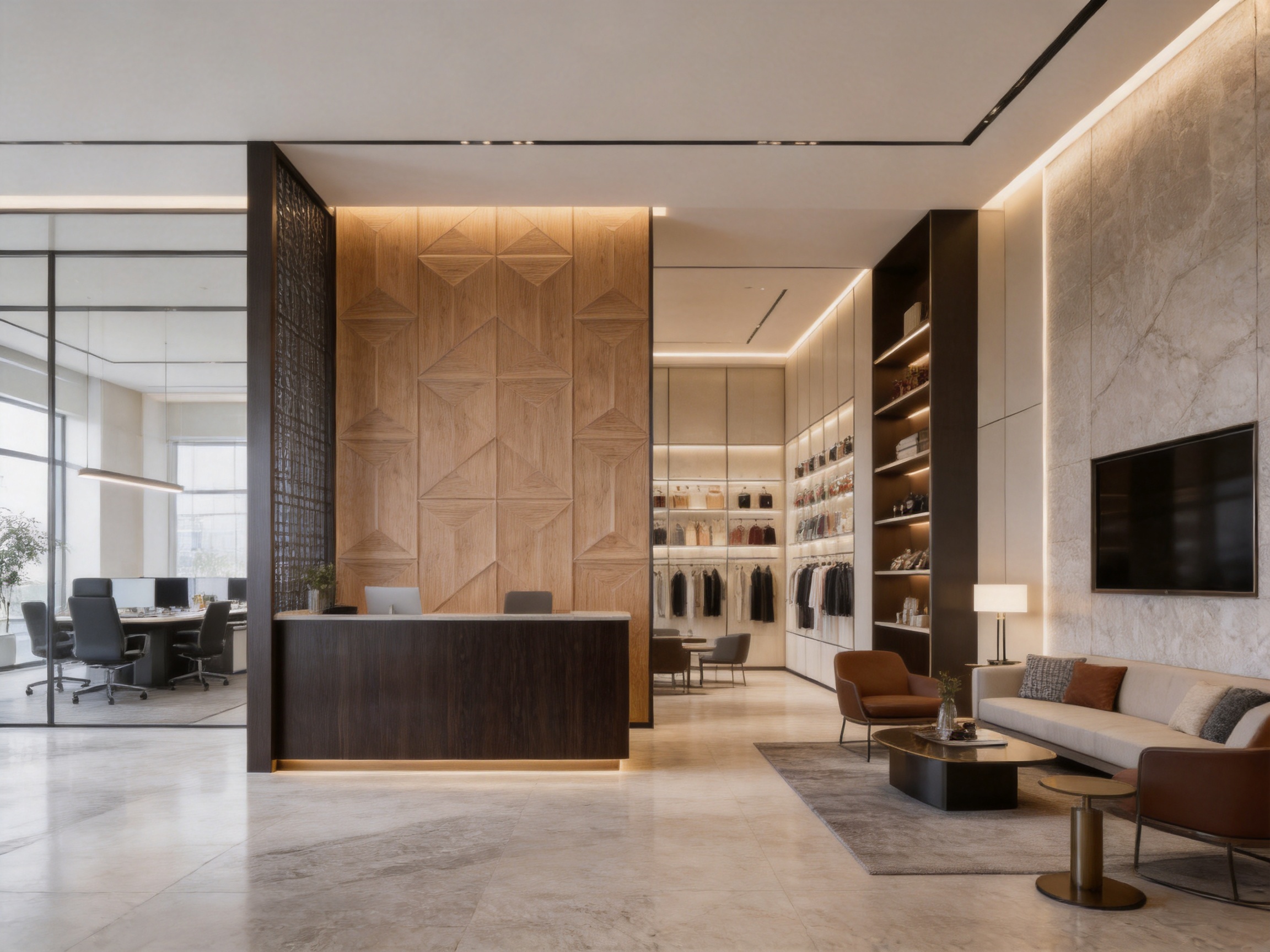
Offices can use the panel on reception walls, meeting-room backgrounds, collaborative areas, executive offices, and circulation zones. A reception wall often requires a strong identity but must remain professional. The ZZ01 grid offers a recognizable surface language without relying on excessive color or ornament.
In open-plan offices, the panel can help distinguish zones. It may be installed behind a collaboration area, used as a partial partition facing, or applied to a meeting-room wall. The texture can provide visual separation even when the space remains physically open.
Shopping malls and retail stores can use the panel for brand-neutral display backgrounds, feature walls, checkout areas, fitting-room approaches, or product presentation zones. The surface can support lighting and signage while maintaining a consistent architectural finish.
Restaurants and cafés may use the grid panel on selected walls, counter fronts, ceiling sections, or booth surrounds. In these settings, the panel should be evaluated against cleaning requirements, humidity, heat exposure, and local fire regulations. It is generally most appropriate for controlled interior areas rather than locations exposed directly to water or intense heat.
Hotels and hospitality spaces can incorporate the panel into lobby walls, corridors, guest-room feature areas, lounge backdrops, and reception counters. The regular pattern can create a sense of order across repeated rooms or floors, while color and lighting can be adjusted to support the desired atmosphere.
Educational, exhibition, and institutional interiors may also benefit from the panel’s ability to organize large wall surfaces. Its geometric appearance can support a contemporary and efficient design language, provided that the selected specification satisfies the required safety and durability standards.
9. Ceiling and Partition Uses
Although the panel is primarily described as a wall panel, its design principle also supports ceiling applications. A grid relief on the ceiling can reinforce a modular plan or create a transition above a reception desk, dining area, corridor, or lounge.
Ceiling installation requires special attention to weight, support spacing, fixing systems, access requirements, and overhead safety. The board thickness and substrate should be selected in cooperation with the project’s technical team. The grid direction should be coordinated with lighting, air outlets, sprinklers, inspection panels, and other ceiling services.
For partitions, the panel can be attached to a suitable supporting frame or used as a decorative facing. It can help define zones while retaining a lighter visual quality than a solid masonry wall. The final acoustic, fire, and impact performance will depend on the complete partition assembly rather than the decorative panel alone.
Designers may also combine the panel with open shelving, glass, metal frames, or other materials. Such combinations can create partial visual separation while preserving daylight and connectivity between spaces.
10. Furniture and Joinery Applications
The ZZ01 texture can enhance furniture surfaces where a more distinctive architectural appearance is required. Potential uses include cabinet side panels, reception counters, display plinths, wall-mounted storage, wardrobe features, and decorative door fronts.
When used for furniture, the fabrication plan should account for the relief direction, edge visibility, hardware locations, and the relationship between the grid module and the component dimensions. Cutting through the pattern may be intentional in some designs, but unwanted interruptions can weaken the visual effect.
Edges may require suitable finishing, edging, profiling, or framing depending on the desired appearance. Fasteners and hinges should be selected according to the substrate and board thickness. Designers should also consider the possibility of repeated opening, impact, or contact in high-use furniture applications.
The panel can be especially effective when used selectively. A complete room filled with the same pattern may become visually repetitive, while a coordinated feature on a cabinet or counter can establish a clear focal point. Combining textured components with flat matching boards can provide contrast and improve the balance of the interior.
11. Installation and Project Planning
Successful installation begins before the panels arrive at the site. The project team should verify the wall condition, moisture level, flatness, support structure, access route, storage area, and cutting requirements. Because the panels are large format, transportation through doors, corridors, elevators, and staircases should be planned in advance.
Panels should be stored flat on a clean, stable, level support with protection from direct moisture and severe temperature changes. The decorative surface should be protected from abrasion, impact, dust, and contamination. Improper storage can affect flatness or damage the surface before installation begins.
Pattern alignment is a key consideration. The installer should establish a datum line and determine the starting point so that the grid appears balanced at corners, openings, and visible ends. Where possible, the layout should minimize narrow strips and awkward interruptions. Door frames, windows, electrical outlets, and service penetrations should be shown on the shop drawings.
Cutting should be carried out with equipment appropriate to the selected substrate and thickness. Clean, sharp tools can help reduce chipping and surface damage. The visible face should be supported and protected during machining, and all dust-control and personal-protection procedures should be followed.
The fixing method may involve mechanical fasteners, an approved adhesive system, a batten framework, metal channels, or another suitable installation solution. The selected method must consider the wall type, panel weight, environmental conditions, access for maintenance, and local construction standards.
Joints should be designed rather than hidden as an afterthought. A joint may be aligned with the grid, placed in a recess, covered by a trim, or treated as part of the design. The best solution depends on panel orientation, wall dimensions, lighting, and the desired level of visual continuity.
12. Maintenance and Long-Term Appearance
Routine maintenance of a melamine decorative panel is generally straightforward when the surface is used in an appropriate interior environment. Dust can usually be removed with a soft, dry cloth or a vacuum attachment that does not scratch the finish. Light cleaning should use a soft cloth and a mild, compatible cleaning solution.
Abrasive powders, aggressive solvents, wire brushes, and excessive water should be avoided unless specifically approved by the technical documentation. Liquids should not be allowed to remain in joints or exposed edges. Any spill should be removed promptly, particularly on furniture components or low-level wall areas.
Wall panels should be protected from direct impact by carts, heavy furniture, sharp objects, and construction equipment. During later renovation work, the surface should be covered to prevent paint, plaster, adhesive, or dust contamination.
Long-term performance depends on the complete environmental condition. The product is intended for suitable interior applications, and project teams should confirm whether a specific location involves high humidity, direct water exposure, extreme temperature, intense sunlight, or unusual chemical contact. In such conditions, a different material specification or additional protective system may be required.
13. Sustainability and Responsible Material Selection
Responsible material selection involves more than choosing a decorative appearance. It includes understanding the board substrate, adhesive system, environmental classification, manufacturing process, service life, maintenance needs, and disposal options.
The product information identifies P2 and F4 environmental grades and describes the use of environmentally friendly glues. These details can support project evaluation, especially where indoor emissions and formaldehyde performance are part of the specification. The exact compliance documents should be requested for the selected substrate, thickness, and production batch when required.
Durability is also relevant to sustainability. A surface that remains visually useful and structurally stable for a long period may reduce the frequency of replacement. The grid design has a restrained, adaptable quality that can remain compatible with changing furniture and color schemes, potentially extending the practical life of an interior finish.
Efficient panel planning can reduce waste. Accurate shop drawings, optimized cutting layouts, careful handling, and the use of suitable offcuts for smaller furniture components can improve material utilization. Designers should coordinate the panel module with the wall dimensions wherever possible.
14. Manufacturing Strengths of the Producer
The producer, YAKCO New Materials (Jiangsu) Co., Ltd., was established in 2007 and operates from a facility covering approximately 50 acres, including a modern standard factory building of more than 30,000 square meters. This scale provides a manufacturing foundation for decorative boards and wall panels intended for residential and commercial applications.
The company specializes in high-end decorative panels and wall panels, with a particular focus on 3D decorative panel technology. Its development direction includes deep-pressing processes, multiple core production processes, and MDI medical adhesive bonding. These capabilities are relevant to the ZZ01 product because the product depends on accurate pattern transfer, stable layer integration, and reliable surface formation.
A specialized 3D panel manufacturer can offer advantages over a general board supplier when the project requires consistent relief depth, repeatable pattern geometry, and coordinated production of different thicknesses. The ability to manage mould design, pressing parameters, substrate selection, bonding, and finishing within an integrated manufacturing system can improve process control.
The company also describes product benefits including enhanced depth, layering, texture, stability, easy cutting, deformation resistance, and environmentally friendly performance meeting the international ENF formaldehyde standard. These claims should be verified through the applicable product documentation for each specification, but they reflect a manufacturing strategy centered on more than surface decoration.
The YAKCO brand was established in 2016, building on the company’s earlier manufacturing experience. Its stated commitment is to provide high-quality building materials for residential and commercial spaces. For buyers, a supplier with experience in decorative board development can be valuable when the project involves custom coordination, technical questions, repeated orders, or multiple product categories.
15. Why Process Control Matters to Competitiveness
In the decorative-panel market, appearance alone is not enough to establish a reliable product. Two panels may show a similar pattern in a catalog but perform differently in production, installation, and service. Competitiveness depends on the ability to deliver the expected pattern, dimensions, surface quality, stability, and environmental performance consistently.
The ZZ01 product benefits from a process concept that combines plate making or mould embossing with hot pressing and engineered substrates. This combination is more technically demanding than applying a simple printed image to a flat board. It requires control of temperature, pressure, mould condition, bonding, board composition, and finishing.
Process control also supports project confidence. Contractors need panels that can be cut and installed without unexpected surface failure. Designers need the pattern to remain recognizable from one board to the next. Building owners need a finished wall that continues to look orderly after normal use. These expectations are connected to manufacturing discipline.
Another competitive advantage is product flexibility. Offering OSB, MDF, and particleboard substrate options, together with several thicknesses, allows the supplier to address more than one application. A single decorative pattern can therefore be adapted for walls, ceilings, furniture, partitions, and other interior elements, subject to technical approval.
16. Recommended Specification Checklist
When specifying the ZZ01 Grid Pattern 3D Wall Panel, the design and procurement team should confirm the following points:
| Specification Item | Available or Stated Information | Project Confirmation Needed |
|---|---|---|
| Product type | 3D grid pattern melamine wall panel | Confirm intended use and complete assembly |
| Panel size | 2745 mm × 1220 mm | Confirm tolerances, orientation, and cutting layout |
| Thickness options | 9 mm, 12 mm, 18 mm, 22 mm, and 25 mm | Select according to support, weight, fixing, and appearance |
| Substrate options | OSB, MDF, and particleboard | Confirm board type, density, moisture conditions, and machining needs |
| Surface technology | YAKCO 3D Melamine Board manufacturing process | Confirm finish, color, texture depth, and batch consistency |
| Pattern | Regular square grid with clear intersections | Confirm orientation, joint alignment, and visual module |
| Environmental grade | P2 / F4 | Request current certificates and verify local compliance |
| Installation location | Interior walls, ceilings, furniture, or partitions | Confirm humidity, heat, impact, fire, and maintenance conditions |
| Installation method | To be selected for the project | Confirm wall condition, fixing system, adhesives, and support spacing |
17. Design Recommendations
For a calm minimalist effect, the grid panel can be paired with one dominant neutral color, concealed storage, and linear lighting. The texture should be allowed to remain visible without being surrounded by too many competing patterns.
For an industrial interior, designers may combine the panel with dark metal, concrete-look finishes, black-framed glass, and exposed services. Lighting from one side can emphasize the relief and create a stronger shadow pattern.
For a warmer residential composition, the panel can be coordinated with wood flooring, soft textiles, upholstered furniture, and indirect lighting. The regular pattern can provide structure while the surrounding materials introduce comfort and softness.
In retail or hospitality spaces, the panel may be used selectively behind signage or display elements. A continuous field can create brand consistency, while a smaller framed area can draw attention to a particular product, reception point, or service counter.
Designers should also consider scale. A large wall may benefit from full-height installation, while a small room may require only one feature section. The grid can appear subtle when viewed from a distance and more tactile at close range, making it suitable for spaces experienced at different viewing distances.
18. Frequently Asked Questions
Q1: What is the ZZ01 Grid Pattern 3D Wall Panel?
The ZZ01 is a decorative melamine engineered panel with a regular square-grid relief. It is designed for interior walls, ceilings, furniture surfaces, partitions, and other decorative applications where a structured three-dimensional texture is desired.
Q2: Is the grid pattern printed or embossed?
The production description includes sophisticated plate-making and printing techniques as well as advanced mould embossing techniques. Depending on the selected production route and finish, the visual design may be supported by printing, physical embossing, or a combination of both. The order specification should confirm the exact surface construction.
Q3: What panel sizes are available?
The listed product size is 2745 mm by 1220 mm. The project team should confirm dimensional tolerances, packing details, and any available customization before final procurement.
Q4: What thicknesses can be selected?
The stated thickness options are 9 mm, 12 mm, 18 mm, 22 mm, and 25 mm. The correct thickness depends on the application, support system, handling requirements, desired visual mass, and relevant technical standards.
Q5: Which substrates are available?
The listed substrates are OSB, MDF, and particleboard. Each has different characteristics related to density, machining, stiffness, moisture response, weight, and cost. The substrate should be selected according to the complete project specification.
Q6: Can the panel be used on a ceiling?
It may be suitable for interior ceiling decoration when the selected board, support structure, fixing system, and safety requirements are appropriate. Ceiling installations require special attention to overhead support, weight, service access, and local regulations.
Q7: Can it be used for furniture?
Yes, the product information identifies furniture surface decoration as an application. The fabricator should evaluate edge treatment, hardware, cutting, repeated use, impact exposure, and the suitability of the selected substrate and thickness.
Q8: Is the panel suitable for wet areas?
The product is intended primarily for suitable interior applications. Direct water exposure, high humidity, steam, and frequent wet cleaning require specific verification. The technical documentation should be reviewed before use in bathrooms, kitchens, commercial wash areas, or other demanding locations.
Q9: What are the environmental grades?
The listed environmental grades are P2 and F4. Buyers should request the current certificates and confirm that the selected product meets the emissions and indoor-air requirements of the destination market and project.
Q10: What makes the product different from a flat printed panel?
The ZZ01 design includes a three-dimensional grid texture that can create physical depth, tactile variation, and changing light-and-shadow effects. A flat printed panel can reproduce the appearance of a grid but generally cannot provide the same relief or tactile response.
Q11: How should the panel be cleaned?
Routine dust can generally be removed with a soft cloth or suitable vacuum attachment. For light cleaning, use a soft cloth and a compatible mild cleaning solution. Abrasive materials, harsh solvents, and excessive water should be avoided unless approved by the product documentation.
Q12: Can the panels be aligned continuously across a wall?
They can be planned for continuous visual alignment, but the installer must carefully coordinate panel orientation, joint positions, wall dimensions, and the grid module. Shop drawings and a controlled installation sequence are recommended for large or highly visible surfaces.
Q13: Is the panel easy to cut?
The company describes its products as offering easy cutting, but the actual cutting method depends on the substrate, thickness, equipment, and pattern direction. Proper tools, support, dust extraction, and protective procedures are necessary to achieve clean results.
Q14: Who should install the product?
Installation should be carried out by qualified fabricators or installers familiar with engineered boards, decorative surfaces, large-format handling, and the selected fixing system. Professional installation helps protect the panel and maintain pattern alignment.
Q15: Can the product be used in offices and shopping malls?
Yes. The stated applications include offices, shopping malls, residential interiors, and other interior spaces. The project team must still confirm fire, impact, cleaning, moisture, and accessibility requirements for the specific location.
Q16: What should buyers request before placing a large order?
Buyers should request product samples, technical data, substrate and thickness confirmation, environmental documentation, color and finish information, installation recommendations, packing details, and quality requirements. For large projects, a sample installation or approved reference panel can help reduce uncertainty.
19. Conclusion
The ZZ01 Grid Pattern 3D Wall Panel combines a disciplined geometric design with physical surface relief and engineered-board construction. Its regular grid gives interiors a clear visual structure, while the three-dimensional texture introduces depth, shadow, and tactile interest. The product can function as both a decorative finish and a tool for organizing space.
Its advantages include a broad range of thicknesses, several substrate options, large-format dimensions, compatibility with modern interior styles, and suitability for walls, ceilings, partitions, and furniture surfaces. Compared with flat decorative boards, wallpaper, applied mouldings, or heavier relief materials, it offers a distinct balance of texture, integration, and design flexibility for suitable interior applications.
The manufacturing process is central to its value. Plate making, printing, mould embossing, hot pressing, adhesive bonding, and quality control must work together to produce a clear and stable pattern. The producer’s experience in 3D decorative panel technology, deep-pressing processes, multilayer production, and environmentally considered adhesive systems supports the product’s positioning in the high-end decorative panel market.
For architects, interior designers, contractors, furniture manufacturers, and building-material buyers, the product offers a practical way to introduce order and depth without relying on excessive ornament. With appropriate substrate selection, installation planning, environmental verification, and maintenance, the ZZ01 Grid Pattern 3D Wall Panel can contribute to durable, coordinated, and visually distinctive residential and commercial interiors.
References
1. Product technical information for ZZ01 Grid Pattern 3D Wall Panel, including dimensions, substrates, manufacturing process, environmental grades, and intended applications.
2. Manufacturer-provided company profile for YAKCO New Materials (Jiangsu) Co., Ltd., including production facilities, company history, 3D decorative panel technology, and adhesive-bonding capabilities.
3. General technical principles for melamine-faced engineered wood panels, hot pressing, surface embossing, adhesive bonding, and interior decorative-board installation.
4. General architectural and interior-design guidance concerning geometric pattern coordination, wall-panel layout, furniture integration, lighting, maintenance, and material specification.
5. Applicable regional standards and project documentation concerning formaldehyde emissions, indoor air quality, fire performance, moisture exposure, substrate classification, and engineered-board installation.