中文简体



Previous Post
Modern interior design increasingly depends on materials that can balance appearance, performance, installation efficiency, and long-term value. Designers and project owners are no longer looking only for a beautiful decorative surface. They also need products that can be supplied consistently, adapted to different substrates, processed efficiently, and maintained easily after installation. The ZZ25 Straight Line Texture Panel responds to these requirements through a restrained linear design, deep embossed texture, melamine surface technology, and a flexible selection of thicknesses and substrates.
Unlike many decorative panels that attempt to imitate natural wood, stone, fabric, or leather, ZZ25 takes a more architectural approach. Its visual identity comes from the straight line: a simple geometric element that creates rhythm, direction, depth, and order. This makes the panel suitable for interiors ranging from minimalist residences and contemporary offices to retail stores, hotels, public spaces, and large-scale commercial developments.
The product is manufactured by YAKCO New Materials (Jiangsu) Co., Ltd., a Chinese decorative-panel manufacturer established in 2007. The company operates a modern production facility covering approximately 50 acres, with more than 30,000 square meters of standard factory buildings. Its expertise includes high-end decorative panels, wall panels, three-dimensional surface technology, deep pressing, and melamine-faced board production.
At the center of ZZ25 is a practical design philosophy: the simpler the graphic language, the more adaptable the material becomes. Straight grooves and raised ridges create a tactile surface without overwhelming the surrounding space. The panel can work as a primary feature, a background surface, or a coordinating element alongside wood grain, stone patterns, metal, glass, paint, and other finishes.
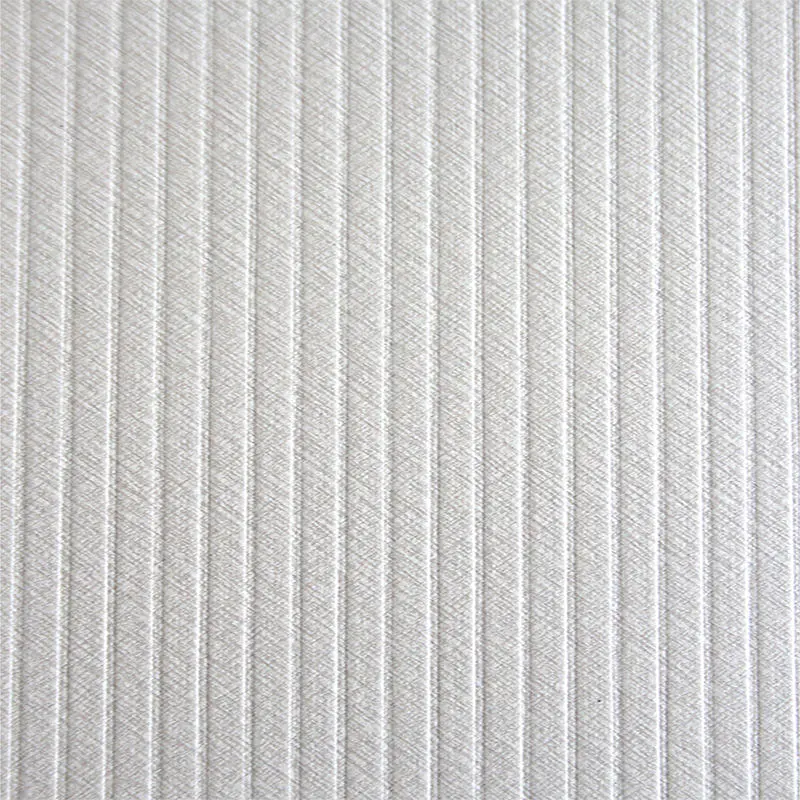
ZZ25 Straight Line Texture Panel - Light Luxury
What Is the ZZ25 Straight Line Texture Panel?
The ZZ25 Straight Line Texture Panel is a melamine-faced decorative board with a deep embossed surface inspired by orderly, repeated linear forms. It is designed to provide a crisp three-dimensional texture while retaining the practical advantages associated with melamine-faced panels.
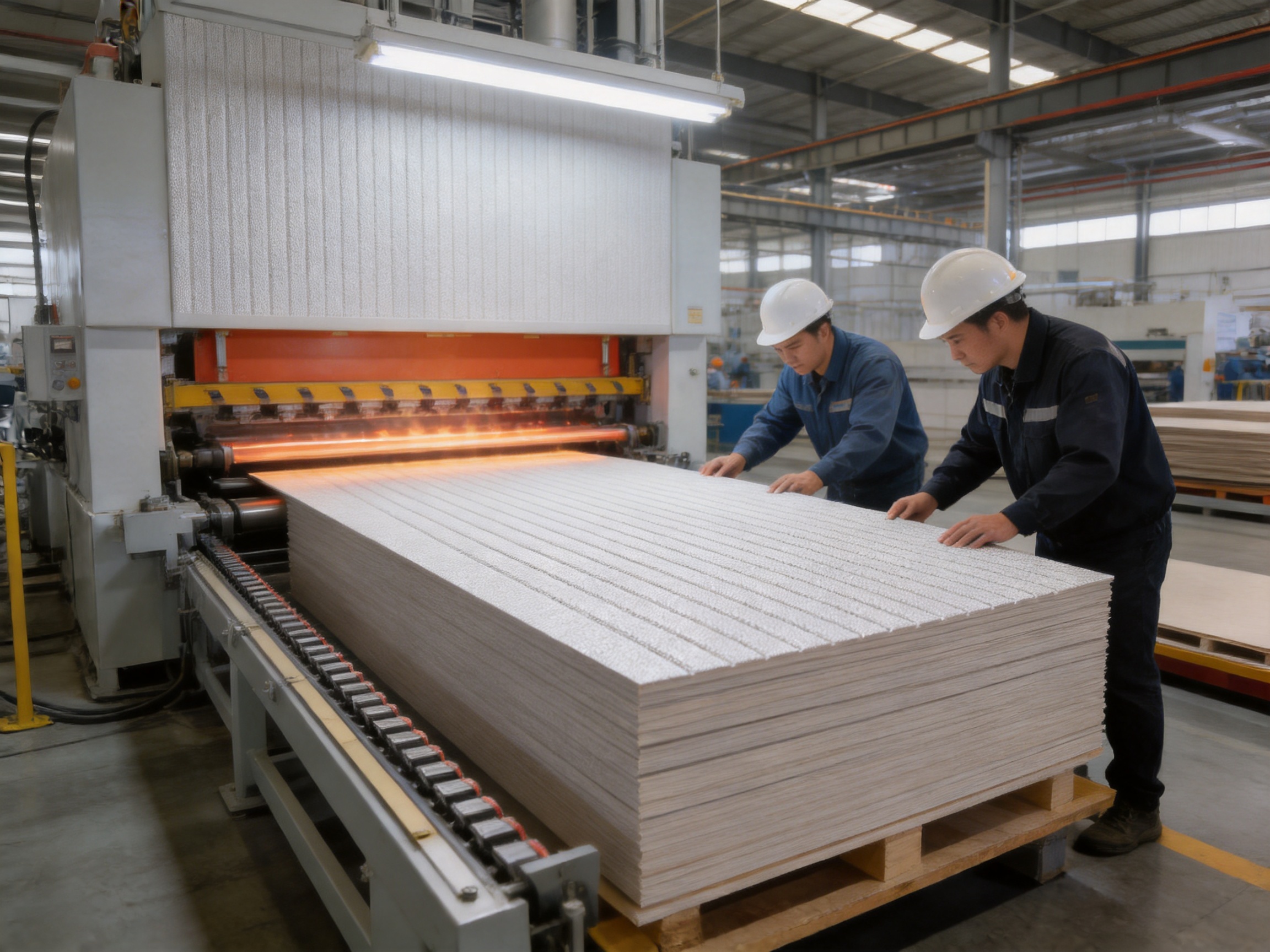
The product uses melamine-impregnated paper as its facing material. During production, this decorative layer is bonded to a selected substrate through a controlled hot-pressing process. The surface is formed with a deep embossed wood-texture finish, creating alternating grooves and ridges that can be seen and felt. Although its technical description refers to wood texture, the appearance is intentionally more geometric than naturalistic. It does not imitate a specific tree species or attempt to reproduce irregular timber grain.
This distinction is important. Many decorative surfaces are designed to look like materials found in nature. ZZ25 instead expresses a rational, manufactured aesthetic. Its linear arrangement is consistent, repeatable, and highly compatible with modern architectural compositions. The surface can reinforce the horizontal or vertical direction of a room, help define zones, and add shadow variation without requiring elaborate ornamentation.
The product is available in several thicknesses, including 1.5 mm, 9 mm, 12 mm, 18 mm, 22 mm, and 25 mm, depending on the required application and construction format. Standard dimensions are listed as 1220 × 2745 mm, with additional lengths of 2800 mm, 3050 mm, and 3300 mm available for selected configurations. Product information also identifies 2745 × 1220 mm boards in thicknesses of 9, 12, 18, 22, and 25 mm.
Because specifications may vary by substrate, production batch, market, and order quantity, purchasers should confirm the final thickness, dimensions, surface finish, substrate, edge-banding compatibility, and environmental documentation before placing an order.
Specification Overview
| Specification | ZZ25 Product Information |
|---|---|
| Product type | Deep embossed straight-line melamine decorative panel |
| Surface finish | Deep embossed wood texture with a regular linear pattern |
| Facing material | Melamine-impregnated decorative paper |
| Common thicknesses | 1.5 mm, 9 mm, 12 mm, 18 mm, 22 mm, and 25 mm |
| Standard size | 1220 × 2745 mm |
| Other listed sizes | 1220 × 2800 mm, 1220 × 3050 mm, and 1220 × 3300 mm |
| Substrate options | LSB, SOSB or OSB-type board, MDF, HMR MDF, fire-resistant MDF, particleboard, fireproof board, and veneer-based options |
| Matched edge banding | 1 × 26 mm and 1 × 56 mm options |
| Environmental grades listed | E0, E1, P2, and F4 information is provided for different product specifications |
| Typical application areas | Furniture, cabinetry, doors, wall cladding, partitions, retail interiors, hospitality, offices, and large-scale projects |
The range of available configurations is one of the product’s main commercial advantages. A decorative surface becomes more useful when it can be adapted to different construction requirements. Thin formats may be appropriate for overlay or specialized decorative applications, while thicker boards can be used for cabinet components, furniture parts, wall systems, doors, and other applications requiring structural body and dimensional stability.
For professional projects, the substrate is as important as the decorative surface. MDF may be selected for smooth machining and detailed routing. Moisture-resistant MDF can be considered for areas where increased humidity resistance is required, subject to the application conditions. Particleboard and structural board options may provide an economical solution for furniture and interior fit-out. Fire-resistant substrates may be considered where project specifications require improved fire performance. These choices should always be matched to local building codes and the specific technical demands of the installation.
A Design Language Based on Straight Lines
Geometric Simplicity
Straight lines are among the most universal elements in visual design. They appear in architecture, furniture, graphic design, engineering, and interior planning. Because they are visually neutral, they can be incorporated into many styles without creating conflict.
ZZ25 uses this neutrality as a strength. The panel does not depend on a highly fashionable color, a dramatic organic pattern, or a narrowly defined decorative theme. Instead, it delivers depth and rhythm through the repetition of lines. This allows designers to use it in minimalist, contemporary, industrial, transitional, commercial, and hospitality interiors.
A panel with an aggressive pattern can dominate a room and limit future design changes. A linear panel is generally easier to coordinate with other surfaces. It may be paired with warm wood-look boards to add structure, with stone-look materials to soften their visual weight, or with metal and glass to support a contemporary industrial atmosphere.
Visual Rhythm and Light
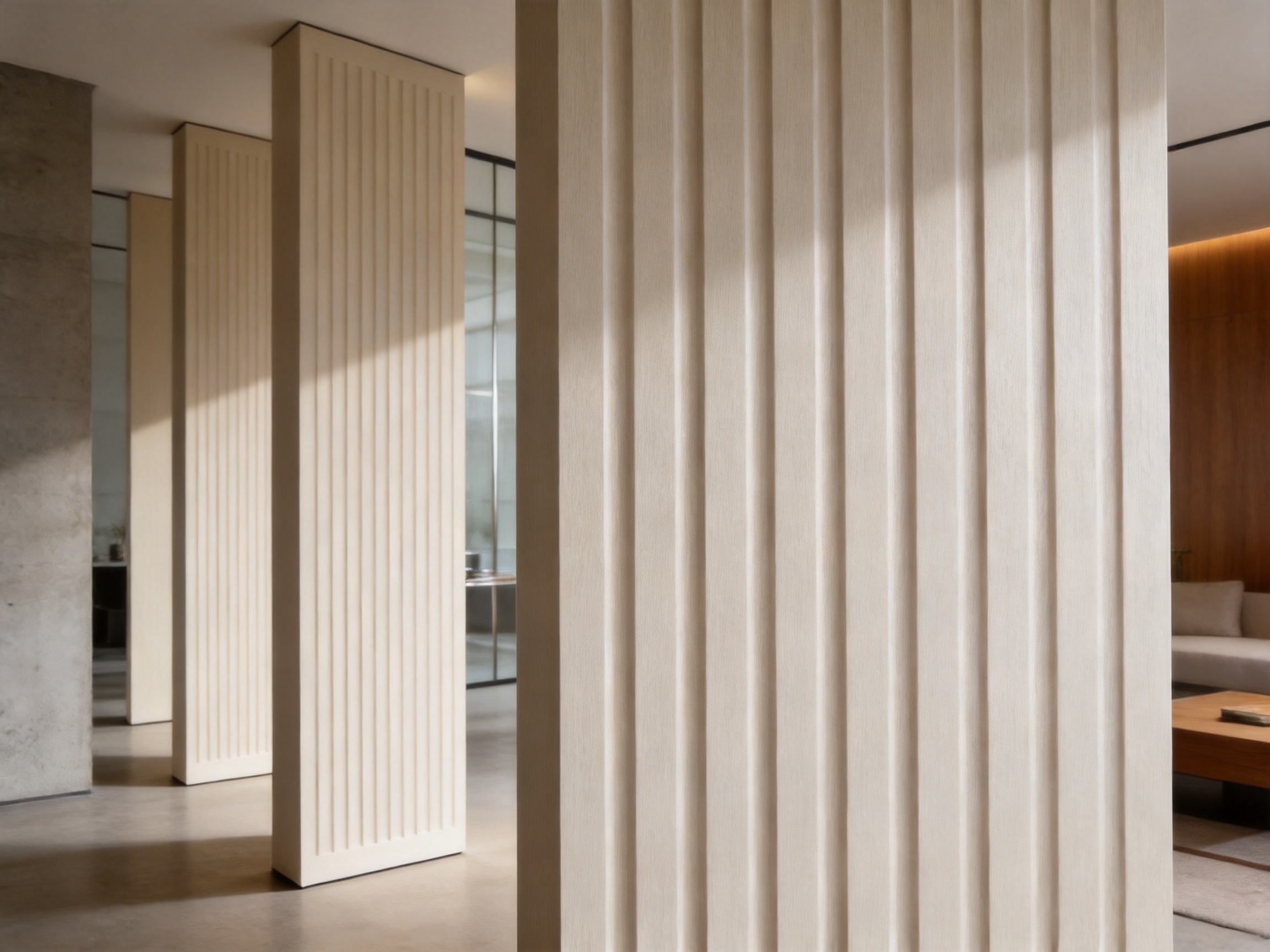
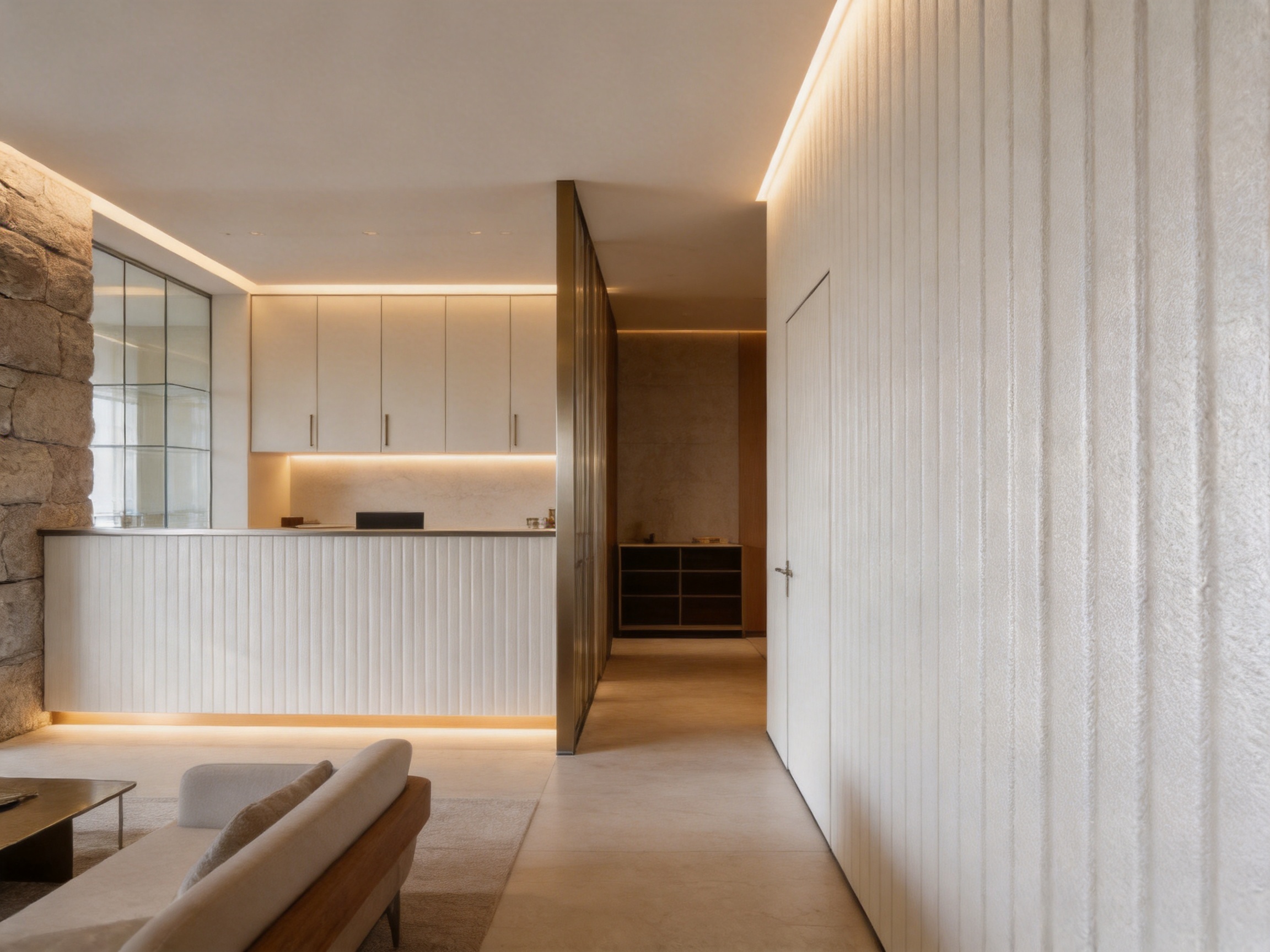
The grooves and ridges of ZZ25 interact with natural and artificial light. As light moves across the surface, raised and recessed areas produce subtle changes in brightness and shadow. This effect gives a large wall or cabinet elevation more visual interest than a completely flat panel while avoiding the complexity of heavily sculpted surfaces.
Lighting direction can influence the appearance of the panel. Light from above may emphasize vertical grooves and make a wall appear taller. Side lighting can create stronger shadow definition and reveal the depth of the embossing. Diffused lighting produces a softer, more uniform appearance. This flexibility allows the same material to be used in different environments while achieving different levels of visual prominence.
Perceived Spatial Expansion
Vertical lines can make a ceiling appear higher by directing the eye upward. This does not physically increase room height, but it can change how the room is perceived. The effect may be especially useful in apartments, offices, retail units, corridors, and hospitality spaces with standard ceiling heights.
When used on a full-height wall, ZZ25 can provide a continuous vertical emphasis. When applied only to a feature zone, it can frame a reception desk, television wall, headboard, entrance, or display area. The panel can also be installed horizontally when the design objective is to visually widen a wall or emphasize a long architectural axis.
Deep Embossing Technology and Surface Performance
The principal technical characteristic of ZZ25 is its deep embossed finish. Ordinary printed decorative paper can provide color and visual pattern, but it may not offer a corresponding tactile experience. Deep embossing adds physical relief, allowing the surface to communicate its design through both sight and touch.
Controlled Texture Depth
According to the supplied product information, ZZ25 is produced by controlling hot-press pressure and temperature distribution. The objective is to achieve consistent texture depth across the panel. Regular grooves and ridges require greater process control than a flat or lightly textured surface because variations can become visible across large areas.
When embossing depth is consistent, the panel presents a cleaner visual rhythm. The grooves appear more deliberate, and the transitions between raised and recessed areas remain sharp. This helps prevent the surface from looking blurred or uneven, particularly when it is viewed under directional lighting.
Uniform embossing also supports project consistency. In commercial interiors, multiple panels may be installed across walls, partitions, counters, doors, or furniture. If the texture depth varies significantly from one panel to another, the completed installation may look inconsistent. Controlled production helps reduce that risk, although installers should still follow recommended handling, orientation, and batch-matching procedures.
Thermosetting Resin Protection
The melamine surface contains a thermosetting resin layer. During pressing, this resin forms a hard protective surface over the decorative paper. The result is a finished panel that is intended to resist everyday abrasion, surface marking, heat exposure within normal use conditions, and staining better than many unprotected decorative surfaces.
The resin layer also helps retain the embossed contours. Rather than leaving the decorative paper as a vulnerable printed layer, the process consolidates the surface into a durable finish. The precise performance of any panel depends on its substrate, thickness, edge treatment, installation conditions, and maintenance practices, but the melamine surface provides a strong practical foundation for interior applications.
It is important to distinguish between resistance and complete immunity. No decorative panel should be treated as indestructible. Excessive heat, standing moisture, harsh chemicals, impact, incorrect cutting, or unsuitable cleaning products may damage the surface. Nevertheless, the combination of a hard melamine finish and a deep embossed pattern makes ZZ25 well suited to environments where daily handling and regular cleaning are expected.
Advantages Compared with Competing Decorative Surfaces
Compared with Flat Melamine Panels
Flat melamine panels are economical and versatile, but they may appear visually plain over large surfaces. ZZ25 adds physical depth and light variation without requiring a separate decorative layer or complicated finishing process. This can help designers create a more distinctive interior while retaining the practical characteristics of a melamine-faced board.
The linear embossing also offers a degree of visual masking. Minor dust, fingerprints, and light surface marks may be less conspicuous on a textured panel than on a completely smooth, dark, or high-gloss surface. This does not eliminate cleaning requirements, but it can help maintain a more consistent appearance between maintenance cycles.
Compared with Natural Wood Veneer
Natural wood veneer provides authentic grain variation and material character, but it can require careful selection, matching, coating, and maintenance. Natural timber appearance may also vary substantially between sheets. For projects requiring a highly consistent geometric appearance across many panels, a manufactured linear surface can offer more predictable repetition.
ZZ25 is also positioned as a cost-effective alternative to natural veneer, lacquer, and PET finishes. The melamine-faced construction can reduce the need for additional finishing steps after the panel is produced. Depending on the project and substrate, this may support faster installation, more consistent procurement, and lower overall finishing costs.
Unlike natural wood, ZZ25 does not attempt to reproduce irregular annual rings, knots, or species-specific character. Its advantage is not natural authenticity; it is controlled design consistency. This makes it particularly appropriate where the interior concept depends on repetition, precision, and visual order.
Compared with Lacquered Panels
Lacquered panels can achieve smooth, vibrant, and premium-looking surfaces, but they may require more careful handling to avoid visible fingerprints, scratches, and localized damage. Glossy finishes can also emphasize surface imperfections and may demand frequent cleaning in high-contact areas.
ZZ25 offers a more tactile and lower-glare alternative. The textured finish breaks up reflections and creates a layered appearance. Its linear pattern can help reduce the visual prominence of minor marks, which is useful for cabinet fronts, walls, doors, and commercial interiors exposed to frequent contact.
Compared with PET and Other Decorative Films
PET-faced products are valued for their color range, smoothness, and contemporary appearance. However, not every project requires a soft-touch or high-gloss film. ZZ25 provides a deeper, more architectural surface that can be used where texture and shadow are more important than a perfectly flat appearance.
Its suitability depends on the design brief. A project requiring a seamless glossy cabinet may select PET, while a project seeking structured relief and a more robust visual rhythm may prefer a deep embossed melamine board. The ability to choose between these surfaces allows designers to assign different materials to different functions within the same project.
Compared with Handcrafted Wall Treatments
Hand-applied wall treatments, slatted systems, carved panels, and custom decorative features can create strong visual effects, but they may require more labor, longer installation schedules, and greater coordination between trades. ZZ25 can deliver a three-dimensional linear appearance in a standardized board format, making it easier to plan, cut, transport, and install.
For large-scale projects, repeatable production is a significant advantage. Standardized boards can support quantity planning, replacement management, and consistent visual results across multiple locations. This is particularly useful for chain stores, hotel groups, serviced apartments, offices, and commercial developments with repeated interior layouts.
Manufacturing Strengths of YAKCO New Materials
YAKCO New Materials (Jiangsu) Co., Ltd. was established in 2007 and focuses on decorative panels and wall panels for residential and commercial interiors. Its experience in the sector provides a foundation for developing products that combine decorative appearance with manufacturing repeatability.
The company’s facility covers approximately 50 acres and includes more than 30,000 square meters of modern standard factory buildings. A production base of this scale can support organized material storage, dedicated production areas, equipment integration, quality-control procedures, and coordinated delivery for project orders.
Focus on Three-Dimensional Decorative Panels
The company has developed expertise in three-dimensional decorative panel technology. This specialization is relevant to ZZ25 because the product depends on accurate surface relief rather than color printing alone. Three-dimensional panels require attention to embossing tools, paper positioning, pressing conditions, cooling, board flatness, and surface inspection.
Its reported deep-pressing processes are designed to enhance depth, layering, and tactile definition. These characteristics help distinguish ZZ25 from products that use only a shallow printed or embossed effect. Deeper relief gives the panel a stronger material presence and allows lighting to reveal the design more clearly.
Multiple Core Production Processes
YAKCO reports the development of six core production processes. While the exact process sequence may vary by product, a complete decorative-panel manufacturing system generally involves substrate preparation, decorative-paper treatment, alignment, hot pressing, surface inspection, sizing or trimming, and packaging. Each stage can affect the final panel.
Substrate preparation influences flatness, density, screw-holding performance, machining behavior, and dimensional stability. Decorative-paper preparation affects color, pattern continuity, and resin distribution. Alignment is important for maintaining the intended direction of the straight-line texture. Hot pressing determines bonding quality and embossing definition. Final inspection helps identify visual defects, edge issues, surface contamination, or dimensional deviations before shipment.
The integration of these steps is particularly important for deep embossed products. A decorative surface can look attractive in a sample but perform poorly in production if pressure, temperature, moisture, or board properties are not controlled. Manufacturing discipline helps convert a design concept into a repeatable commercial material.
MDI Medical Adhesive Bonding
The company also identifies MDI medical adhesive bonding as one of its technical strengths. MDI, or methylene diphenyl diisocyanate, is used in certain engineered wood and composite-board bonding systems. The supplied company information associates this technology with improved bonding performance and environmental objectives.
Adhesive selection influences emissions, moisture response, internal bond strength, and long-term stability. In a decorative panel, the bonding system is not visible, but it contributes to the reliability of the substrate beneath the melamine surface. Proper adhesive application and curing are therefore essential to reducing risks such as delamination, swelling, and deformation.
Because environmental performance depends on the complete board construction rather than the adhesive name alone, buyers should request current test reports and certifications for the precise product configuration being purchased. The substrate, thickness, production date, and market standard should all be identified in the documentation.
Deformation Resistance and Ease of Processing
YAKCO describes its products as offering stability, easy cutting, and deformation resistance. These attributes are important for furniture manufacturers, contractors, and installers. A board that can be accurately cut and assembled reduces material waste and helps improve the quality of finished edges, joints, doors, and wall modules.
Processing should be performed with tools and parameters appropriate to the selected substrate and thickness. Deep embossed surfaces may require careful support during cutting and handling to avoid chipping, crushing, or localized damage. Edge treatment should be selected according to the application, and exposed edges should not be left vulnerable to water penetration or impact.
Environmental and Indoor-Air Considerations
The supplied product information lists E0, E1, and P2 environmental grades in the general specifications, while the product information table identifies P2/F4. The company description also states that its products are designed to meet the international ENF formaldehyde standard. Because these classifications may apply to different substrates, markets, or product series, buyers should confirm the exact environmental grade for the ZZ25 configuration in their purchase order.
Environmental performance is determined by the complete board assembly, including the core substrate, adhesive system, decorative paper, resin, edge treatment, and manufacturing conditions. A melamine surface alone does not define the formaldehyde classification of the entire product. Professional purchasers should request current test reports from an accredited laboratory or an appropriate certification body.
For residential projects, schools, offices, hotels, and healthcare-related interiors, indoor-air requirements may be especially strict. The correct product should be selected according to the applicable local regulations. Installation should also provide adequate ventilation, and cutting dust should be controlled through suitable extraction and personal protective equipment.
The use of wood-based panels can support material efficiency because engineered boards make use of wood fibers, strands, particles, or veneers in a controlled format. However, responsible sourcing, production emissions, packaging, transportation, service life, and end-of-life handling should all be considered when evaluating the environmental profile of an interior material.
Application Scenarios
Residential Interiors
ZZ25 can be used for wardrobe doors, cabinet doors, interior doors, feature walls, hallway walls, television backgrounds, bedroom headboards, and selected furniture components. Its vertical texture can help make compact spaces feel more open, while its relatively neutral pattern allows residents to update furniture, lighting, and accessories without replacing the entire wall finish.
In a wardrobe application, the panel can become the principal decorative element on the door fronts. In a hallway, it may be installed as a full-height wall treatment or used to frame an entrance zone. In a living room, the linear surface can provide a background for shelving, artwork, or a media unit.
For kitchens and utility areas, selection should consider moisture exposure, edge protection, cleaning practices, and the performance of the chosen substrate. The product may be suitable for cabinet doors and panels in normal interior conditions, but it should not be treated as a waterproof board unless the specific configuration has been tested and approved for that use.
Office Interiors
Offices benefit from materials that appear professional without becoming visually tiring. ZZ25 can be used on reception walls, meeting-room feature surfaces, storage doors, workstation screens, acoustic-system backgrounds, and selected partitions. Its linear pattern can reinforce a sense of organization and structure, which is appropriate for corporate, financial, technology, and professional-service environments.
The panel can also help distinguish zones without relying on excessive color contrast. A textured wall behind a reception desk may identify the front-of-house area, while the same surface applied to a corridor or collaboration zone can create continuity across the workplace.
Retail and Brand Showrooms
Retail spaces require surfaces that can withstand frequent contact while supporting the brand’s visual identity. ZZ25 can be used for display back panels, fitting-room walls, cashier counters, product shelving, wall elevations, and entrance features. Its regular texture provides a background that is noticeable but generally less distracting than a highly irregular pattern.
Because the surface can be produced in a consistent format, it may be suitable for brand rollouts involving multiple stores. Repetition of the same panel type can help maintain a recognizable interior language while allowing local teams to adapt furniture layout and merchandising.
Hotels and Hospitality
Hospitality design often requires a balance between comfort, durability, and visual refinement. ZZ25 may be used in guest-room furniture, headboards, corridor walls, reception areas, elevator lobbies, restaurant interiors, and public-space partitions. The linear texture can create a calm, ordered appearance when combined with warm lighting, natural textiles, soft upholstery, and muted colors.
Maintenance is an important consideration in hotels. Surfaces are exposed to luggage, cleaning routines, fingerprints, and repeated contact. A hard melamine surface with a textured pattern can provide a practical alternative to delicate finishes in selected locations, provided that the cleaning chemicals and maintenance procedures are compatible with the product.
Custom Furniture
Furniture manufacturers can use ZZ25 for drawer fronts, cabinet sides, open shelving, tabletop features, bookshelf backs, doors, and decorative inserts. Using the same panel across several components can create a coordinated appearance throughout a room or project.
When the product is used for furniture, attention should be paid to grain direction, joint placement, edge-banding color, door alignment, and the visual continuity between adjacent panels. Because the design is linear, orientation is especially important. A change from vertical to horizontal may be intentional, but an accidental change can appear as a manufacturing error.
Large-Scale Construction Projects
Fully furnished apartments, centralized commercial complexes, chain stores, office developments, and hospitality projects often require stable supply and consistent appearance. ZZ25’s range of sizes, thicknesses, and substrates can help adapt the product to different parts of a project.
For large orders, project teams should establish a technical schedule before production. This schedule may include panel dimensions, substrate type, thickness, surface direction, edge-banding requirements, environmental classification, packaging method, inspection standards, and replacement quantities. Early coordination can reduce delays and limit the risk of mixing incompatible configurations on site.
Installation and Handling Recommendations
Successful performance depends not only on product quality but also on storage, handling, fabrication, and installation. Boards should be stored flat on a dry, level surface and protected from direct moisture, excessive heat, and impact. They should be acclimatized to the installation environment when recommended by the supplier.
During transport, panels should be supported adequately to reduce bending and corner damage. The embossed face should be protected from abrasion. Dragging boards across rough surfaces can damage the decorative finish, even when the melamine surface has good normal-use resistance.
Before cutting, installers should confirm the texture direction and establish a cutting plan. For visible furniture and wall applications, parts should be laid out so that the linear pattern follows the design intent. Cutting tools should be sharp and suitable for the chosen substrate. Excessive feed speed or unsuitable blades may cause edge chipping or surface breakout.
Edges should be sealed, banded, or otherwise protected according to the application. The listed matched edge-banding options include 1 × 26 mm and 1 × 56 mm configurations. The correct edge treatment should be confirmed with the supplier because edge-banding dimensions and compatibility can depend on the board thickness and fabrication method.
Adhesives, fasteners, clips, and support systems should be selected according to the substrate and installation environment. Wall panels require a stable, clean, and sufficiently level backing surface. Large panels may require mechanical support or a designed subframe. Installers should avoid trapping moisture behind the panel and should provide appropriate movement allowances where required by the construction system.
Cleaning and Maintenance
Routine maintenance is straightforward when the surface is treated correctly. Dust and loose particles can generally be removed with a soft cloth or a suitable vacuum attachment. Light dirt may be cleaned with a damp, non-abrasive cloth and a mild cleaning solution approved for melamine surfaces.
Abrasive powders, steel wool, rough scouring pads, strong solvents, and untested chemical cleaners should be avoided. These products may dull the surface, alter the resin layer, or leave visible marks within the embossed grooves. Spills should be removed within a reasonable period, particularly around exposed edges and joints.
Although the textured pattern may make minor marks less noticeable, routine cleaning remains important in kitchens, hospitality settings, healthcare environments, and high-traffic commercial locations. Maintenance teams should use a consistent cleaning method and test any new product on an inconspicuous area first.
Cost and Procurement Value
ZZ25 is positioned as a cost-effective alternative to higher-priced decorative finishes such as natural wood veneer, lacquer, and selected PET products. The value proposition comes from several factors: a standardized melamine-facing process, multiple substrate choices, repeatable embossing, reduced need for on-site finishing, and suitability for both individual furniture pieces and larger installations.
The supplied information lists indicative prices for several 2745 × 1220 mm board configurations: 25 mm at approximately 56 USD, 22 mm at approximately 51.60 USD, 18 mm at approximately 46 USD, 12 mm at approximately 40 USD, and 9 mm at approximately 36.50 USD. These figures should be treated as reference information rather than fixed quotations. Actual pricing may vary according to quantity, substrate, finish, packaging, shipping terms, certification, edge treatment, and customization.
Total project value should be assessed rather than comparing sheet prices alone. A material that arrives ready for use, produces less finishing waste, and maintains a consistent appearance across repeated units may reduce labor and coordination costs. The availability of longer panels may also reduce horizontal joints or the number of pieces required in certain wall applications.
For international procurement, buyers should also calculate freight, import duties, insurance, local warehousing, cutting waste, replacement stock, and installation accessories. A complete bill of materials provides a more accurate comparison with veneer, painted boards, slatted systems, or custom wall treatments.
Why Straight-Line Texture Works for Large Areas
Large surfaces create a common design challenge: a material must provide enough character to avoid looking empty, but not so much visual variation that the space becomes restless. ZZ25 addresses this challenge through repetition. The linear pattern produces rhythm without relying on dramatic color changes or irregular motifs.
Repetition also helps organize a composition. A continuous panel installation can guide the eye along a corridor, frame a wall, or connect separate pieces of built-in furniture. Vertical lines may establish height, while horizontal arrangements can emphasize length. The designer can therefore use the same product to respond to different spatial geometries.
The texture’s visual noise-canceling quality is another practical advantage. Dust, fingerprints, and small marks may be less obvious when the eye is already reading a field of lines and shadows. This can be particularly useful around entrances, hallways, cabinet doors, retail displays, and other areas where completely smooth surfaces may show every contact mark.
At the same time, the product remains sufficiently restrained for repeated use. A highly decorative motif may become tiring when applied to every wall or every store in a chain. The rational appearance of ZZ25 is more likely to remain compatible with changing furniture, signage, artwork, and merchandising systems.
Quality-Control Points for Buyers
Professional buyers should inspect samples before approving a large order. The sample should be evaluated under the lighting conditions expected at the project site. Surface depth, gloss level, color consistency, edge quality, flatness, and texture direction should all be reviewed.
Buyers should confirm whether the selected panels come from the same production batch or whether batch variation is acceptable. They should also request drawings or technical data showing the nominal thickness, board tolerance, usable dimensions, substrate density, formaldehyde classification, and recommended processing method.
For a project using multiple thicknesses or substrates, each configuration should be identified separately. A 9 mm decorative board and a 25 mm furniture panel may have different processing, support, and edge-treatment requirements even when they share the same surface pattern.
Packaging should protect the embossed face, corners, and edges during transportation. For overseas orders, moisture protection and container loading should be discussed in advance. It is also advisable to order a reasonable quantity of spare panels for future repairs, particularly when the project uses a distinctive finish that may be difficult to match later.
Q&A: Frequently Asked Questions
What makes ZZ25 different from a conventional melamine board?
ZZ25 combines a melamine-faced construction with a deep embossed straight-line texture. Conventional melamine boards may have a flat or lightly textured surface, while ZZ25 adds stronger physical relief, tactile depth, and light-and-shadow variation.
Does ZZ25 imitate natural wood?
The surface is described as a deep embossed wood texture, but its design philosophy is geometric rather than naturalistic. It uses regular straight lines instead of irregular timber grain, knots, or species-specific patterns.
What substrates are available?
The listed options include LSB, SOSB or OSB-type board, MDF, high-moisture-resistant MDF, fire-resistant MDF, particleboard, fireproof board, and veneer-related options. Availability should be confirmed for the required thickness, size, market, and order quantity.
What sizes and thicknesses are available?
Common thicknesses include 1.5 mm, 9 mm, 12 mm, 18 mm, 22 mm, and 25 mm. The standard listed size is 1220 × 2745 mm, with additional lengths of 2800 mm, 3050 mm, and 3300 mm available for selected configurations.
Can the panel be used for cabinet doors?
Yes, cabinet doors are among the intended applications. The selected thickness, substrate, hinge system, door dimensions, edge treatment, and environmental conditions should be checked before fabrication.
Is the surface suitable for high-traffic areas?
The melamine surface is designed to provide scratch, heat, and stain resistance under normal interior use. Its linear texture may also make minor marks less visible. However, the panel is not indestructible and should be protected from severe impact, standing water, harsh chemicals, and excessive heat.
Can ZZ25 be used in kitchens?
It may be used for selected kitchen cabinet and wall applications when the chosen substrate and edge treatment are appropriate. The product should not be considered waterproof unless the specific configuration has been tested for that purpose. Edges, joints, and areas near sinks or appliances require particular attention.
Does the product have an environmental certification?
The supplied information lists E0, E1, P2, and F4 classifications in different product descriptions and states that the company develops products meeting ENF formaldehyde requirements. Because classifications may vary by substrate and market, buyers should request current documentation for the exact ZZ25 configuration.
How should the panel be cleaned?
Use a soft cloth, mild cleaning solution, and limited moisture. Avoid abrasive cleaners, rough pads, strong solvents, and untested chemicals. Spills should be removed promptly, especially near edges and joints.
Can the panel be customized?
The supplied information identifies several sizes, substrates, thicknesses, and edge-banding options. Customization possibilities should be discussed directly with the manufacturer, including color, dimensions, surface direction, substrate, packaging, and project quantities.
Is ZZ25 appropriate for commercial chain projects?
Its standardized appearance, flexible board formats, and suitability for furniture, walls, partitions, retail interiors, hotels, and offices make it appropriate for consideration in chain projects. A project-specific quality standard and supply schedule should be established before mass production.
What information should be included in a purchase order?
The order should identify the product name, surface pattern, color, thickness, dimensions, substrate, environmental grade, edge-banding requirement, quantity, packaging, inspection standard, delivery terms, and any required certificates or test reports.
Conclusion
The ZZ25 Straight Line Texture Panel presents a disciplined alternative to decorative surfaces based primarily on natural imitation. Its identity comes from geometry, repetition, and controlled relief. The straight-line pattern creates visual order, supports spatial direction, and works with a wide range of interior styles and companion materials.
Its deep embossed melamine surface combines tactile depth with practical resistance to everyday wear. Compared with flat boards, it offers more visual character. Compared with natural veneer, lacquer, and some specialty finishes, it can provide more consistent production and a potentially lower overall finishing cost. Its multiple thicknesses, dimensions, and substrate options make it suitable for furniture, cabinetry, wall panels, partitions, doors, retail environments, offices, hotels, and large-scale developments.
The manufacturing capabilities of YAKCO New Materials strengthen the product proposition. The company’s experience, modern factory, focus on three-dimensional decorative panels, deep-pressing technology, multiple production processes, and MDI adhesive-bonding expertise support the development of stable and repeatable decorative boards.
For designers, ZZ25 offers a long-lasting visual language that is unlikely to depend on a short-term trend. For manufacturers and contractors, it offers a practical panel format with adaptable substrates and thicknesses. For project owners, it offers a balance between appearance, performance, supply flexibility, and cost control.
The central idea is simple: straight lines can create extraordinary spatial results when they are manufactured with precision. By combining geometric restraint with deep embossed technology and a durable melamine surface, ZZ25 provides a versatile material for modern residential, commercial, hospitality, and custom-furniture applications.
References
1. YAKCO New Materials (Jiangsu) Co., Ltd. Product information for the ZZ25 Straight Line Texture Panel, including dimensions, thicknesses, substrates, surface finish, environmental grades, and application data.
2. YAKCO New Materials (Jiangsu) Co., Ltd. Company profile and manufacturing information concerning three-dimensional decorative panel technology, deep pressing, MDI adhesive bonding, factory capacity, and product development.
3. Product specification table supplied for ZZ25, including indicative board dimensions, thickness-based pricing, substrate information, and environmental classifications.
4. General technical principles of melamine-faced wood-based panels, thermosetting resin surfaces, deep embossing, substrate selection, edge protection, and interior-panel maintenance.
5. General interior-design principles concerning geometric repetition, vertical visual emphasis, material coordination, lighting interaction, and large-area decorative surface planning.