中文简体



Previous Post
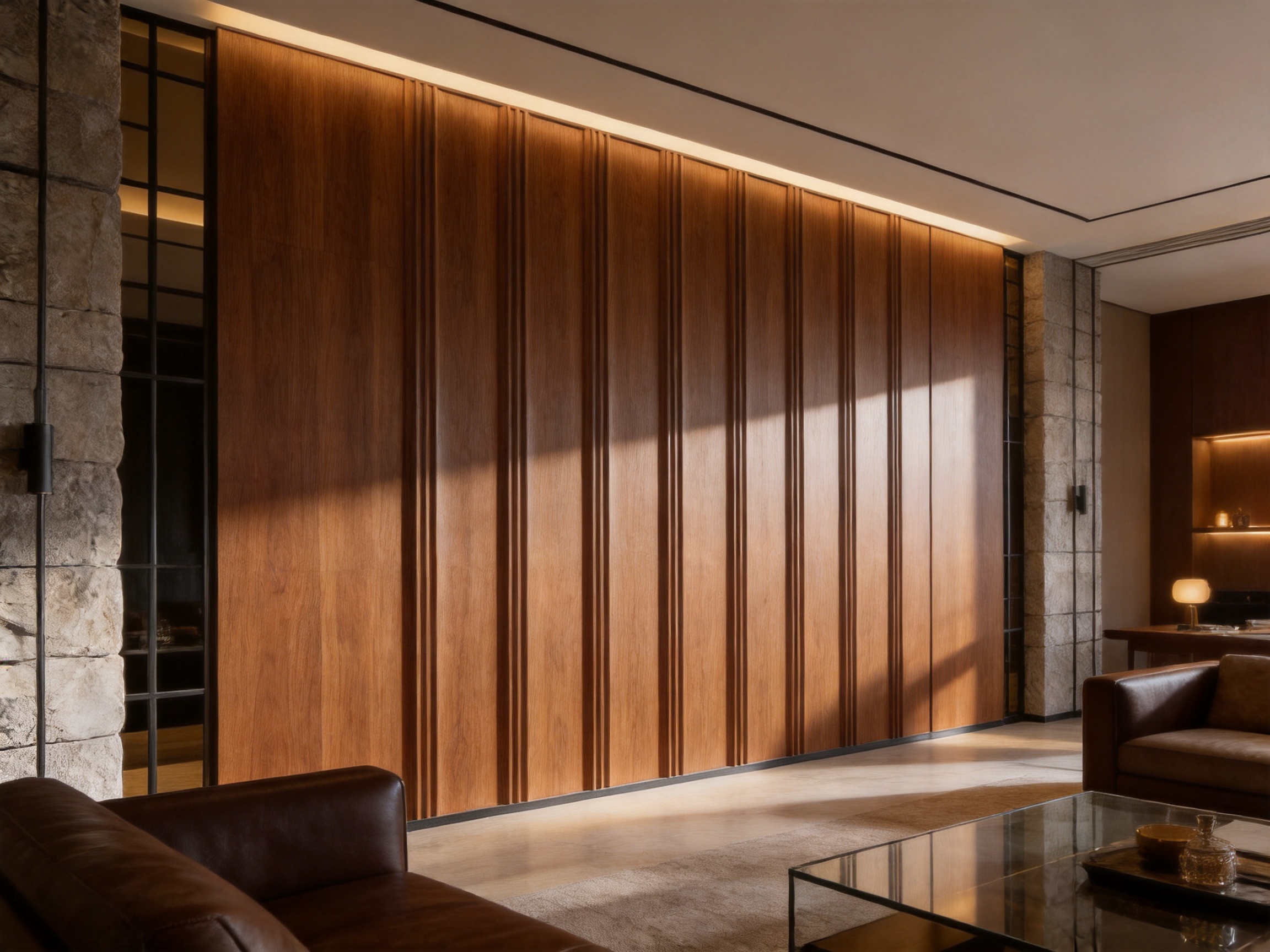
Interior design is increasingly moving beyond purely visual decoration. In contemporary residential, hospitality, retail, office, and commercial environments, designers and clients want surfaces that look refined, feel distinctive, perform reliably, and remain practical throughout years of use. The PZ01 Leather1 Texture Panel responds to this demand with a carefully developed leather-inspired finish applied to a melamine-faced panel substrate.
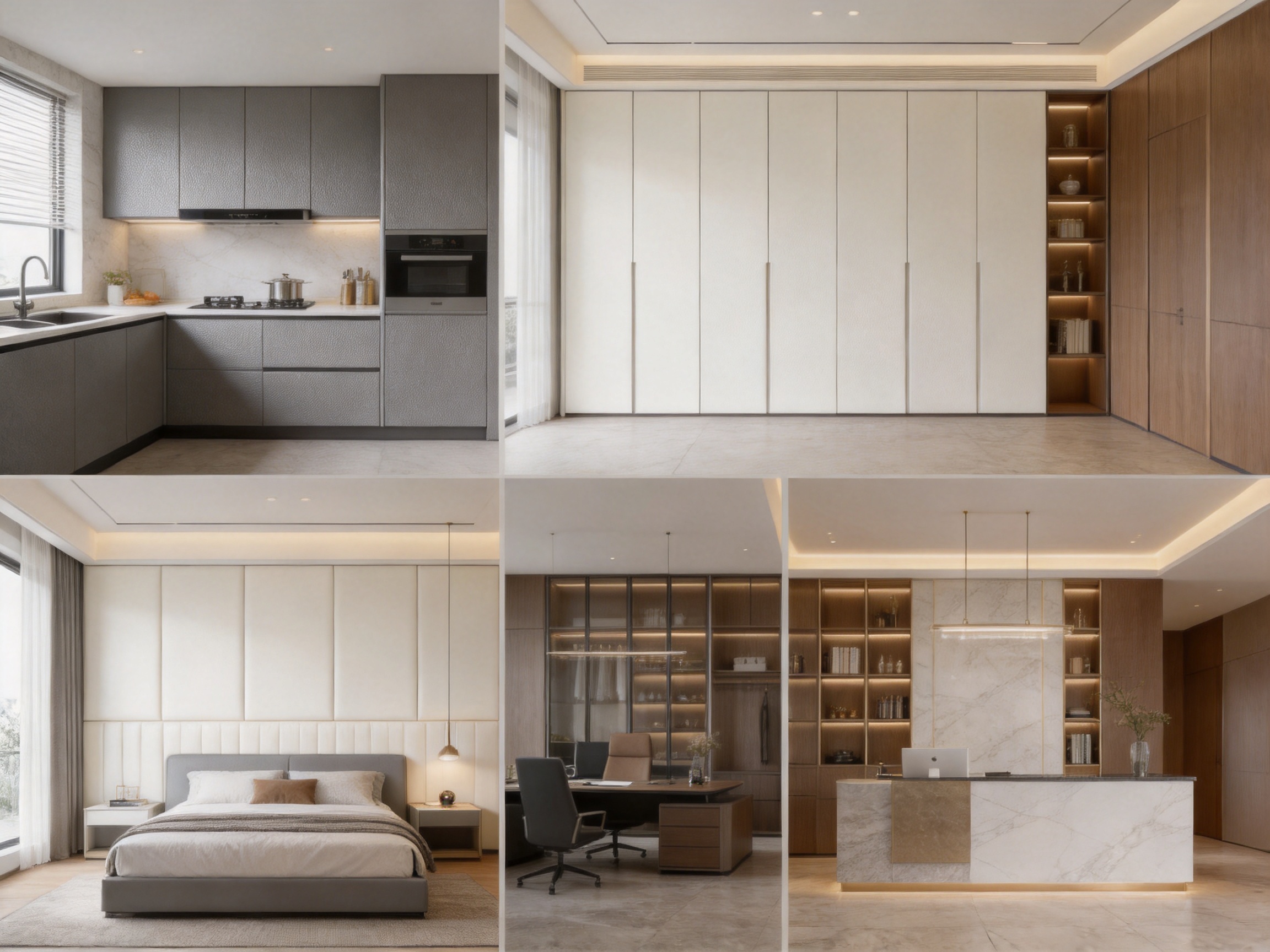
The panel combines a restrained solid-color appearance with a fine leather grain, creating a surface that is visually calm but tactilely rich. It is intended for spaces where luxury should feel natural rather than excessive: modern kitchens, wardrobes, feature walls, reception areas, bedrooms, executive offices, retail displays, hospitality interiors, and custom furniture.
Unlike genuine leather finishes, the PZ01 panel is not dependent on the natural variation, maintenance requirements, or sensitivity associated with animal hide. Instead, precision deep embossing and a specialized skin-like coating reproduce the subtle grain and soft visual character of fine leather on a stable, engineered decorative board. The result is an accessible light-luxury material that offers coordinated appearance, manufacturing consistency, ease of fabrication, and practical daily performance.
1. What Is the PZ01 Leather1 Texture Panel?
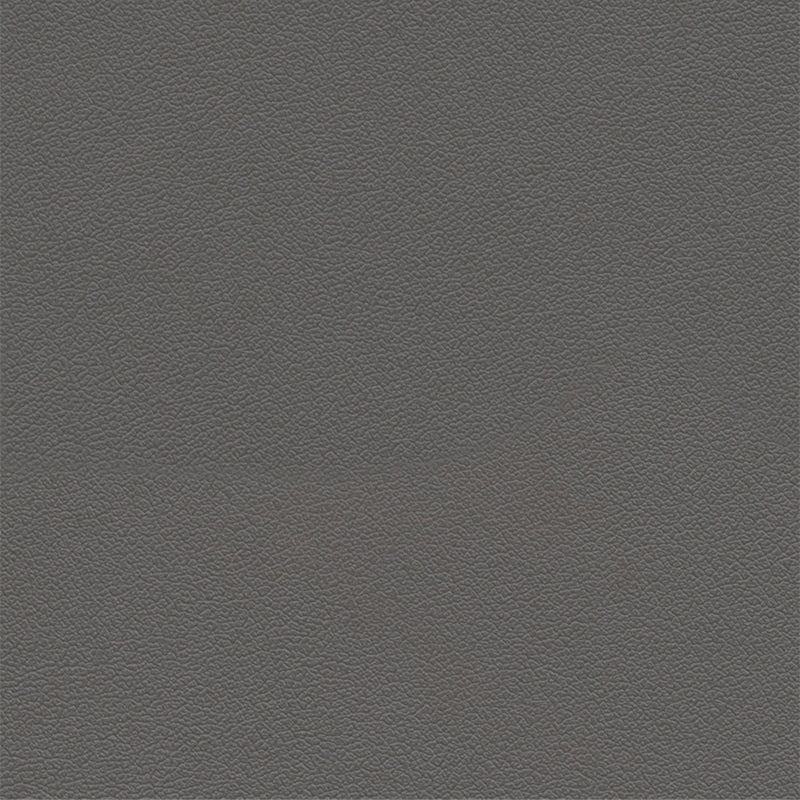
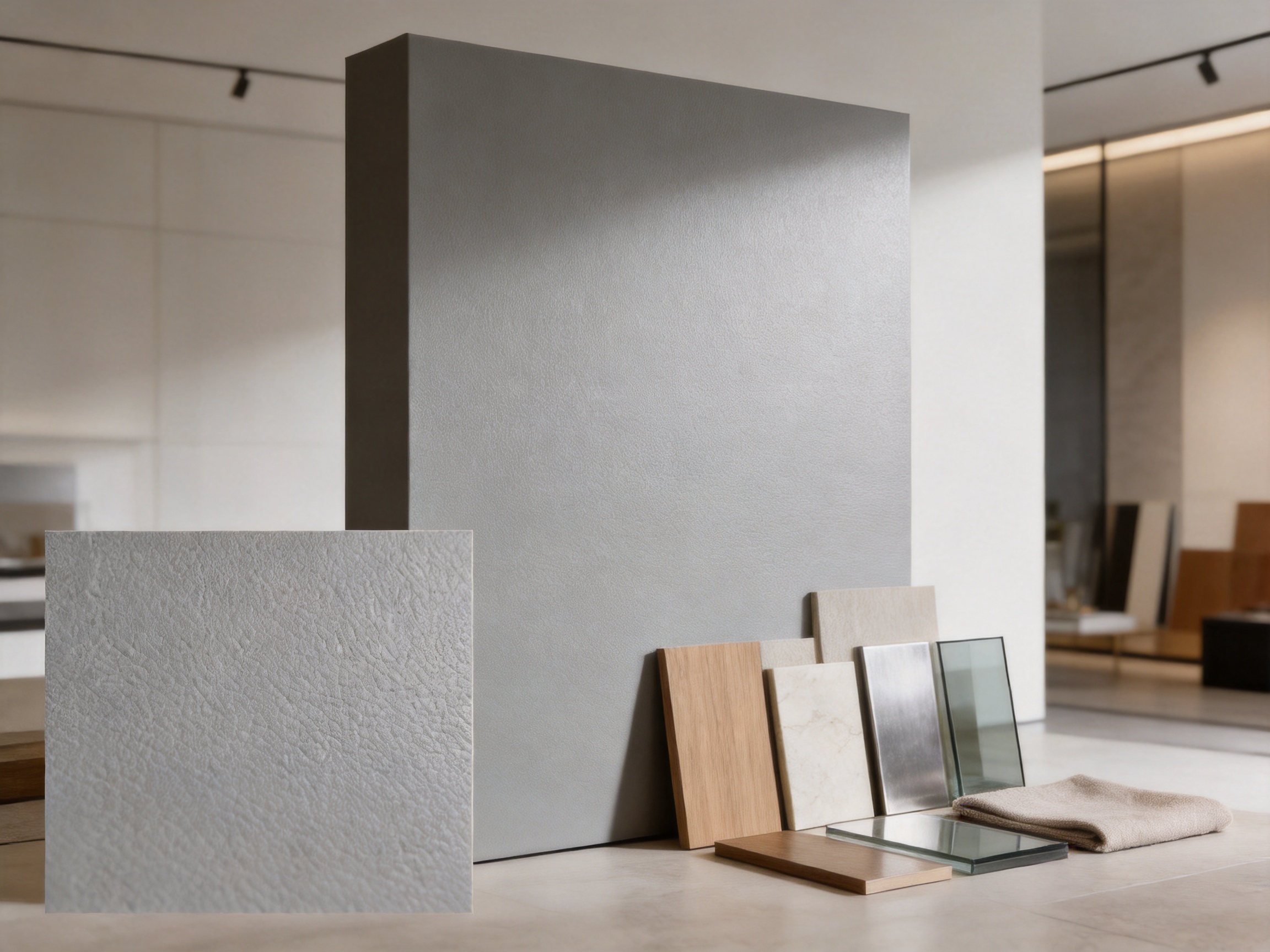
The PZ01 Leather1 Texture Panel is a melamine-faced decorative panel featuring a light leather-textured surface. Its design is based on the modern interpretation of fine leather rather than on a heavily patterned or exaggerated imitation. The grain is delicate, controlled, and sufficiently understated to integrate with a broad range of interior styles.
The surface is available in refined neutral tones, including Cloud Gray, Pure White, and Cloud White Fine Leather Grain. These colors are designed to create a sophisticated foundation for interior compositions. They can be paired with natural wood, stone, metal, glass, textile, painted surfaces, or other decorative panels without overwhelming adjacent materials.
At a visual level, the panel offers the clean appearance of a solid-color board. At a tactile level, it introduces a fine embossed structure that can be experienced through touch and seen through the way light moves across the surface. This combination gives the panel greater depth than an ordinary flat board while preserving the simplicity required by minimalist and contemporary design.
The panel is produced using melamine-impregnated decorative paper and can be manufactured on several substrate types, including LSB, SOSB, MDF, HMR MDF, particleboard, fire-resistant board, wood veneer, and plywood. The supplied product information also identifies OSB, MDF, and particleboard as relevant substrate options. This range allows the material to be specified according to structural needs, moisture considerations, machining requirements, fire-related project conditions, and budget.
2. The Design Philosophy Behind Light Luxury
Light luxury is sometimes misunderstood as a style dependent on metallic accents, ornamental details, or visibly expensive materials. In practice, modern light luxury is often more restrained. Its defining qualities are proportion, material quality, tactility, subtle contrast, and a sense of controlled refinement.
The PZ01 panel supports this interpretation by placing emphasis on surface quality rather than visual excess. Its fine leather grain does not dominate the room. Instead, it adds an almost textile-like softness to a rigid architectural surface. The result is a material that can be used across larger areas without becoming visually tiring.
In a wardrobe, for example, a Cloud Gray leather-textured door can provide a calm, sophisticated appearance while avoiding the coldness of a completely smooth gray panel. In a bedroom, Pure White can make cabinetry appear clean and architectural while the embossed grain prevents the surface from feeling sterile. In an executive office or hospitality setting, the same texture can create a premium impression without the expense and maintenance of genuine leather wall covering.
The design is particularly suitable for projects that rely on material layering. A fine leather texture may be placed beside a wood-grain panel to create a contrast between natural linear movement and soft granular detail. It may also be combined with stone-look surfaces, dark metal, brushed aluminum, smoked glass, or warm lighting. Because the color palette is restrained, the panel can serve either as a quiet background or as a tactile accent.
2.1 Visual restraint with tactile richness
Minimalist interiors frequently face a technical and aesthetic challenge: when decoration is reduced, the quality of each remaining material becomes more important. A flat surface with no variation may look inexpensive or unfinished, while a heavily patterned surface may undermine the intended calmness of the space.
PZ01 addresses this balance through a fine-grain structure. The panel remains visually organized and easy to coordinate, yet it offers enough relief to catch light and reward close inspection. This is especially valuable on cabinet fronts, wall panels, headboards, reception counters, and built-in furniture, where users may see or touch the surface at close range.
2.2 A modern alternative to natural leather
Natural leather can communicate quality, but it also presents practical limitations. It may require specialized care, show color variation, respond to humidity, develop marks, and involve higher material and installation costs. Large-scale application can be particularly difficult when a project requires consistent color, repeatable dimensions, and predictable surface appearance.
The PZ01 panel offers a leather-inspired alternative with a more controlled manufacturing result. The grain is engineered rather than naturally variable, making it easier to achieve consistency across multiple boards. The panel can also be processed using standard furniture and interior fabrication methods appropriate to its selected substrate, allowing manufacturers and contractors to plan production more efficiently.
This does not mean that the panel should be regarded as a direct replacement for every genuine leather application. Rather, it is a purpose-designed architectural surface that captures the visual and tactile character associated with fine leather while offering the dimensional stability, cleanability, and cost structure of a decorative engineered panel.
PZ01 Leather1 texture Panel-Light Luxury
3. Surface Construction and Material Composition
The visible finish of the PZ01 panel is produced with melamine-impregnated paper. Melamine decorative surfaces are widely used in furniture and interior applications because they can provide a durable, consistent, and cleanable finish over an engineered board substrate.
For the PZ01 design, the decorative paper is not simply printed with a leather image. The product concept depends on physical surface relief. Precision deep-embossing technology creates a fine grain that can be seen in the interaction of light and felt during use. This physical texture is central to the product’s identity and differentiates it from a flat printed imitation.
The panel’s surface finish is described as a light leather texture. This indicates a design direction that favors a delicate, refined grain rather than a deep, rugged, or strongly distressed leather effect. The subtle profile is appropriate for contemporary furniture because it contributes texture without making cleaning, visual coordination, or edge detailing unnecessarily complicated.
3.1 Available substrates
The stated substrate options include LSB, SOSB, MDF, HMR MDF, particleboard, fire-resistant board, wood veneer, and plywood. Each substrate offers different benefits, and the correct selection should be made according to the application.
MDF is often chosen when a smooth, uniform core is important for painted-style profiles, routed details, shaped components, and furniture manufacturing. High-moisture-resistant MDF may be considered where the project requires improved resistance to humid conditions, subject to correct sealing, installation, and application limitations.
Particleboard can provide an economical and efficient foundation for cabinets, furniture carcasses, shelving, and other interior components. LSB and SOSB may be selected when the project requires particular structural or board-performance characteristics. Plywood may be appropriate when screw-holding, layered construction, or specific strength requirements are important. Fire-resistant board can be specified for projects where the selected system must comply with applicable fire-performance requirements.
The substrate does not change the basic design language of the PZ01 surface, but it can influence machining, weight, fastening, edge treatment, moisture behavior, and installation. For this reason, project teams should confirm the appropriate board construction before ordering.
3.2 Thickness range
The product information lists thicknesses of 1.5 mm, 9 mm, 12 mm, 18 mm, 22 mm, and 25 mm. The commercial size information specifically lists 9 mm, 12 mm, 18 mm, 22 mm, and 25 mm products. The thinner 1.5 mm specification may relate to a particular panel configuration, facing material, or project offering and should be confirmed during technical communication.
The 9 mm and 12 mm formats can be suitable for selected wall applications, furniture components, decorative inserts, and systems where reduced weight is helpful. The 18 mm format corresponds closely to a common furniture-board thickness and may be suitable for cabinet doors, panels, shelving, and built-in furniture. The 22 mm and 25 mm formats can provide a more substantial visual and structural presence for premium cabinetry, counters, partitions, and architectural features.
Thickness selection should consider span, fixing method, edge exposure, hardware, door size, panel weight, and the requirements of the selected substrate. A decorative finish alone does not determine structural suitability; the entire panel assembly must be evaluated for the intended use.
4. Dimensions and Product Specifications
The standard listed panel dimension is 1220 × 2745 mm. Additional dimensions include 1220 × 2800 mm, 1220 × 3050 mm, and 1220 × 3300 mm. These larger formats can help designers reduce the number of joints in tall wardrobes, wall cladding, reception features, and other broad interior surfaces.
| Specification | Product Information | Practical Relevance |
|---|---|---|
| Surface finish | Light leather texture | Provides subtle grain, tactile depth, and a refined solid-color appearance |
| Finish material | Melamine-impregnated paper | Supports consistent decorative coverage and routine cleanability |
| Listed thicknesses | 1.5 mm, 9 mm, 12 mm, 18 mm, 22 mm, 25 mm | Allows specification for different furniture and interior applications |
| Standard dimension | 1220 × 2745 mm | Suitable for many furniture and wall-panel layouts |
| Additional dimensions | 1220 × 2800 mm, 1220 × 3050 mm, 1220 × 3300 mm | Supports taller or larger-format applications and may reduce joints |
| Substrate options | LSB, SOSB, MDF, HMR MDF, particleboard, fire-resistant board, wood veneer, plywood | Enables selection according to project performance requirements |
| Matching edge banding | 1 × 26 mm and 1 × 56 mm | Helps coordinate exposed panel edges with the decorative surface |
| Environmental information | E0 / E1 / P2 listed; product information also identifies P2/F4 | Provides a basis for project-specific environmental and emissions review |
Large-format availability is valuable because visual continuity is an important part of a luxury interior. Excessive joints can interrupt a leather-like grain, create additional installation work, and reduce the sense of a continuous architectural surface. By offering multiple lengths, the product can be planned for different ceiling heights, furniture dimensions, and wall layouts.
As with all decorative panels, actual dimensions, tolerances, available colors, substrate combinations, and minimum order conditions should be confirmed before production. This is particularly important where panels are being used in a coordinated package with edge banding or other surfaces.
4.1 Matching edge banding
Matching edge banding is listed in 1 × 26 mm and 1 × 56 mm formats. Coordinated edge treatment helps maintain a professional appearance on cabinet doors, shelving, desk components, partitions, and other furniture parts where the board edge is visible.
Edge consistency is especially important with textured surfaces. A mismatched or visually unrelated edge can make a premium panel appear incomplete. Matching edge banding helps extend the color and design language from the face of the panel to the exposed edge, supporting a more integrated finished product.
5. Advanced Deep-Embossing Technology
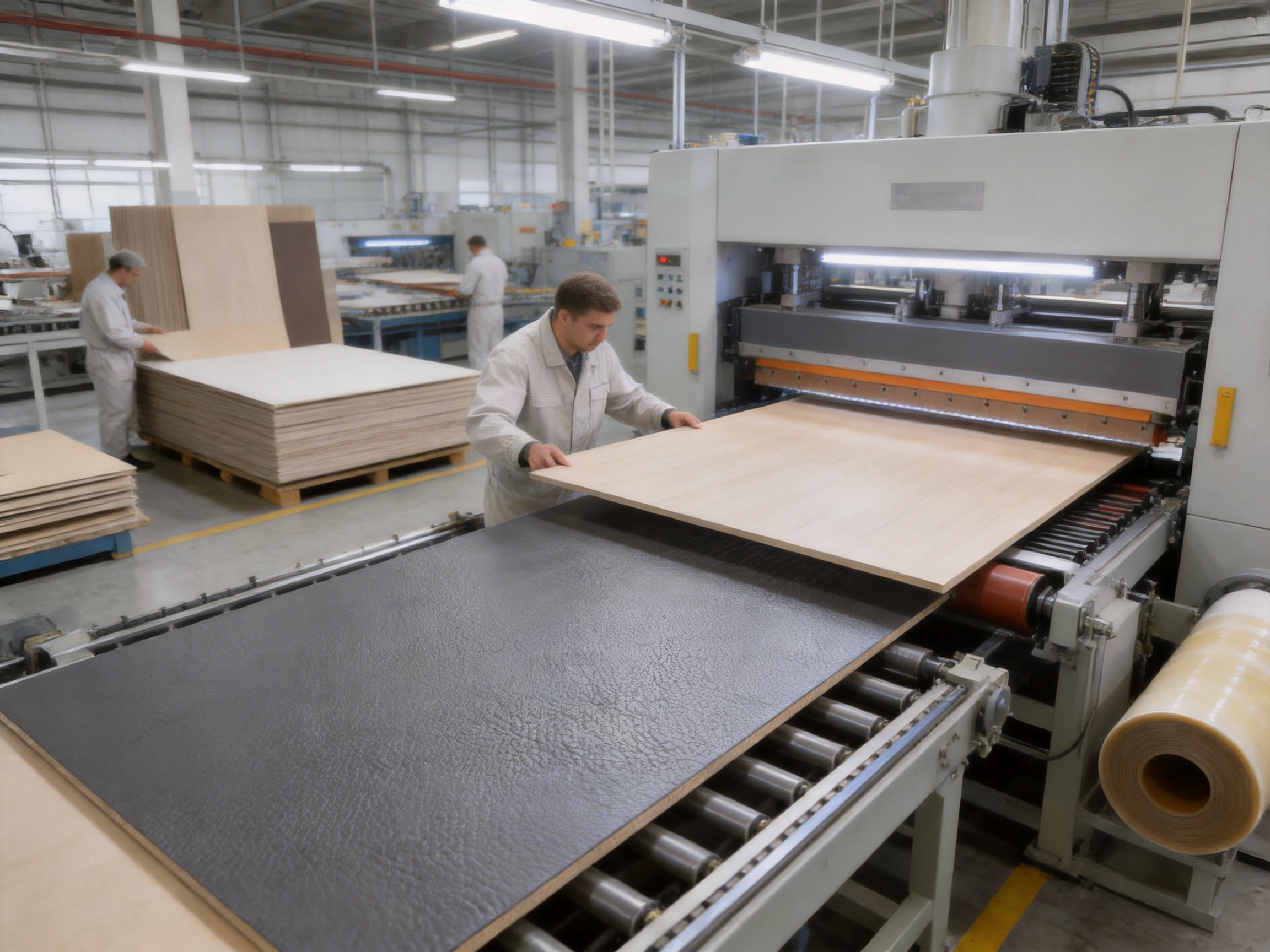
The central technical feature of the PZ01 panel is precision deep embossing. This process gives the decorative surface its physical grain and creates the tactile quality expected from a leather-inspired finish.
Deep embossing must be carefully controlled. If pressure, temperature, timing, paper preparation, or surface alignment is not properly managed, the result may show inconsistent grain, weak definition, whitening, cracking, or surface defects. A fine leather grain requires especially careful control because its visual quality depends on the regularity and subtlety of many small details.
The product description emphasizes production control intended to avoid carbonization, whitening, and speckling. These defects can be particularly noticeable on light colors such as Pure White and Cloud White. A clean surface is therefore essential to maintaining the premium appearance of the design.
5.1 Embossing as both a visual and tactile process
Printing alone can reproduce the color and general image of leather, but it cannot fully reproduce the way a leather grain receives light or responds to touch. Embossing adds a physical dimension. Small changes in elevation create highlights and shadows, while the texture changes the way the hand experiences the panel.
The result is a surface that appears more natural under changing lighting conditions. Daylight, warm artificial lighting, and directional spotlights can all reveal different aspects of the grain. This makes the material useful in hospitality and retail interiors, where atmosphere and material presentation are important.
5.2 Fine-grain control
The PZ01 design is based on a light leather texture rather than an aggressive relief. Fine-grain control helps preserve the smooth visual order of a solid color. It also enables the surface to function across larger panels without creating a repetitive, overly dramatic pattern.
For manufacturers, controlled grain depth can support predictable cutting and edge finishing. For designers, it makes the panel easier to combine with other finishes. For users, it provides tactile interest while retaining a surface that is practical for everyday cleaning.
6. Skin-Like Coating and Touch Quality
In addition to embossing, the PZ01 panel incorporates a special skin-like coating treatment. This coating is intended to create a soft, supple surface experience reminiscent of premium leather or a skin-like lacquer finish.
This treatment is important because the character of leather is not defined by grain alone. The hand-feel, low-key luster, and gentle response to touch contribute equally to the perception of quality. A surface that looks like leather but feels sharply plastic may not achieve the intended design effect. The skin-like coating helps bridge the difference between visual imitation and tactile experience.
The coating also supports the product’s light-luxury positioning. It does not depend on a mirror-like gloss or an excessive reflective effect. Instead, the finish is intended to remain elegant and controlled, allowing the panel to communicate quality through close interaction.
6.1 Tactile comfort in everyday spaces
Furniture and wall panels are often touched more frequently than designers initially expect. Cabinet doors, drawer fronts, wardrobe panels, reception desks, headboards, and partition surfaces all invite contact. A pleasant surface can make an interior feel more considered and comfortable.
The PZ01 finish is therefore relevant to applications where touch is part of the user experience. In a residential setting, the soft leather-like feel can add warmth to storage furniture. In a hotel or showroom, it can encourage visitors to notice the quality of the finish. In an office, it can soften the perception of hard industrial materials.
7. Performance Advantages Compared with Conventional Decorative Surfaces
The main competitive strength of the PZ01 panel is that it combines an elevated surface experience with the practical benefits associated with engineered melamine panels. It is not merely a decorative imitation; it is a manufactured panel system designed for repeatable interior use.
7.1 Scratch and wear resistance
The surface receives wear-resistant treatment intended to withstand routine scratches and abrasion. This is important for furniture and architectural applications where panels are exposed to hands, clothing, bags, cleaning activity, and everyday contact.
Compared with delicate decorative coverings, a melamine-faced panel can offer a more practical solution for high-use interiors. However, no decorative finish is completely immune to damage. Sharp objects, abrasive tools, excessive force, and improper cleaning can still affect the surface. The product should therefore be used and maintained according to suitable panel-care recommendations.
7.2 Stain resistance and easy cleaning
The high-density surface is designed to resist fingerprints and common stains, allowing routine cleaning with a simple wipe. This is a major advantage over some textile-based or untreated leather-like finishes that may absorb liquids or require specialized maintenance.
Easy cleaning is particularly valuable in kitchens, hospitality areas, retail displays, healthcare-adjacent interiors, offices, and family homes. A surface that can be maintained with ordinary gentle cleaning helps reduce long-term ownership effort and supports a consistently neat appearance.
7.3 Moisture and dimensional stability
The product is described as moisture-resistant and warp-resistant when produced with an appropriate structurally stable substrate. This offers an advantage over natural leather, which can respond to humidity, drying, stretching, and environmental changes.
Moisture resistance should not be interpreted as unlimited waterproofing. Panel edges, joints, cutouts, and substrate selection remain important. Correct sealing, installation clearance, ventilation, and application planning are necessary, especially in kitchens, utility rooms, and other environments where humidity may be elevated.
7.4 Reduced fading and aging concerns
Engineered decorative panels offer a more controlled appearance than natural leather, whose color and surface can change through use, light exposure, handling, and conditioning. The PZ01 design is intended to retain its coordinated appearance more consistently under normal interior conditions.
Actual color stability depends on lighting, exposure, cleaning products, temperature, and installation conditions. Nevertheless, the manufactured surface gives project teams a more predictable starting point than a naturally variable material.
7.5 Cost efficiency
Genuine leather finishes and specialized leather-textured wall systems can be expensive, particularly when applied across large areas. They may also involve additional installation, maintenance, and replacement considerations.
The PZ01 panel offers an affordable-luxury route. It aims to deliver the visual and tactile impression associated with fine leather while using a scalable engineered-board format. This can make it more accessible for residential developers, furniture manufacturers, hospitality projects, retail interiors, and commercial fit-outs that require a premium appearance within a controlled budget.
8. Environmental and Indoor-Air Considerations
The product information lists E0 and E1 environmental ratings and identifies P2/F4 in the commercial information. Because environmental classifications can vary according to substrate, market, test method, and certification system, project purchasers should request current technical documentation for the precise product configuration being ordered.
Low formaldehyde emissions are increasingly important in residential and commercial interiors. Furniture, cabinetry, wall panels, and built-in systems can contribute to indoor-air considerations, especially in rooms with limited ventilation. A panel designed around low-emission requirements can support responsible material selection when combined with appropriate adhesives, edge treatments, installation methods, and ventilation planning.
The company states that its products are developed to meet international ENF formaldehyde requirements. This claim should be reviewed against current certificates and the exact substrate and production batch before being used in a regulated project specification.
8.1 Responsible material selection
Environmental performance should be evaluated as a complete system rather than as a single label. Important factors include the board core, decorative paper, adhesive, formaldehyde emissions, production efficiency, service life, maintenance requirements, waste generation, packaging, and end-of-life handling.
A durable panel that remains attractive and functional for a long period may reduce the need for premature replacement. Easy cleaning may also reduce dependence on aggressive maintenance chemicals. At the same time, designers should optimize cutting plans to reduce offcuts and select the correct thickness and substrate rather than over-specifying material.
9. Manufacturing Strengths and Production Experience
The manufacturer, YAKCO New Materials (Jiangsu) Co., Ltd., was established in 2007 and operates a modern production facility covering approximately 50 acres, with more than 30,000 square meters of standard factory buildings. This scale provides a foundation for organized production, quality control, material handling, and product development.
The company specializes in high-end decorative panels and wall panels for residential and commercial spaces. Its stated focus includes 3D decorative panel technology, deep-pressing processes, six core production processes, and MDI medical adhesive bonding.
These capabilities are relevant to the PZ01 product because a leather-textured panel depends on coordination among decorative paper preparation, embossing, adhesive bonding, substrate stability, pressing conditions, surface treatment, trimming, inspection, and packaging. A weakness in any one stage can affect the final appearance or performance.
9.1 Integrated development of decorative surfaces
Advanced decorative panels require more than a library of printed designs. The manufacturer must understand how a visual pattern, physical relief, coating system, paper structure, and substrate interact during pressing and use.
The company’s focus on deep-pressing technology suggests an emphasis on developing surface effects as engineered products. This is significant for the PZ01 design, where the texture must remain delicate, consistent, and free from visible defects across a large panel.
9.2 Six core production processes
The company describes six core production processes as part of its manufacturing capabilities. Although the supplied information does not define each process individually, the stated approach indicates a structured production system rather than a single-stage decorative treatment.
In a high-quality panel workflow, process control may include substrate preparation, paper treatment, adhesive application, pressing, embossing, surface finishing, cooling, trimming, inspection, and packaging. The precise sequence and technical parameters depend on the product configuration, but the principle remains the same: repeatable quality requires controlled transitions between stages.
9.3 MDI adhesive bonding
The use of MDI medical adhesive bonding is identified as one of the company’s technical strengths. Adhesive selection affects bond integrity, emissions, moisture response, dimensional stability, and long-term product reliability.
For a textured decorative panel, stable bonding is especially important. The surface must remain securely integrated with the substrate during cutting, handling, installation, and daily use. Proper adhesive technology can support a more stable composite structure and contribute to the manufacturer’s low-emission and durability objectives.
9.4 Quality control and defect prevention
The PZ01 description emphasizes zero-defect manufacturing standards and identifies carbonization, whitening, and speckling as defects the production process is designed to prevent. This focus is important because small imperfections can be highly visible on a fine, light-colored texture.
Quality control should include visual inspection, dimensional verification, surface evaluation, bonding checks, color consistency review, and packaging protection. A high-end decorative panel is judged not only by its design concept but also by its consistency from board to board.
10. Advantages Over Competing Surface Solutions
The PZ01 panel competes with several categories of material: flat melamine boards, printed leather-look panels, natural leather coverings, PVC or synthetic leather laminates, painted boards, textile wall coverings, and premium wood veneers. Its advantages depend on the requirements of the project, but several distinctions are notable.
10.1 Compared with flat melamine board
A conventional flat melamine board may offer color consistency and easy maintenance, but it may lack tactile depth. PZ01 adds physical grain and a skin-like surface experience while retaining the practical format of a melamine-faced board.
This can help a designer achieve greater material richness without changing to a more complex wall-covering or upholstery system. The panel remains compatible with furniture manufacturing and standard board-based construction methods.
10.2 Compared with a printed leather image
A printed image can suggest leather but may appear flat when viewed at close range or under directional lighting. PZ01 uses deep embossing to create actual surface relief. The grain therefore participates in the visual effect through highlights, shadows, and touch.
The physical texture also makes the product feel more intentional and architectural. It is not simply a photograph of leather transferred to a board; it is a coordinated surface design with a manufactured tactile structure.
10.3 Compared with genuine leather
Natural leather can provide authenticity and a distinctive patina, but it may involve higher cost, greater variation, specialized care, and more complex installation. PZ01 offers a more consistent and scalable alternative for projects that want leather-like warmth without requiring natural hide.
The engineered panel is also easier to coordinate across multiple rooms or production batches because the grain and color can be manufactured to a defined specification. This is valuable for large commercial projects where repeatability is essential.
10.4 Compared with synthetic leather upholstery
Synthetic leather is flexible and useful for upholstered surfaces, but it may not provide the rigid architectural quality required for cabinetry, wall panels, partitions, or built-in furniture. PZ01 combines a leather-inspired appearance with the dimensional structure of a board.
This makes it especially suitable where a surface must be cut, drilled, hinged, fixed, or integrated into a cabinet and joinery system. It can provide a more precise architectural line than a flexible covering.
10.5 Compared with painted panels
Painted panels can provide a smooth and attractive finish, but they may lack the tactile complexity of PZ01 and may require more specialized refinishing if damaged. The embossed leather grain gives PZ01 a distinctive identity without relying on a high-gloss or decorative paint effect.
The melamine surface can also support efficient repeat production for furniture manufacturers. This may reduce the time associated with spray finishing, drying, inspection, and color matching across individual components.
10.6 Compared with textile wall coverings
Textile surfaces can add warmth and acoustic character, but they may collect dust, absorb stains, and require more careful maintenance. PZ01 does not replace the acoustic function of a textile system, but it can provide a cleaner, more rigid, and easier-to-wipe alternative where tactile appearance is the primary objective.
11. Application Possibilities
11.1 Residential cabinetry
PZ01 is well suited to wardrobe doors, kitchen cabinets, bathroom storage, media units, sideboards, bedroom furniture, and entryway cabinetry. The neutral colors can support both warm and cool interior palettes.
In kitchens, the surface can create a refined alternative to ordinary solid-color doors. In bedrooms, the leather-like texture can bring softness to large wardrobes and headboard walls. In living rooms, it can be used for media cabinetry or feature storage without competing with artwork and furniture.
11.2 Wall paneling
Large-format boards can be used for selected wall-cladding applications, decorative partitions, headboard walls, and reception features. The fine grain can create visual depth while maintaining a quiet background for lighting and furniture.
Wall installation should account for substrate movement, expansion, fixing method, joint design, ventilation, and edge protection. The correct installation system is essential to achieving a flat and durable result.
11.3 Hospitality interiors
Hotels, restaurants, lounges, and serviced apartments often seek materials that appear luxurious but can withstand frequent contact and cleaning. PZ01 can be considered for reception desks, room cabinetry, wardrobe doors, corridor features, lounge walls, and selected furniture components.
The Cloud Gray tone may create a calm, contemporary atmosphere, while Pure White can support bright and clean hospitality concepts. The leather-like surface can also complement brass, dark timber, stone, and soft indirect lighting.
11.4 Retail and showroom design
Retail environments use material quality to communicate brand positioning. A tactile panel can improve the perceived value of displays, counters, fitting-room furniture, product plinths, and wall systems.
Because PZ01 is available in a board format, it can be integrated into modular display systems and fabricated with coordinated edge details. This supports a professional appearance across repeated store locations or showroom zones.
11.5 Office and executive spaces
Executive offices, meeting rooms, reception areas, and collaborative spaces can benefit from a surface that softens the hard character of desks, storage units, and partitions. PZ01 can be combined with wood tones and metal details to create a polished but not overly formal environment.
12. Installation, Fabrication, and Maintenance Considerations
Before fabrication, panels should be stored flat, protected from excessive moisture, and kept away from direct exposure to heat or sunlight. The storage environment should be appropriate for engineered wood products, with care taken to avoid impact damage to corners and surfaces.
Fabrication should use clean, properly maintained tools suitable for the selected substrate. Cutting direction, blade condition, feed rate, and support can affect edge quality. When visible faces are being cut, production teams should confirm the correct tooling and trial the process on sample material where necessary.
Edges should be treated in a way that protects the substrate and maintains the intended appearance. Matching edge banding in 1 × 26 mm and 1 × 56 mm formats can help coordinate exposed edges. Cutouts, drilled openings, hinges, handles, and service penetrations should be planned carefully so that the panel remains structurally sound.
Routine cleaning should generally use a soft cloth and a mild, non-abrasive cleaning solution. Abrasive pads, harsh solvents, concentrated chemicals, and excessive water should be avoided unless specifically approved for the product. Spills should be removed promptly, particularly around joints and exposed edges.
Although the surface is designed for daily use, heavy impact, sharp objects, prolonged standing water, and unsuitable installation conditions may cause damage. Product samples and technical data should be reviewed before final specification for demanding environments.
13. How Designers Can Use the Panel Effectively
The strongest design results usually come from treating PZ01 as part of a coordinated material palette rather than as an isolated decorative effect. Its fine leather grain is sufficiently subtle to work with other textures, but the surrounding materials should be selected with attention to scale and contrast.
Pairing PZ01 with a linear wood grain can create a balanced contrast between organic direction and soft granular texture. Combining it with stone-look surfaces can introduce a distinction between cool mineral character and warm tactile character. Metal trims can emphasize the panel’s refined quality, while matte glass can reinforce a quiet contemporary mood.
Lighting should also be considered. Grazing light or directional illumination can reveal the embossed structure more clearly, while diffuse light will produce a calmer and more uniform appearance. Designers should request physical samples because a textured panel can look different in photographs, on a large sheet, and under the final project lighting.
13.1 Color planning
Cloud Gray can provide a sophisticated mid-tone foundation. It may work well with warm timber, charcoal, muted green, beige, and brushed metal. Pure White can support crisp modern schemes and increase the perceived brightness of a room. Cloud White Fine Leather Grain can offer a softer alternative to a completely plain white surface.
Color should be evaluated alongside flooring, wall paint, lighting temperature, hardware, and adjacent materials. Neutral panels can shift in appearance depending on the environment, so sample approval is recommended for projects where color consistency is critical.
13.2 Scale and repetition
The texture is designed to remain elegant across a panel, but designers should still consider how repeated doors, drawers, and wall sections align. Consistent grain orientation and thoughtful joint placement can enhance the sense of quality.
Large panels may reduce the number of interruptions, while smaller furniture components can use the same finish to create a coordinated language throughout a room. Matching edge banding is useful when the design includes open shelving, freestanding units, or visible cabinet sides.
14. Ordering and Technical Verification
Before placing a commercial order, buyers should confirm the exact product code, color, substrate, thickness, dimensions, edge-banding availability, environmental classification, and production lead time. The supplied product title identifies the design as PZ01 Leather1 Texture Panel, while the provided alias contains a different PZ02 reference. This discrepancy should be clarified during ordering to prevent coding errors.
Purchasers should also confirm whether the 1.5 mm specification refers to a complete panel, a facing component, or a special product configuration. The commercial price information supplied for 9 mm, 12 mm, 18 mm, 22 mm, and 25 mm boards indicates that these are the principal listed selling thicknesses.
Current prices should be treated as quotations subject to confirmation. The supplied figures are approximately 36.5 USD for 2745 × 1220 × 9 mm, 40 USD for 12 mm, 46 USD for 18 mm, 51.6 USD for 22 mm, and 56 USD for 25 mm. Freight, packaging, taxes, quantity, substrate, surface selection, and market conditions may affect the final transaction value.
15. Frequently Asked Questions
Q1. What makes the PZ01 panel different from a standard melamine board?
The PZ01 panel uses a physical fine leather grain created through precision deep embossing and is described as having a skin-like coating. A standard flat melamine board may provide color and durability but does not offer the same tactile relief and leather-inspired surface character.
Q2. Is PZ01 made from genuine leather?
No. It is a melamine-faced decorative panel with a leather-inspired embossed surface. It is designed to reproduce the visual and tactile qualities of fine leather while offering the consistency and practicality of an engineered board.
Q3. Which colors are available?
The stated colors include Cloud Gray, Pure White, and Cloud White Fine Leather Grain. Availability should be confirmed for the selected thickness and substrate.
Q4. What panel sizes are available?
The standard listed size is 1220 × 2745 mm. Additional listed lengths are 2800 mm, 3050 mm, and 3300 mm, all with a 1220 mm width. Actual availability should be confirmed when ordering.
Q5. What thicknesses can be ordered?
The product description lists 1.5 mm, 9 mm, 12 mm, 18 mm, 22 mm, and 25 mm. The commercial information specifically provides product details for 9 mm through 25 mm. Buyers should verify the meaning and availability of the 1.5 mm option.
Q6. What substrates can be used with the design?
Listed options include LSB, SOSB, MDF, HMR MDF, particleboard, fire-resistant board, wood veneer, and plywood. The commercial information also identifies OSB, MDF, and particleboard. The final substrate should be chosen according to structural, moisture, fire, machining, and environmental requirements.
Q7. Is the surface easy to clean?
The surface is designed to resist fingerprints and stains and can generally be cleaned with a soft cloth and suitable mild cleaner. Abrasive tools, harsh solvents, and excessive water should be avoided.
Q8. Is the panel suitable for kitchens and humid areas?
It is described as moisture-resistant and warp-resistant, but suitability depends on the substrate, installation, edge sealing, ventilation, and exposure conditions. It should not be treated as unlimited waterproof material.
Q9. Can the panel be used for cabinet doors?
Yes. The listed thicknesses, available substrates, and matching edge banding make it suitable for many cabinet-door and furniture applications, subject to correct hardware, panel sizing, machining, and structural design.
Q10. Does the embossing affect fabrication?
The panel can be fabricated as an engineered decorative board, but tooling, blade condition, feed rate, face protection, and edge finishing should be considered. A production sample or trial cut is recommended for unfamiliar equipment.
Q11. What environmental classifications are identified?
The product description lists E0, E1, and P2, while the commercial information identifies P2/F4. Since classifications depend on product configuration and testing requirements, current technical certificates should be requested for the exact panel being purchased.
Q12. What manufacturing capabilities support the product?
The manufacturer reports experience dating from 2007, a large modern factory, expertise in 3D decorative panels, deep-pressing technology, six core production processes, MDI adhesive bonding, and quality controls focused on surface consistency and defect prevention.
16. Conclusion
The PZ01 Leather1 Texture Panel is a sophisticated solution for designers seeking more than a flat decorative board. Its fine leather grain, restrained neutral colors, skin-like coating, and physical embossed structure create a tactile form of light luxury suited to contemporary interiors.
Its principal advantage is the balance between aesthetic character and practical performance. The panel brings warmth and surface depth without the cost, variability, or maintenance demands of genuine leather. It offers scratch and wear resistance, stain resistance, routine cleanability, substrate flexibility, large-format options, matching edge banding, and a range of thicknesses for furniture and architectural applications.
The manufacturer’s experience in high-end decorative panels, 3D surface technology, deep pressing, adhesive bonding, and structured production processes further supports the product’s positioning. Careful control of embossing and surface quality is particularly important for a fine leather design, and the stated emphasis on preventing carbonization, whitening, and speckling addresses the details that determine whether a premium panel looks truly refined.
For residential, hospitality, retail, office, and commercial projects, PZ01 provides an efficient way to introduce tactile richness into cabinetry, wall systems, furniture, partitions, and feature interiors. When specified with the correct substrate, thickness, installation method, and maintenance plan, it can deliver a durable and visually consistent alternative to conventional flat boards, printed leather effects, and more demanding natural leather finishes.
References
1. Product specification and technical information supplied for the PZ01 Leather1 Texture Panel.
2. Manufacturer-provided information regarding decorative panel substrates, dimensions, thicknesses, edge banding, and environmental classifications.
3. Manufacturer-provided company profile describing factory scale, production history, 3D decorative panel technology, deep-pressing processes, adhesive bonding, and environmental objectives.
4. General principles of melamine-faced engineered wood panel fabrication, furniture manufacturing, surface finishing, and interior installation.
5. General interior-design principles concerning tactile materials, light-luxury aesthetics, color coordination, material durability, and maintenance planning.